MOSES KAHN LINEAGE
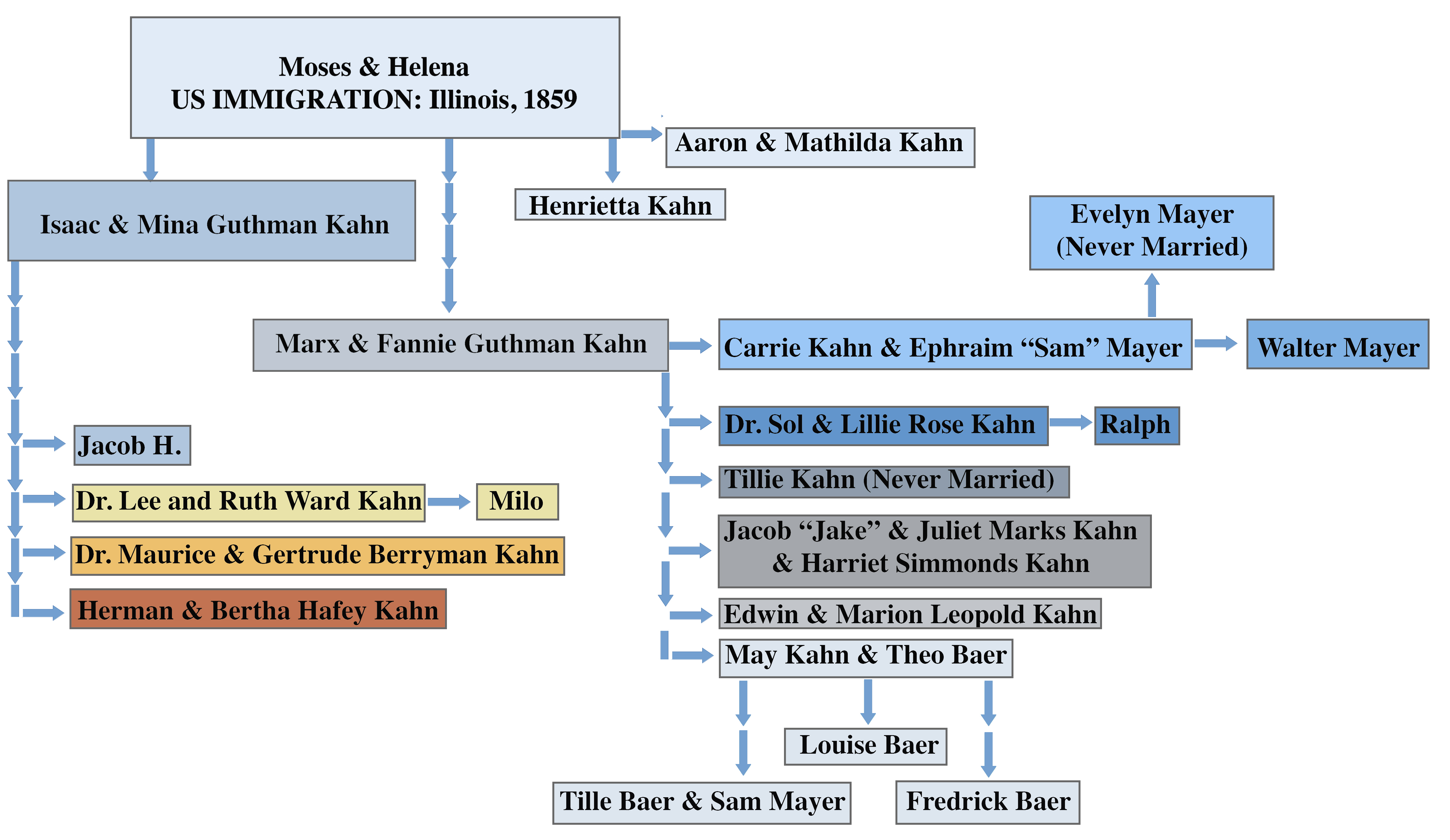
Ancestry tree chart for the Moses branch of the Kahn Family. [4]
Jeffrey P. Grant. Lineage Chart for the Leadville Kahn Family. Leadville, Colorado: Temple Israel Foundation. 2021.
Isaac Kahn
Born: Hessen, Germany, July 18, 1836
Died: Chicago, September 26, 1915
Married to: Mina Kahn 1866-1898
Phillipina Hoefeld 1903-1913,
Ida Greenburg 1914-1915
Hermina “Mina” Guthman Kahn
Born: December 20, 1844
Died: December 5, 1898
Wife of Isaac
Henrietta Kahn
Born: Hessen Germany, 1833
Died:
Dr. Lee Kahn
Born: Illinois, July 19, 1867
Died: Leadville, February 26, 1899
Ruth Ward Kahn
Born: Jackson, Michigan, August 4, 1872
Died: Unknown
Wife of Dr. Lee Kahn
Milo Kahn
Born: July 1, 1892
Died: February 2, 1898
Son of Dr. Lee & Ruth W. Kahn
Jacob H. Kahn
Born: 1869
Died: Chicago, November 24, 1889
Dr. Maurice Kahn
Born: Morrison, IL, March 27, 1873
Died: Los Angeles, September 12, 1950
Gertrude Berryman Kahn
Born: Silver Plume, Co. November 27, 1883
Died: Los Angeles, 1953
Wife of Dr. Maurice Kahn
Aaron Kahn
Born: Hessen, Germany, 1845
Died: Chicago, May 25, 1917
Married to Matilda Kahn (Chicago late 1880s)
Herman E. Kahn
Born: Leadville, 1882
Died: Denver, 1952
Married to Betha Hafey Kahn (1911)
Out of all the Kahn households located in Leadville during the late 19th and early 20th centuries, the most significant branch was the family of Hermina and Isaac Kahn. [34] Like many first-generation German-Jewish immigrants, Isaac was a merchant. He owned and operated a neighborhood grocery in the same location on East 6th Street from 1879 until his departure in the early 20th century. He and his wife, Hermina, [35] or “Mina” as she was commonly known, made their first home in Illinois [36] and brought three children to Leadville from that state: Lee, [37] Jacob, and Maurice. Lee, Maurice and Herman, who was born in Leadville during 1882, [38] climbed up the next socio-economic rung from their parents, starting out as clerks in their father’s grocery store and ending their professional lives as successful physicians. Jacob [39] worked in the grocery store in his early years but passed away at a young age after a tragic accident. The youngest son, Herman, was born in Leadville in 1882 and became a doctor of dentistry. [40] Ike and Marx Kahn’s brother Aaron [41] was also part of the household until 1885, and their sister, Henrietta, would join Ike’s household during the mid-1890s. It is crucial to distinguish family members of the households of Julius and Marx Kahn who share names with Isaac’s children — namely Ruth Kahn and Lee (daughter and son of Julius Kahn), Jacob A. Kahn (son of Marx) and a fourth patriarchal household of Jacob Max Kahn (in Leadville 1881-1883). As previously noted, the frequent duplication of familial forenames by the Kahn family can cause confusion. For this reason, Ruth Ward Kahn, wife of Dr. Lee Kahn, will be identified in this article as “Ruth W.” to distinguish her from Julius Kahn’s daughter Ruth.
The 1870 United States Census recorded that both Mina and Isaac originated in the Grand Duchy of Hessen, Germany. [42] According to the 1900 United States Census, Isaac immigrated from Germany during 1860. [43] Mina may have immigrated during a similar timeframe, but it is unknown whether the couple met each other before either left Germany. The couple married in Illinois during 1866 and likely immigrated separately.
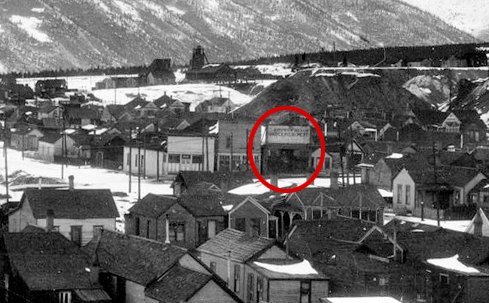
Isaac Kahn’s store building (circled) during 1929 as photographed by the Rocky Mountain Photo Company. [44]
Rocky Mountain Photo Company. Leadville From the East. [Image] (Denver, Colorado: Western History Collection, Denver Public Library). 2021.
Their first child, Lee Solomon Kahn, was born in July of 1867. Jacob came soon after, in 1869, and Maurice was born in 1873. The family spent the 1870s in Illinois, but, by the end of the decade, larger economic opportunities called to Isaac from the Rocky Mountains. He was first mentioned in Leadville as a guest at the Grand Hotel on Chestnut Street in February of 1879. [45] This may have been an exploratory trip, or perhaps Isaac’s first residence after moving to Leadville and opening his store. In 1879, the city directory identified him as a resident and businessman located at the corner of “Jefferson and Hazel Streets.” [46] Isaac was the first Kahn to settle in Leadville. The address he occupied that year would become the 200 block of East 7th Street after Leadville’s east-west streets were renamed with numbers in 1880. [47] By April of 1879, Isaac had opened his grocery store and he was listed as a client with “freights on the road” that month. [48] His public mentions increased in the summer of 1879 as more goods came into and left his store, ebbing with the frenetic early economy of the city. Details of his first grocery store were not elucidated in newspapers, however.
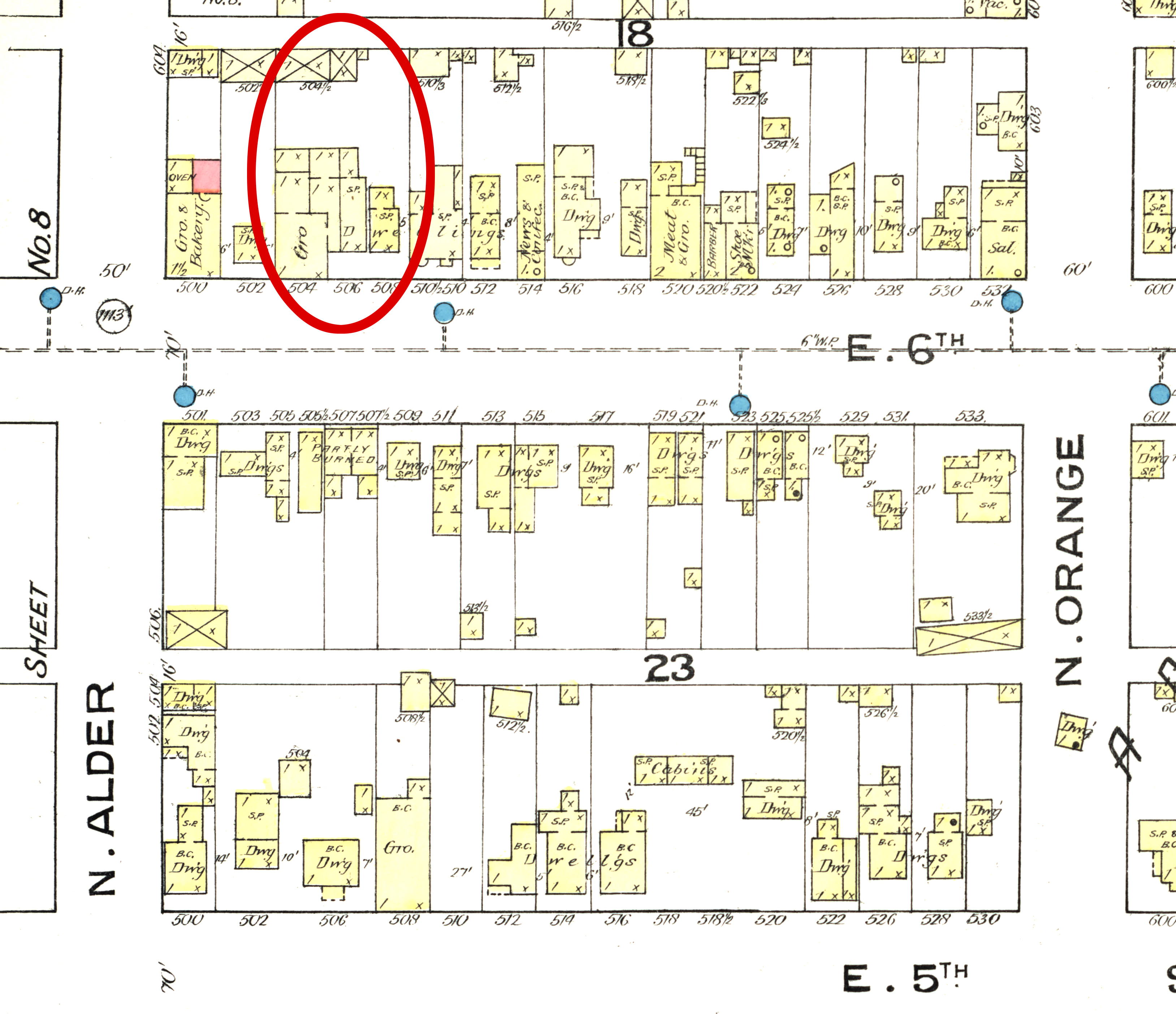
Sanborn Fire Insurance Map for 1886 with the location of Isaac Kahn’s store encircled. [49]
Sanborn Fire Insurance Map from Leadville, (Lake County, Colorado. Sanborn Map Company). 1886.
Mina and the children joined Isaac in Leadville by the winter of 1879-1880. Mina was first identified in a Leadville newspaper during February of 1880 as an attendee of the Leadville Jewish community’s second annual Purim Ball, to which she wore a “seal brown silk with trimmings of satin and silk stripe, white flowers”. [50] During 1880, few mentions of the Kahn’s social involvements made it into local newspapers. In December 1880, Isaac embarked on mining speculation by purchasing the Emma Belle lode for $500. [51] The 1880 Leadville city directory identified the family as residents of 504 East 6th Street, where Isaac and the family lived and did business until 1902.
While this area did not appear in the 1883 Sanborn Fire insurance map, it was well documented with photographs during the 20th century. The 500 block of East 6th appeared in the 1886 insurance map illustrated above; 504-508 East 6th was clearly a large commercial structure with dwellings that extended behind and to the side. Given the sprawling nature of the rooms around the store, the structure was likely a work in progress with additions added as business and family housing needs increased. The photographs here offer a rare glimpse of an off-Harrison Avenue storefront. The fact that Isaac invested so much in the building emphasizes the importance of East 6th Street as an historic commercial corridor. The state of decay of the building captured in Marion Wolcott’s 1940 portrait provides a rare view into a lost era of Leadville. Its Victorian grandeur long disappeared, front doors converted to allow for automobile repair shops, and a ramp replacing the sidewalk. Peeling paint on the façade revealed five decades of use as a grocery store and meat market, captured by the faint outline of one of Isaac’s successors, Andrew Meyer. By the time Wolcott took this photo, the shop was no longer used as a garage.
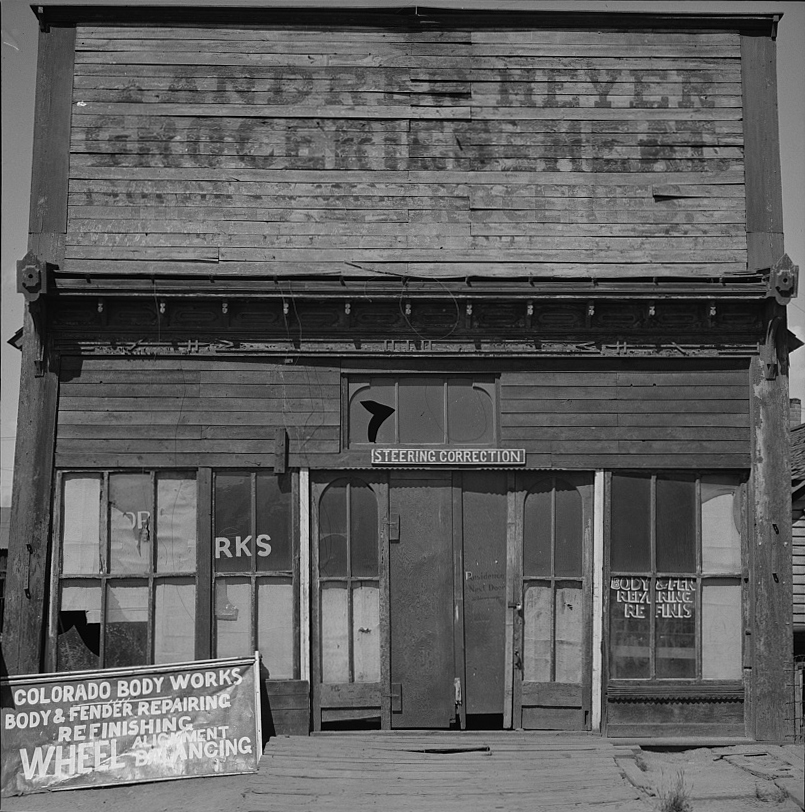
Photograph from 1941 showing the Isaac Kahn storefront in Leadville. [52]
Marion Post Wolcott. September 1941.
LC-USF34- 059007-E [P&P] LOT 477 Library of Congress, Prints and Photographs Division, Washington, D.C. https://www.loc.gov/pictures/collection/fsa/item/2017808485/
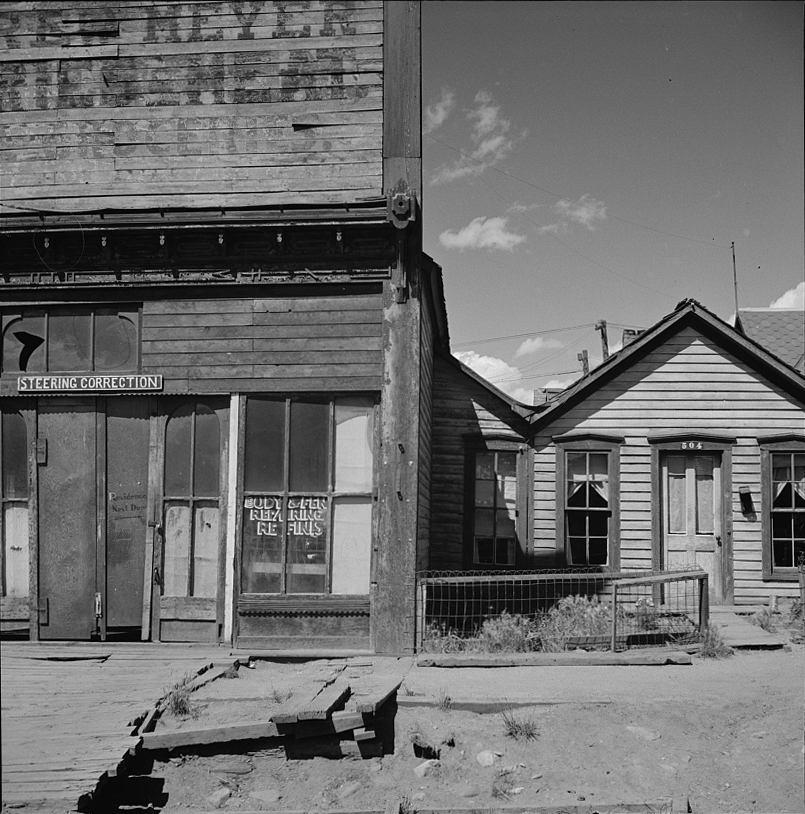
Photograph from 1941 showing another partial view of the Isaac Kahn storefront in Leadville. [52]
Marion Post Wolcott. September 1941.
LC-USF34- 059005-E [P&P] LOT 477 Library of Congress, Prints and Photographs Division, Washington, D.C. https://www.loc.gov/pictures/collection/fsa/item/2017808483/
Between 1881 and 1902, Isaac maintained his store at the same location on the 500 block of East 6th Street; his brother Marx Kahn operated another grocery store just four blocks to the north of Isaac’s, on the 500 block of East 10th Street. The stores existed simultaneously for two decades. Marx operated his grocery store at this location until about 1909, and Isaac ran his grocery until 1899. [53] The 1880 United States Census recorded the Isaac Kahn family at 506 East 6th Street with the following: Isaac 44 years old, grocer; Mina 30 years old, “keeping house;” and children Lee 13, Jacob 10, Morris (Maurice) 7; and Aaron Kahn, Isaac’s 35-year-old brother, as “boarding”. [54] Leadville city directories did not assign unique names to the stores; both are simply listed with their proprietors’ names and addresses under the Groceries and Provisions [55] section. Neighborhood convenience likely played a key role in their longevity as these stores served a regular rotation of hyper-local clients. Given the area’s high population density and resulting demand, the fact that both stores operated for many years with little to no advertising testifies to their vitality.
Aaron Kahn lived in Leadville from 1880 to 1886. He first partnered with Samuel Stone in a commission mercantile much like his cousin, Fannie Kahn, under the name Stone & Kahn located at 112 Oak Street. [56] He moved from Ike’s home in 1883, though he worked as a bookkeeper for the grocery that year and took up residence at 528 East 6th Street. [57] Aaron became a music teacher in 1884 and moved back into Isaac’s home. [58] He likely left town before the end of 1886, and his last known Leadville address was 406 East 6th Street. [59] Aaron was listed in a 20th century document as an Illinois veteran of the American Civil War. [60] He would later move on to Chicago, where he passed away in 1917. [61]
During the remainder of 1881 and in 1882, few mentions of Isaac and his family graced local newspapers; however, city directories consistently cited the store and presumably it continued to be successful. Newspaper mentions of Isaac Kahn and his family increased significantly in 1883. On January 20, 1883, Mina was listed as the secretary of the Ladies Hebrew Benevolent Association. [62] In March, Isaac was listed as a member of the reception committee for that year’s Purim Masque Ball held at Turner Hall. [63] That same weekend, Isaac also attended a St. Patrick’s Day dance hosted by the Knights of Robert Emmet, an Irish militia group. [64] A month later, he went to the Odd Fellow’s Anniversary Ball. Isaac was the only member of his family to attend these non-Jewish events. [65]
In May of 1883, a party of twelve friends hosted a surprise party for “Mr. Isaac and Mr. McManus at their rooms on East Sixth street…” Isaac and Mina, as well as Marx Kahn, were in attendance. [66] Another guest was Richard Kahn, who operated a shoe store with Henry Bruseker in 1883 at 136 East 6th Street, where he also resided. Richard’s precise familial connection to the Leadville Kahns, if any, is obscure. In December, Mina and Isaac went to a social event hosted by the Leadville chapter of the Masonic group the Order of the Eastern Star. [67] Toward the end of the year, Lee and his brother Jacob made an appearance at the christening of the baby daughter of M. D. Altman. [68] Lee and Jacob, who were then between the ages 16 and 18 years old, mature enough to attend such social gatherings.
Leadville’s Jewish community had regularly celebrated Purim with a Bal Masque since 1879. In 1884, the masked ball took place at City Hall on 6th Street, and for the first time it also functioned as a fundraiser to build Temple Israel, Leadville’s new Reform synagogue. Mina was listed as a member of the floor committee [69] and her son Lee dressed as a “fop” for the dance, held on March 12. [70]
Earlier in February, a “Mr. Kahn” was listed as a German language professor at an adult night school owned by J. A. Mitchell. It is unknown which of the multiple “Mr. Kahns” in Leadville this references, but most were likely fluent in the language. [71] That year, Aaron was listed as a piano teacher in the city directory. [72] In June, Isaac appeared on a list with many notable Leadville merchants and politicians as a supporter of the Leadville Chamber of Commerce. [73]
The annual Strawberry & Ice Cream Festival was a highlight on Leadville’s 19th-century Jewish social calendar. The much anticipated event took place at the 5th Street Armory Hall in 1884, and the local Kahn households were well represented. Only Julius Kahn’s household was not listed. [74]
During 1885, Isaac’s family continued to live and do business at the corner of Alder and East 6th Streets. It was also the first year that Isaac’s son Jacob appeared in the city directory, listed as a clerk for the family grocery. [75] In October, Isaac was a pallbearer at the funeral for a companion Odd Fellows member at St. George’s Episcopal Church. [76]
By early 1886, Isaac’s son Maurice was listed as a high school student who was “neither tardy nor absent” for the previous semester. [77] That same week, Aaron published an advertisement for his piano teaching services in an office above a drug store at the corner of East 7th and Poplar Streets. [78] This was also the last year that Aaron appeared in a Leadville city directory. [79]
Isaac’s middle son Jacob H. Kahn was showcased as a student at Leadville’s Central School with a 95% average grade in March of 1886. [80] The reference to the “H.” in his middle name differentiates him from Marx’s son Jacob A. Kahn, an addition confirmed by the 1886 entry in the city directory. [81] During May, Isaac, Mina, and Jacob H. attended the 25th wedding anniversary of Marx and Fannie Kahn in their home at 500 East 10th Street. The event attracted many individuals in Leadville’s Jewish community, including David May, [82] the Monheimers, [83] Bernheimers, [84] Mooneys, [85] Baer, and Marx families. [86] In June, Isaac was referred to as “Ike” when he and the other Kahn households again attended the annual Strawberries & Ice Cream Festival hosted by the Ladies Hebrew Benevolent Association. [87] That winter, Isaac donated 50 pounds of flour and one sack of potatoes to the Knights of Labor, a benefit for Leadville’s working class; most of his patrons were miners and laborers. [88]
It was not until the spring of 1888 that a social event once again highlighted Isaac’s family. In March, Jacob H. was surprised at the family store with a party in his honor. The occasion, unmentioned in the notice, was likely a birthday party; 25 guests attended. [89] In early September, Isaac’s oldest son, Lee, left Leadville for his final year of studies at Rush Medical College of Chicago. The report added that Lee intended to return to Leadville as a practicing physician. [90] Maurice and Jacob garnered attention for their academic achievements throughout the year, and often attended the same school club events. [91]
Tragedy struck Isaac’s family in early December of 1888. Jacob was behind the family store at 506 East 6th Street breaking a horse when the animal threw him and kicked him in the head. The blow inflicted a major skull fracture. The three doctors called to treat the wound saw an obvious dent in Jacob’s head. The reporter suspected the injury might be fatal. [92] However, ten days later Dr. Bosanko conducted a trepanning [93] operation, the boy seemed to be on the mend. [94]
During March of 1889, Isaac’s son Herman appeared in a Leadville newspaper for the first time as a guest at the fourth birthday party of Lizzie Briel; Herman was probably between five and six at this time. [95]
That following March, Lee returned to Leadville for the first time since graduating from Rush Medical School in Chicago in 1886. Lee reportedly intended to share an office room with Dr. Bosanko, the same doctor who operated on his brother the previous winter. [96] Bosanko’s office was located at 116 West 4th Street; Dr. Lee was listed at the same address. [97] Doctors in this era rarely saw patients in their office as house calls comprised the majority of their work. Both Dr. Bosanko and Dr. Lee probably spent a majority of their day visiting patients in their private homes, while their office was commonly used for appointments with healthier patients, consulting, and study. Later in March, Isaac and Mina hosted a birthday party for Jacob, who was still recovering from his head wound. The evening featured music, dancing, and card playing. [98]
During the ensuing months, Dr. Lee became a popular fixture in both Leadville’s medical and social news. One party in late March hosted many of members of Leadville’s Jewish community including the Hyman, [99] Heimberger, [100] Schloss, [101] Friedlander, [102] Simon, [103] and Baer families. [104] In April, Dr. Lee began perfecting his new profession. Early in the month he helped Dr. Law amputate the mangled hand of an unfortunate sawmill worker. [105]
In early summer, Dr. Lee and Dr. Sol participated in a baseball game between Leadville’s doctors and lawyers that took place at the 13th Street field in North Leadville. According to the reporter, the doctors were “more hardy” than their opponents. In the end, however, the lawyers won by one point over the doctors, a close victory accompanied by colorful commentary. [106] In early July, Dr. Lee set the broken arm of an “old-timer” who suffered the injury during a horse wrangling accident on Mosquito Pass. [107]
Several weeks later, Isaac published his first advertisement ten years after he opened his grocery store. The promotion provides an interesting insight into popular household supply products of the time — gallon jugs of coal oil, lard, evaporated California apples and blueberries, free delivery, and a telephone. [108]
At the end of July, 1889, Dr. Lee moved to a new office “over Manhattan”. [110] “Manhattan” referred to the second story offices above the Manhattan clothing store at the corner of 4th Street and Harrison Avenue (not to be confused with today’s bar currently located at Harrison Avenue and 7th Street). [111] This building was the former headquarters for Monheimer’s clothing store, a successful Leadville Jewish-dominated clothing trade in the early 1880s. [112]
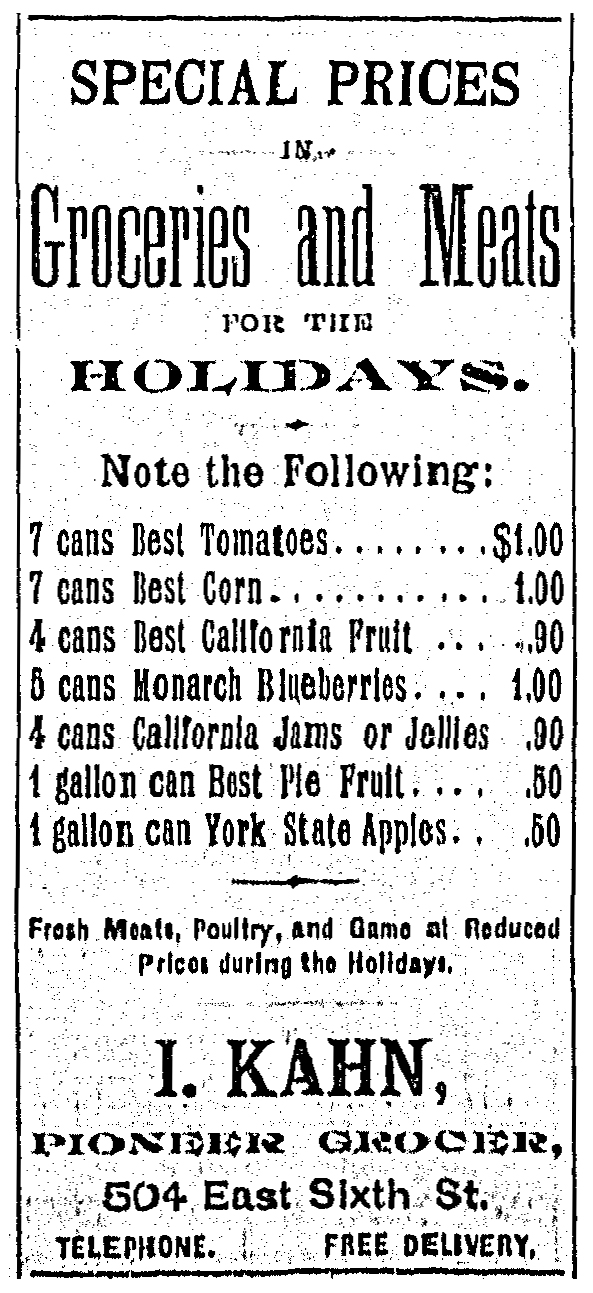
This advertisement for Ike Kahn’s grocery store appeared in The Herald Democrat newspaper on Tuesday, December 17, 1889. [109]
I. Kahn, Pioneer Grocer. (Leadville, Colorado: The Herald Democrat). Tuesday, December 17, 1889. Page 5.
During August of 1889, Dr. Lee saved the life of a young girl who was caught in the act of stealing candy from a store in Stray Horse Gulch. She was so ashamed she attempted suicide by swallowing some “Rough on Rats” poison. The girl’s mother called Dr. Lee and he administered medicine to counteract the poison. The girl survived, but the reporter commented that she learned a double lesson in the perils of death and stealing. [113]
The following month, Dr. Lee attended a Bible class at St. George’s rectory. Besides study, the social event added games, supper, and music as part of the program. [114] Dr. Lee’s exact religious affiliation was unclear up to this point: he did not participate in many activities that were exclusively Jewish, suggesting his orientation was more secular. In October, Lee attended a hop hosted by “The Assembly,” a popular social club housed at 6th Street’s City Hall. [115] The following day, Mina was elected secretary of the Hebrew Ladies Benevolent Association in preparation for a ball the next month. [116] The Hebrew Ladies Benevolent Association hosted a Simcha Torah Ball 28 days later; Dr. Lee was listed both as an attendee and a member of the door committee, along with his mother. [117]
On November 16, tragic news hit Isaac Kahn and his family. Isaac received a morning telegram announcing that his son Jacob had died in Chicago. After nearly a year recovering from the horse’s kick to his head, Jacob succumbed to his injuries. Mina was with her son, according to the reporter, and Isaac left for Chicago that evening:
PASSED TO REST
Mr. Jake Kahn, a Highly Respected
And Well Known Young
Gentleman of this City, Died in Chicago Yesterday
___
Mr. I. Kahn received a telegram Saturday evening from his wife in Chicago, conveying the sad intelligence that their son Jake died at the Presbyterian hospital at 5 P.M. It will be remembered that Jake was thrown from a broncho and kicked on the head and for several months hovered on the threshold of death, but with excellent care and medical attention he gained strength, and his parents decided to send him to Chicago. The deceased was a very bright young man of 21 years, and was highly respected by the people of this city. He was a member of Camp 22, Patriotic Order Sons of America, of this city.
Mr. I. Kahn left last evening for Chicago to attend the funeral. The sympathy of this community is extended to the bereaved family in their hour of affliction. [118]
Jacob’s funeral was held November 19, 1889. [119] On November 27, Mina and Isaac returned from Chicago together. No other members of the Kahn family were with them, suggesting that neither sons Dr. Lee, Herman or Maurice joined them. [120]
On December 2,1889, a newspaper noted that Dr. Lee was “…furnishing his elegant suite of rooms.”. [121] As the next year would reveal, Dr. Lee was on the lookout for a wife and accumulated furniture in preparation.
Isaac expanded his advertisements during late 1889 and early 1890. While the grocery business seemed in good shape, community sympathy surrounded Isaac and Mina in the wake of Jacob’s death. In middle December the Hebrew Ladies Benevolent Association published the following resolution:
“…Resolved, That the sympathy of the members of the H.L.B.A. be extended to our sister [Mina Kahn] and her family in their bereavement, and that we humbly beseech our Heavenly Father to grant them that spiritual consolation that ever flows from the well-spring of Judaism; and it be further resolved that these resolutions be spread on our records and be published in the Leadville daily papers and in the Chicago Israelite, and a copy be transmitted to our sister and her family.
Carrie Schayer
Esther Bergerman
Minnie Heimberger” [122]
The Temple Israel congregation also passed a similarly worded resolution directed toward the Kahn family loss in conjunction with the above-transcribed pronouncement. [123]
Isaac continued publishing scheduled advertisements for the grocery store in Leadville newspapers throughout December. In early January of 1890, Mina was among those listed as a member of Leadville’s chapter of the Order of the Eastern Star who donated gifts to a newly wedded couple. [124] Jews often belonged to other social and fraternal or maternal organizations, including Masonic groups such as the Eastern Star.
In late January, Dr. Lee was mentioned as ill with “la grippe” and confined to his bed. [125] “La grippe” was a commonly used term for various strains of the Spanish flu. The most severe outbreak in the 20th century killed millions after the First World War, and variants of the virus affected populations every year. During the 1880s, “la grippe” was a severe diagnosis; Dr. Lee likely contracted it from one of his patients. Dr. Lee recovered and was listed among Leadville’s ten professional and accredited doctors in early February. [126] In March, Dr. Lee was elected secretary of a gentleman’s dancing club based at City Hall on 6th Street. [127] Several days later, Lee treated a severe burn sustained by a smelter worker who accidently picked up a molten ingot. [128]
Isaac amassed real estate during his professional tenure in the city. In April of 1890, he sold the property at 623 East Sixth Street to Terrance Connors for $100. [129] This was probably an investment property because he, Mina, Herman, and Maurice continued living at 504 East 6th Street. In late April, Lee attended to men who were injured in a steam boiler explosion at an East 7th Street sawmill. The boiler became clogged with muddy debris after spring runoff from the Starr Ditch, which fed the sawmill. Flying debris from the explosion injured Albert Evans and Angus McDonald. Evans was taken to his house on East 5th Street where Lee was called to tend to his wounds. [130] During the summer of 1890, Dr. Lee resided at his office at 321 Harrison Avenue (Manhattan building). [131]
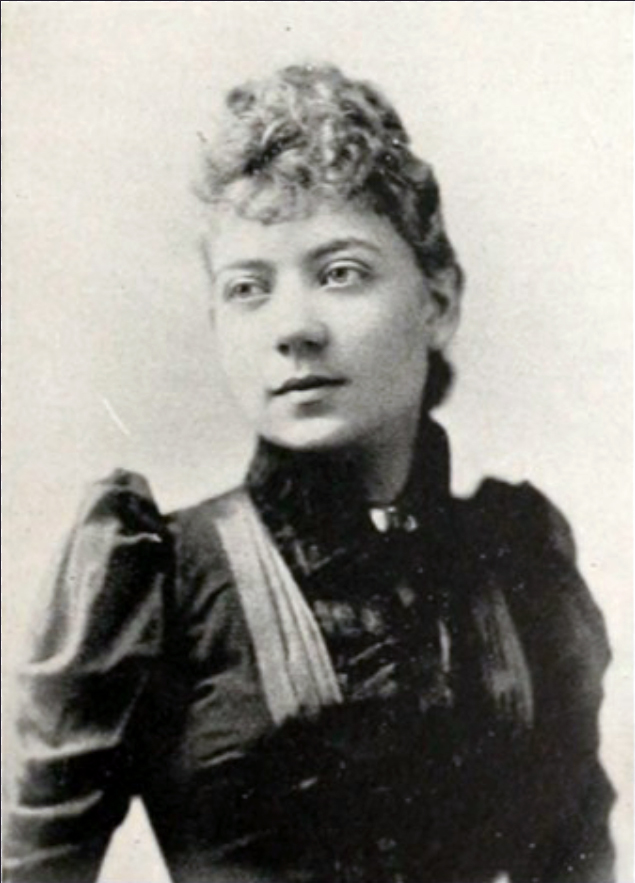
A portrait published in Elizabeth Willard Frances’ 1893 biography of Ruth Ward Kahn; “A Woman of the Century”. [132]
Elizabeth Willard Frances. A Woman of the Century; Fourteen Hundred-Seventy Biographical Sketches Accompanied by Portraits of Leading American Women in all Walks of Life. (Buffalo, New York: Moulton). 1893. Page 428.
In May of 1890, a significant chapter in Lee’s life commenced when a fascinating writer joined the Kahn family, as The Herald Democrat elaborated:
“In the picturesque little mining town of Breckenridge, high up in the fastness of the main range, a quiet marriage took place on a beautiful Sunday afternoon last May, the high contracting parties being Dr. Lee Kahn, of this city and Miss Ruth Ward of Ann Arbor, Mich…” [133]
Only the judge and “the necessary witnesses” were in attendance. According to the reporter, the union was “…a love match with the coloring of romance…”
That morning, Ruth W. and Dr. Lee departed on the Colorado & Southern Railroad from Leadville to Breckenridge and reportedly returned to Leadville that evening:
“…Why they chose this rather novel method of entering the wedded state, and why the matter has been kept so long a secret, is plausibly explained by the groom, who would have been glad to have had it otherwise, but for conditions beyond his control…” [134]
While the “conditions beyond his control” are not elucidated, one possibility was that friends and family disapproved of the marriage. Ruth W. was not Jewish at this time, which may have caused friction. The reports of their wedding came almost seven months after the fact — a testament to the secrecy of the wedding, and evidence that it may not have been viewed favorably by some certain parties. As will be explored later, Ruth W. converted to Judaism within the year, but departed for Hawaii during mid-summer shortly after the couple had eloped. According to a December report, Ruth W. planned to return to Leadville in February of 1891 and move in with Lee. [135]
In late May of 1890, Ruth W. was mentioned in a dispatch from Leadville in the American Israelite. She was described as a “handsome young lady” who had been in Leadville a few weeks at the time. She possibly married in secret the same week. [136] The Israelite article primarily focused on her literary accomplishments and did not mention the wedding. However, the marriage may not have been a complete secret. In June, The Herald Democrat published the following “Positive Fact”: “That rumor says that Lee Kahn has purchased return tickets for two.” [137] This light jab at the young doctor seems to be a playful reference to his fairly obvious relationship, and marriage, to Ruth W. [138] In mid- June, Lee went on a weeks-long trip to Chicago, likely accompanied by Ruth W. who then departed for the South Pacific on her own. [139]
Ruth W. was a promising young writer and poet in the early 1890s. Her widely published writings and travels encompassed Hawaii, Mexico, Spain, and England, and her membership in several elite writing clubs attracted moderate attention in publications of the time. [140] After her marriage to Lee, Ruth W. lived in Leadville over the next decade, which provides interesting insights into the career of a female writer during the late Victorian era. She also embarked on long lecture tours during her years of Leadville residency. Ruth W.’s marriage into the Kahn family was an important catalyst for her conversion to Judaism which she was interested in and wrote about before she met Lee. The same article that described her wedding to Lee also stated that she had lectured on Judaism in Boulder, Colorado during 1889.
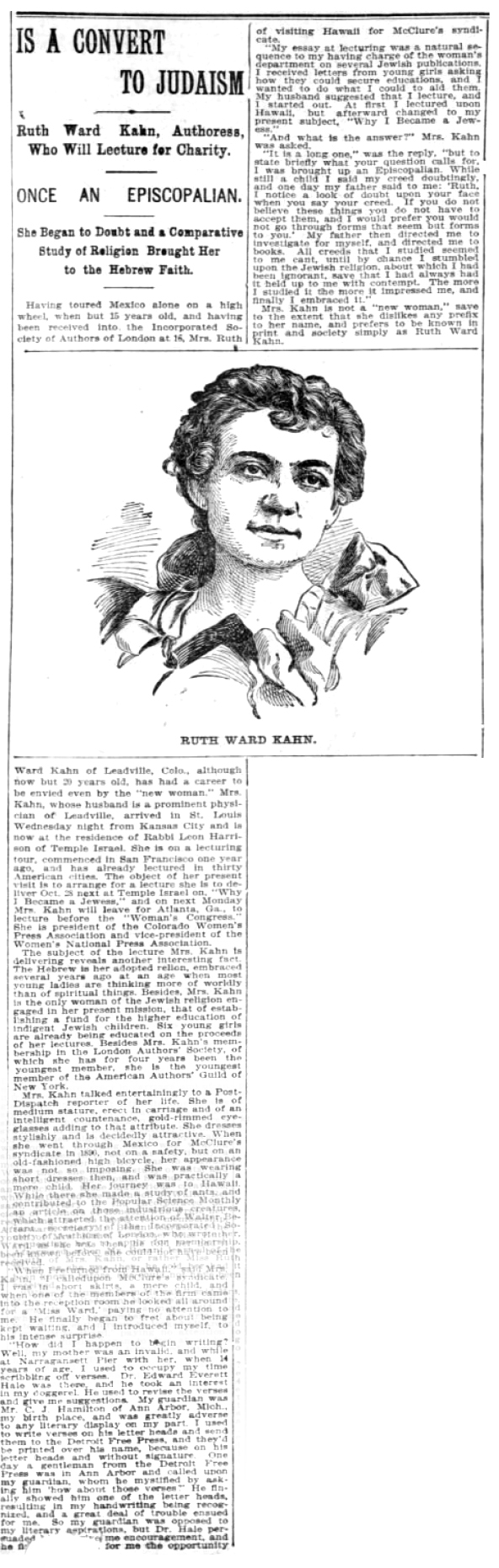
From the article, Is A Convert to Judaism, in the St. Louis Post Dispatch, Sunday, October 20, 1895. [141]
Is A Convert to Judaism. (St. Louis, Missouri: St. Louis Post Dispatch). Sunday, October 20, 1895. Page 24.
Ruth Ward was born in Jackson, Michigan in 1872 and graduated from the University of Michigan at Ann Arbor in 1888 or 1889. While her life between 1889 and 1900 is well documented, her beginnings and end of her life are obscure. An interview conducted while she was on a tour stop in St. Louis that appeared in the St. Louis Post Dispatch is the most comprehensive biography of Ruth W.’s early life thus far. In the interview, she claimed to have been a resident of Narragansett, Rhode Island during her teenage years. When asked about her conversion to Judaism after her marriage to Dr. Lee Kahn, Ruth W. relayed a childhood experience:
“’…to state briefly what your question calls for, I was brought up an Episcopalian. While still a child I said my creed doubtingly, and one day my father said to me, ‘Ruth, I notice a look of doubt upon your face when you say your creed. If you do not believe these things you do not have to accept them, and I would prefer you would not go through forms that seem but forms to you.’ My father then directed me to investigate for myself, and directed me to books. All creeds that I studied seemed [implausible], until by chance I stumbled upon the Jewish religion, about which I had been ignorant, save what I had always had it held up to me with contempt. The more I studied it the more it impressed me, and finally embraced it.’”
The article, entitled Why I Became a Jewess, stated that Ruth W. had lectured in 30 American cities by 1895 and published two books of poetry and one novel. She was also president of the Colorado Women’s Press Association in addition to serving as vice president of the national arm of that organization. In the interview she also revealed that when she was 12 years old, she began writing secret essays and poems on stationery belonging to her guardian, “Mr. C. J. Hamilton.” Despite his disapproval, she sent the papers to the Detroit Free Press and they were published under the name Hamilton. When a newspaperman came to Hamilton about the essays and found out Ruth W. had been the true author, she reported that “a great deal of trouble ensued.” However, a neighbor named Dr. Hale recognized her talents and arranged to send her to Hawaii to join a newspaper syndicate. As noted in Leadville newspapers, she traveled to Mexico and Hawaii shortly after her marriage to Dr. Lee Kahn during May of 1890.
Ruth W. first came to Colorado as a school teacher during 1889, and secured a job in Fort Collins. Later she taught in Hartzel, Park County, spent some time in Boulder, and was also documented in Aspen in April of 1890. She arrived in Leadville by May of that year. [143] On May 11, a local newspaper announced her as a Leadville resident with the comment that she was “…a perfect blonde and a Jewess.” [144] She and Dr. Lee were wed that same week [145] and by June she was steaming across the Pacific to Hawaii. [146]
During Ruth W.’s time abroad, Dr. Lee stayed in Leadville and continued to practice medicine. In August 1890, Dr. Lee was called to the Iron Silver mine on Iron Hill east of the city to help extract a large splinter from the hand of the chief engineer. [147] Throughout the summer he published regular advertisements for his office in Room 1 of the Manhattan block (321 Harrison). [148] Later in August, Lee attended to more miners’ injuries, this time from a powder mishap at the Dinero Mine on Sugar Load Mountain. [149] Lee traveled outside Leadville with relative frequency to attend to patients. Throughout the remainder of the summer and autumn of 1890, Dr. Lee consistently advertised his medical practice but was not profiled as often in the news for his treatments. Like his wife Ruth W., Dr. Lee began to engage in lectures. In his case, he spoke on the topic of medicine in Leadville starting that autumn. In November, he delivered a series of well received presentations [150] on the brain and spinal cord to a physiology class at Leadville’s Central School. [151] As noted above, Dr. Lee moved from the Manhattan block in December and took up residence at the “Iszard House,” 110 West 6th Street on December 14. [152] As recorded by the city directory, he also moved his office to his new residence at the Iszard House. According to a short notice in a Leadville newspaper, Ruth W. arrived back in the United States in late December and was expected back in Colorado by January. [153]
On January 12, 1891, Ruth W. and Lee were married in a second ceremony, this time a strictly Jewish one attended by friends and family at Denver’s Temple Emanuel. [155] The ceremony was traditional and conducted by a rabbi. After the legal and religious observances were performed, the party went by carriage to the Hotel Windsor for a reception. In attendance were C.C. Davis of Leadville’s The Herald Democrat, Miss Schloss, [156] and other individuals from Detroit and Boulder. The couple returned to make a home in Leadville on January 13. [157] By January 20, Ruth W. began to settle into her new life in Leadville and published a notice for friends to call on her at her home on 6th Street during Tuesday afternoons and evenings. [158] When she wasn’t hosting, Ruth W. wrote poetry as well as articles about her travels across the Pacific. In late January, she expressed her condolences to the people of Hawaii upon the death of King Kalakaua, whom she met and interviewed during her time in the kingdom. [159] A February issue of the American Israelite published one of her poems, First Love, which she signed “Ruth Ward Kahn-Leadville, Col.” Ruth W. sent her writings to publications in various states, including Ohio, California, Nebraska, and Pennsylvania during the winter and early spring of 1891. [160]
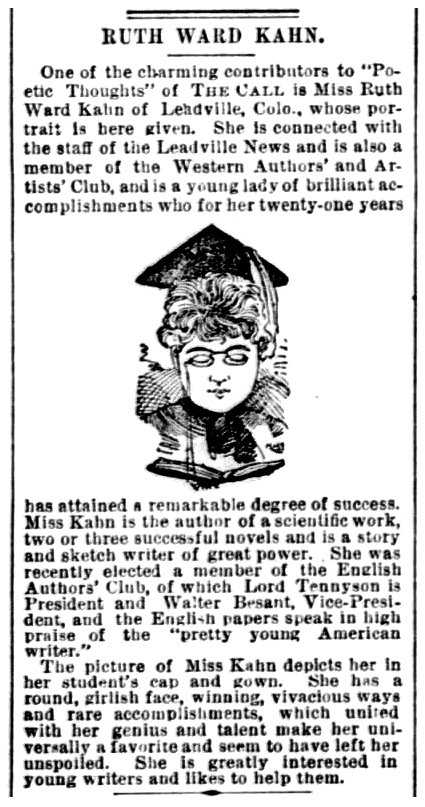
Illustration of Ruth Ward Kahn in The San Francisco Call on Sunday, June 28, 1891. [154]
Ruth Ward Kahn. (San Francisco, California: The San Francisco Call). Sunday, June 28, 1891. Page 12.
In late January, Isaac and Mina celebrated their 25th wedding anniversary. Both Lee and Ruth W. attended as well as a collection of friends and family members. [161] Lee and Ruth W.’s presence at the festivities demonstrates that any prior conflicts over the marriage had dissipated. Shortly after the anniversary party, Isaac’s middle son, Maurice, began appearing in the local social columns. [162] The city directory recorded him working as a clerk at Isaac’s store starting in 1890, when he turned 18 years old. [163] Like his brother, Maurice pursued a medical career and became well known in Leadville over the next decade. During late February, Ruth W. read a poem at a memorial service for the recently deceased General William Sherman hosted by the Garfield Post of the Grand Army of the Republic (G.A.R). A reunion of American Civil War veterans, the notice invited “old soldiers, confederates as well as union.” [164] In addition to the memorial service for the G.A.R. at 615 Harrison Avenue, there was an impromptu sleigh exposition. The mild winter had idled sleighs that season, so citizens took the opportunity to show off their “Portland sleighs” and prized horses. [165] A few days later the son of Hattie and Isaac Baer, Ezra, cut his hand while sledding on 7th Street. Dr. Lee was called upon to give the boy, who was his second cousin, several stitches. [166]
In the middle of March, Ike and Hattie Baer hosted their tenth wedding anniversary party. Guests included Hattie’s Uncle Isaac and Aunt Mina Kahn. David May of clothing store fame, who had relocated to Denver several years before, was also in attendance, demonstrating the increasing ease of travel between Leadville and Denver at that time [167] which was reduced to nine hours.
Several days later, Dr. Lee was asked to treat a man named James Ferry who had suddenly become paranoid and delusional while working for the Leadville Water Company. The Herald Democrat used words like “delirium,” “raving maniac,” and “senseless lunatic” to describe his behavior while hiding in a livery stable on West 6th Street. After Ferry was observed with a “very strange expression” while trying to hide under a wagon, the proprietor of the stable approached him. When asked what he was doing, Ferry began chewing on wagon wheels and scrap wood, at which point an officer was summoned. He fought “like a demon” when the sheriff and several policemen tried to arrest him, and reportedly bit off large pieces of the barn door. After several attempts to subdue Ferry, the police called Dr. Lee to give the man chloroform. The reporter stated that many who witnessed the suspected man’s turbulent behavior thought he was experiencing delirium, tremens, and associated paranoia. In a series of short interviews, Ferry’s wife and his employer denied witnessing any use of liquor. Dr. Lee stated that he did not think the paroxysm resulted from a long period of drunkenness or delirium tremens. Ferry remained in jail and was reported to be “sleeping deeply” later that day. His case was not mentioned again and the conclusion is unknown. [168]
On March 29, Ruth W. was invited to join London’s Incorporated Society of Authors. The club’s president, the renowned poet Alfred Lord Tennyson, reflects the status of the invitation, and Ruth W.’s importance and fame. [169] Although she continued to write, Ruth W. was reported to be seriously sick in the middle of April with an undisclosed illness. [170] She was well enough to publish a Memorial Day poem in high patriotic style by the end of May. [171]
By July, Ruth W. completed her first full book of poetry entitled Gertrude, which she likely wrote in Leadville. Her author’s note was signed “Leadville Colo. July 19, 1891” and was dedicated to Lee. [172] The Leadville Daily Evening Chronicle published the following poem in the August 4, 1891 edition:
PREFERMENT
Give me the crown of love!
Men’s praise is but a breath,
Whose loudest echoes ever rise
From out the halls of death
A loving eye beguiles me more
Then Fame’s enchanting seal,
And one dear word of tenderness
Than triumph’s wildest peal.
Give me the crown of love!
The path of fame is dear,
But victory’s arch doth ever span
A hillside cold and drear.
One little flower of holy love,
All hidden through it lie,
Is dearer than the Israel crowns
That wave to lure the eye.
Give me the crown of love!
The gleam of fame shines far:
But love’s soft glow is near and warm
A holy household star.
One tender glance can fill the soul
With a perennial fire.
But Glory’s flame burns fitfully
A lonely funeral pyre.
Give me the crown of love!
Fame’s echoes soon depart:
But love’s sweet lute breathes melody
That lingers in the heart.
The proofs of fame will burn
When sea and earth consume:
But hearts will live on endlessly,
And rejoice in deathless bloom.
RUTH WARD KAHN.
Leadville, August 3, 1891. [173]
Isaac appeared in the local news for dubious reasons in the middle of August as a result of tax difficulties. On August 18, 1891, The Herald Democrat reported a tax sale of his grocery items, suggesting delinquent taxes and debt. A notice further down the page in the same issue of the newspaper reported that the case also involved David May. [174] An advertisement several days later clarified that David May purchased the stock from the county and was selling it below wholesale. [175] While the circumstances are unclear, it is possible David May purchased the stock in an effort to help Isaac out of difficulty as both were German immigrants and fellow Jews with deep ties to the Temple Israel congregation. The following month, Leadville’s First Baptist Church thanked Ruth W. for help rendered to the congregation. [176] That same day, an interesting article on the evolution of Isaacs store on East 6th Street appeared.
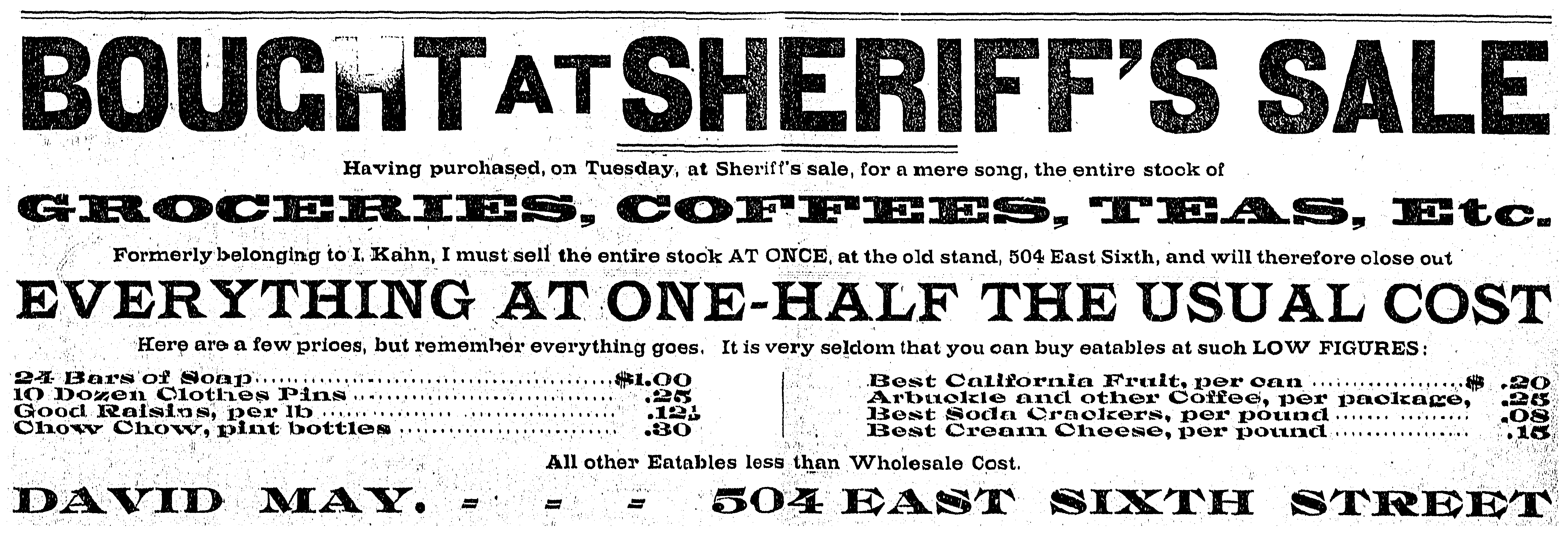
This advertisement showing the sale of former I. Kahn merchandise at David May’s store appeared in The Herald Democrat on Wednesday, August 26, 1891. [177]
Bought At Sheriff’s Sale. (Leadville, Colorado: The Herald Democrat.) Wednesday, August 26, 1891. Page 5.
A short advertisement noted that the store was back in operation, but this time it was signed “H. Kahn”. [178] Henrietta was the sister of Isaac, Marx and Aaron Kahn, and her residential addresses always coincided with either the Isaac and Ruth W. Kahn residence [179] or the grocery. [180] She appears to have held the controlling interest in Isaac’s store from 1891 to 1898. [181] A brief notice published a few days later simply read, “Power of attorney-Henrietta Kahn to Isaac Kahn.” [182] Records offering a definitive explanation of this exchange have not yet been found.
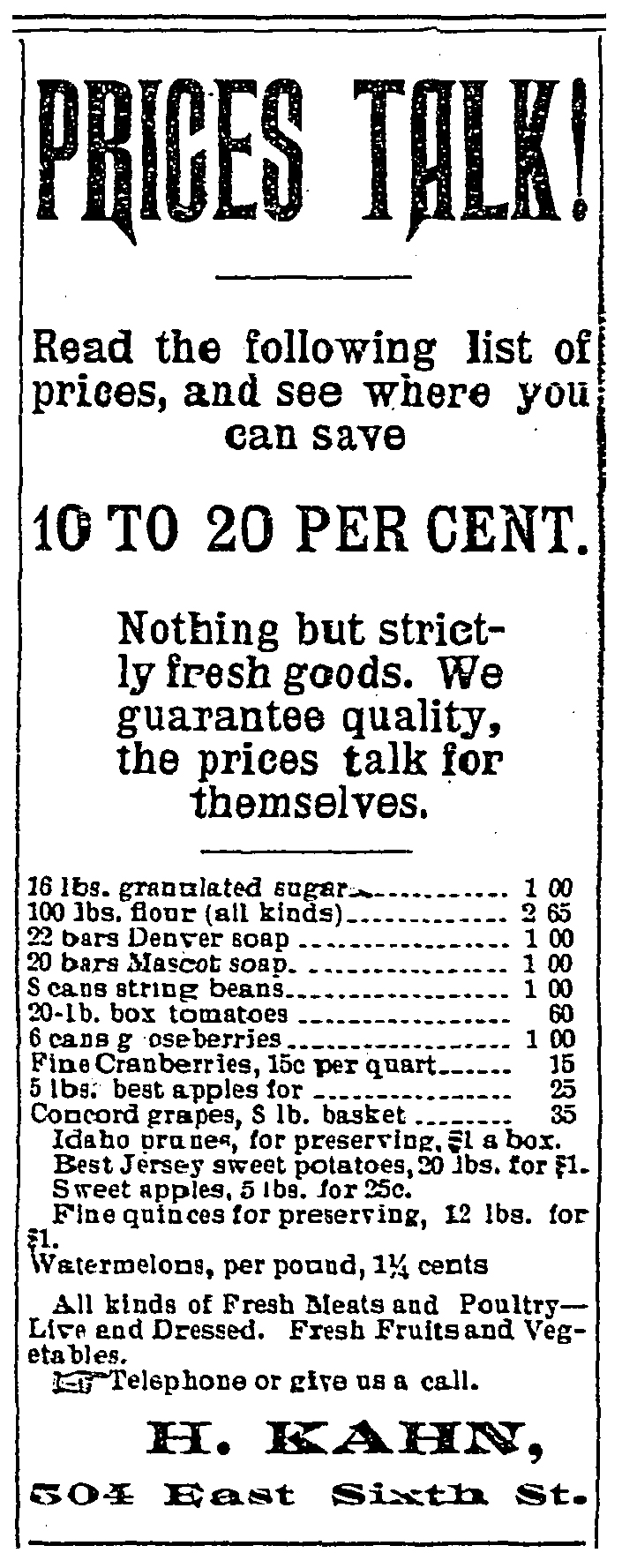
Advertisement for groceries by H. Kahn in The Herald Democrat on Thursday, October 29, 1891. [183]
Prices Talk. (Leadville, Colorado: The Herald Democrat). Thursday, October 29, 1891. Page 3.
Henrietta’s life in the United States is largely a mystery. She disappeared from Leadville around 1899 after she severed ties with Isaac’s grocery. She resurfaced in Denver between 1913 and 1915, [184] but additional records are elusive.
During the election season of 1891, Dr. Lee was nominated as a candidate for Lake County Coroner on the Democratic ticket. He ran against Republican James Nelson and People’s Party candidate Mark A. Sears. [185] Nelson won the election several days later. [186] The day after the election, both James Nelson and Lee delivered a lecture on the History of Our Flag for children at Ninth Street School, suggesting the men maintained good relations. [187]
While Dr. Sol Kahn, Lee’s cousin, made frequent newspaper appearances as the city’s primary physician, challenging cases also visited Dr. Lee’s office, located at 501 Harrison in 1892. [188] At the beginning of February, Dr. Lee provided care to a young man who had been in a fight. The man did not identify himself or explain how he got a large cut running the length of his arm. After Dr. Lee sewed the cut together, the young man left without a word. [189] Several days later, Dr. Lee treated another young man caught in an avalanche near Hagerman Tunnel. The man had been cooking supper when a snowslide demolished his cabin. After climbing out of the debris, he walked to a nearby ranch. That night, as the swelling and pain increased, he hobbled to Leadville in search of a doctor. Dr. Lee stitched up a wound on his arm and scalp. [190]
Three days after Dr. Lee treated the avalanche victim, he successfully saved a woman from a suicide attempt. Early in the morning, neighbors woke Lee and informed him a woman tried to commit suicide on lower West 6th Street. Her husband had left her the previous day, and she swallowed several vials of morphine. Dr. Lee pumped her stomach and by early morning she had recovered. [191] A week later, Dr. Lee moved to the 501 Harrison Avenue location. He occupied an office in rooms 10 and 15 in the three-story structure until the late 1890s. The building originally served as Leadville’s post office, which then had a number of storefronts on Harrison Avenue and 5th Street, in addition to office and residential space. Located on the northwest corner of 5th and Harrison, it later suffered fire damage and neglect and was demolished in the mid-20th century. [192]
An unusual article published at the end of March listed the shoe sizes of prominent Leadville men, including Lee. Apparently, most men in Leadville preferred custom-made shoes with lace boots, and most wore gaiters or spats to keep out the dust, snow, and mud. The information reportedly came from a man who was described as mildly insane. This unidentified person “…found the pedal understandings of his fellow citizens a subject of much interesting study…” and wandered the streets regularly measuring and cataloging the “sandy” boot prints he found, evidently tracing most of them to their houses and places of work. [193]
During April, Dr. Lee treated a man who had lost two fingers in a railcar coupling accident on Freemont Pass. [194] Since danger was a given in mining communities, Dr. Lee had plenty of work on a daily basis during the 1890s. In June, Ruth W. reportedly recovered from a serious illness — but subsequent months showed that Ruth W. was pregnant at the time. [195] On July 10, 1892, Dr. Lee and Ruth W. hosted the bris for their son, Milo, [196] who was born in Leadville on July 1, [197] at their new home located at 137 West 8th Street. [198] Temple Israel Cantor Ben Davies conducted the ceremony [199] and Dr. Lee’s cousin, Dr. David Heimberger, performed the circumcision. [200] A reception was held afterward at Isaac and Mina’s residence on East 6th. Most of those in attendance were members of Leadville’s Reform Jewish congregation based at Temple Israel. [201] Several days following the event, Dr. Lee treated the six-year-old daughter of the aforementioned James Ferry after she fell from a fence in the backyard of his house and broke her arm. [202]
September brought a bizarre character into Dr. Lee’s office. A young man named McDuffy came to Dr. Lee with a grisly injury he sustained in a freight hopping accident. McDuffy claimed he did not have any money and could not pay for treatment. Despite this, Dr. Lee examined the injury and immediately recognized it as self-inflicted — a ploy to solicit money from people on the streets. While aware of the ruse, the reporter wrote that Dr. Lee dressed the wound but sent the man away with a warning to never return. [203] The following week, Ruth W. appeared as the poetic character “Sapino” in a Women’s Relief Corp’s production at the Tabor Opera House entitled The Temple of Fame. [204]
Ruth W., who was absent in the social columns during the late autumn of 1892, escaped a close encounter in mid-November. Late in the evening of November 12, Ruth W. answered a knock at the back door of their house. The stranger claimed to be delivering clean clothes from a nearby laundry. Once she opened the door, a strange and “rough looking” man stumbled out of the shadows. Ruth W. slammed the door shut and locked it. She ran to the front room and was dialing her telephone when the man barged in the front of the house. The stranger hit Ruth W. so hard that she hit the floor. A person walking by the house startled the intruder, who disappeared into the night. Dr. Lee arrived moments later and the police were summoned. A search commenced for a man Ruth W. described as wearing a large white hat, a dark suit, and pants tucked into heavy riding boots. No further mention of the incident surfaced, nor did any injuries sustained by Ruth W. [205] In December, Ruth W. hosted a dinner party for a number of friends and family; Dr. Lee was not listed as an attendee, however. [206] A few weeks later Ruth W. and a woman named Cora Smith advocated for the establishment of a state mining hospital at Leadville. Ruth W. and Cora stated they had created a donation campaign for a young mother of three who lost her husband in a mining accident. The women claimed the man could have been saved had a specialty clinic for mine accidents existed in the city. [207]
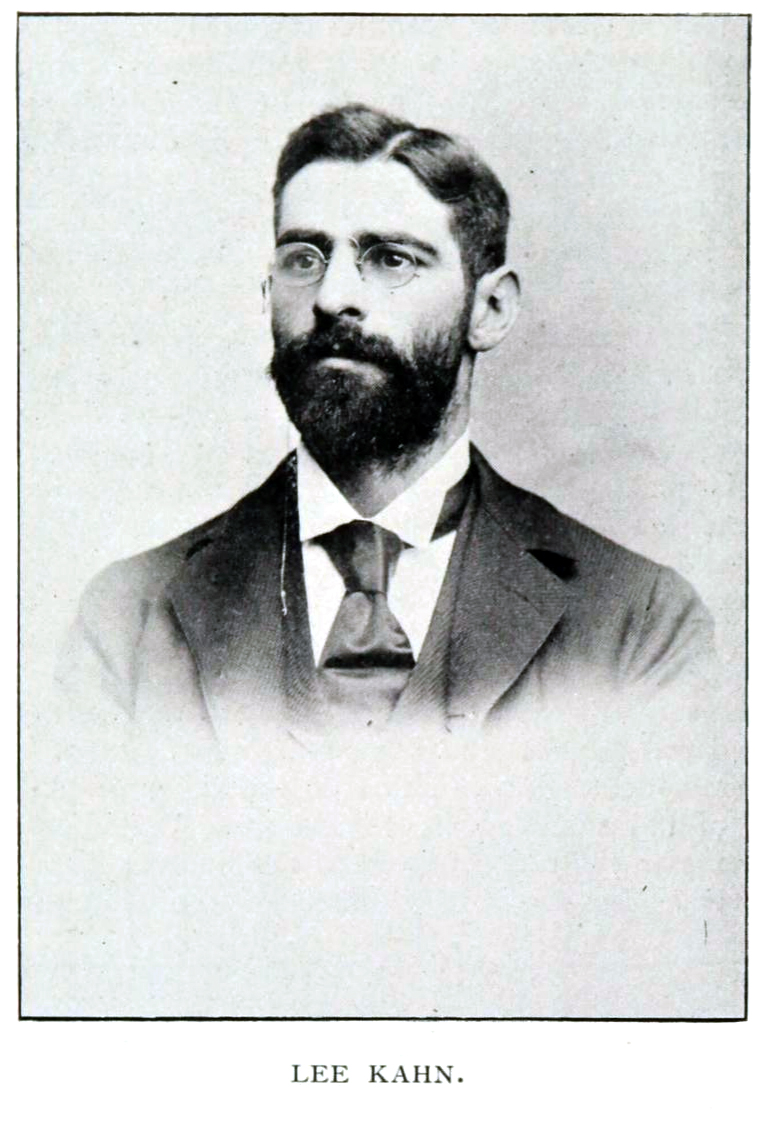
Portrait of Dr. Lee Kahn taken in 1896. [208]
Irving A. Watson. 1896. Page 646.
At the beginning of 1893, Ruth W. immersed herself in motherhood. Lee continued his medical practice on Harrison Avenue. In late January, an employee of the Singer Sewing Machine Company — located on the floor below Lee’s office — was injured in an accident on Mosquito Pass. His wagon and horse lost traction and slid over a cliff while he was on his way back to Leadville from Breckenridge. The man sustained cuts and bruises to his entire body, and Dr. Lee dressed the wounds. [209] In early February, Ruth W. was interviewed by Leadville newspapermen on the status of the new Hawaiian queen Liliuokalani. Ruth W. revealed that her 1890 trip to the island enabled her to dine with the future queen. She reported Liliuokalani as “not an overly appreciative acquaintance” and detailed the queen’s opposition to the American presence on the island, information she learned firsthand at a roast dog feast in the palace. According to Ruth W., Liliuokalani blamed the Americans for making her skinny, and related that the queen said at a luncheon, “…since you compel us to wear clothing, it makes us thin. Once I was fat, but I am getting thinner every day from having to wear clothes.” The notes on Ruth W.’s visit were published as an interview that contained few direct quotes. Its authenticity cannot be confirmed and no further writings from Ruth W. on the subject of the Hawaiian Queen appeared. [210]
In May of 1893, Dr. Lee became Leadville’s city physician by eight votes to cousin Dr. Sol’s two. The position was not publicly elected; only city aldermen cast their votes. [211] Several days later, on May 5, Ruth W. departed for Ann Arbor to attend elocution classes at her alma mater, the University of Michigan. [212] The same day, Dr. Lee visited the city jail in his first capacity as city physician. He dressed the wounds of a man who fell through a window “while watching beer kegs being piled up in front of the building below.” [213] That week, Dr. Lee and Dr. Crook attended a drunken Austrian who had been injured by a fight with a circus employee. [214] Ruth W. returned from Michigan in July and she and her husband made an appearance at the Hebrew Ladies Benevolent Association’s annual Strawberries & Ice Cream Festival. [215] The next day, Dr. Lee saved another patient in the throes of a suicide attempt. A night railway yard man named Charles Sowers swallowed twelve doses of morphine while lying in the parlor of his house. He was reportedly “despondent” over the recent loss of his job and felt shame over losing his money to drinking and gambling. His estranged wife ordered Lee to examine her husband’s pockets to prove the morphine was not secretly administered to obtain a life insurance policy. [216]
One month later, Dr. Lee was called to the scene of a successful suicide attempt. He was unable to revive the patient, described as “an adipose Swede”. [217] Dr. Lee encountered suicides several more times during 1893, possibly related to economic upheavals in the United States that year — and specifically silver-producing states like Colorado due to the repeal of the Sherman Silver Purchase Act, which caused silver prices to plummet. [218]
In August of 1893, Dr. Lee saved yet another young woman on Chestnut Street from a suicide attempt after her husband abandoned her in search of work. [219] Throughout the autumn, Dr. Lee regularly treated the injuries of woodcutters, miners, and laborers in Leadville and the surrounding county. In addition to rising suicide attempts, most injuries consisted of severe and moderate lacerations requiring stitches. A number of patients also suffered broken bones from falls and impacts. Drunken accidents also proliferated, as well as fights. Dr. Lee fine-tuned his bone-setting and sewing skills because they were in constant demand. Stabbings also contributed to patients’ injuries, many of which he treated in the late autumn and winter of 1893. At Thanksgiving that year, Dr. Lee said that he was thankful “…because there have been no suicide cases to get me out of bed at 2 a.m.” [220]
In late 1893, Isaac’s youngest son, Herman, began popping up in newspaper copy. Now between nine and ten years old, Herman was mature enough to help lead the opening prayers for Chanukah services at Temple Israel. Ruth W. and Dr. Lee, as well as his brother Maurice Kahn, were also listed as guests at the service. [221]
Life continued its frenetic gallop for Dr. Lee and Ruth W. In early 1894, Ruth W. began teaching elocution lessons at the Tabor Opera House. [222] In February, Dr. Lee stitched a severe wound sustained by an Italian immigrant who got in a “friendly knife fight” with a fellow boarder. [223] Several weeks later a man named Jim Walor was caught in a blizzard near the summit of Tennessee Pass, roughly ten miles northwest of Leadville. He was rescued by a search party after the blizzard subsided and was taken to Dr. Lee in Leadville. All of Walor’s limbs were badly frostbitten. [224]
In early March of 1894, Ruth W. hosted a poetic recitation group she dubbed the “Longfellow afternoon” at her residence. The group, composed entirely of women, recited a number of personal works as well as those by the poet Longfellow. Later in the afternoon, a group of high school students arrived at Ruth W.’s, and Dr. Lee’s brother Maurice was among them. They spent the evening enjoying fashionable Victorian pastimes such as a Gypsy palm reader, musical solos, and parlor games. [225] In April, young Herman attended an Eastern Star meeting and presented several recitations throughout the evening. His mother Mina, a member of the Masonic organization, probably used her connections to recruit Herman despite his elementary school age. [226] In late April, Ruth W. and Dr. Lee traveled to Cottonwood Hot Springs west of Buena Vista. A brief notice reported that Ruth W. stayed at the resort after Dr. Lee departed for the benefit of her health. [227] In late April, Mina hosted a ladies Passover gathering at Isaac’s East 6th Street residence. Ruth W., as well as the wives and daughters of many of Leadville Jewish families attended, including Madames [228] Leppel, [229] Baer, Schayer, Janowitz, [230] Heimberger, Gross, [231] and Angerman. [232]
At the end of May 1894, rumors of smallpox circulated in the neighborhood of Upper Chestnut Street — but the reality proved much less severe. An innkeeper named Mrs. Goodwell, annoyed with an itinerant sewing machine debt collector, told him there was a smallpox victim in the house to deter him. The collector immediately went to city authorities and both Dr. Lee and Dr. Crook visited the house. Mrs. Goodwell explained the “mistake” and Dr. Lee verified that no one in the house was sick. [233]
A curious report in the Herald Democrat during mid-August of 1894 ranked the frequency of surnames in Leadville during the previous year. Among surnames with the most individuals were: Johnson with 76, Smith with 66, Miller and Anderson with 40, Sullivan with 38, and most relevant to this study, Kahn with 11. [234] Isaac’s branch of the Kahn family accounted for eight of these, suggesting “eleven” was a gross miscount. The families of Isaac, Julius and Marx alone would nearly triple that number.
As earlier reported, Dr. Lee was often visited by troubled and mysterious patients. In late August of 1894, a man with a mangled face arrived at Lee’s office for treatment. The patient said nothing while Dr. Lee dressed his head injuries, which apparently resulted from a fight. When Dr. Lee asked his name, the man said nothing. Dr. Lee suggested that he go to the police and report his attacker, but the stranger replied simply, “Didn’t see no policeman; wasn’t lookin’ for none.” After this vague answer, the patient walked out silently into the street and disappeared. The reporter surmised that Lee was left “…to meditate alone and uninterrupted upon the [pleasures] of a sporting life.” [235] The following day, Lee attended the tenth wedding anniversary celebration for Mrs. and Mr. Adolph Schayer, a distinctly Jewish affair with guests including many of Leadville’s most prominent citizens. [236] In September, Ruth W. returned from a trip to the east, but her length of stay and reasons for traveling were omitted. The couple relocated their residence to the “Gunnell” house after Ruth W. returned. [237] The Gunnell house was probably located at 114 West 8th Street — Ruth W. and Dr. Lee’s home in 1895. [238] Another taciturn patient received treatment from Dr. Lee in October for his wounds. The mute man pantomimed that he was injured while being forcibly removed from a nearby saloon. [239]
On the evening of November 26, 1894, a 14-year-old girl named Mary Fikani was hit by a train in the Rio Grande Railroad yard. Her family, reportedly Arabs, operated a lunch counter at the depot, and Mary regularly sold “specimens” of ore to passengers on incoming and outgoing trains. She was following a train, waiting for payment from a passenger, when her dress caught in the tracks, making her trip. As she fell, the train ran over her arm, nearly severing it. Doctors Sol, Lee, and Heimberger all responded to the girl’s house to treat the horrible injury. After Mary’s arm was successfully amputated, she received “a narcotic.” Her condition was reportedly critical but savable.” According to the reporter, the railroad posted signs earlier that year to deter children from wandering the railway yard, but the notice was ignored. [240] The girl belonged to Leadville’s very small Arab-Christian community. The Fikanis were recorded in contemporary documents as natives of Lebanon, Syria, or Turkey, depending on the source.
On New Year’s Day, 1895, Ruth W. and Dr. Lee hosted a small dinner party. Isaac and Mina Kahn, members of the Baer and Schloss families, and Tillie and Dr. Sol Kahn attended. [241] At the end of January, Dr. Lee read a paper at the Lake County Medical Society on “Anesthetics.” [242] Although little information about Isaac’s 1880s investments in mining claims are available, in February he leased a 1/16th interest with a 10% to 20% on the “Favorite” claim in California Gulch to A. V. Hunter. [243]
In January of 1895, Dr. Lee posted new office hours: 9-10 a.m., 1-3 p.m. and 7-9 p.m. — a total of five hours. He also provided his home address in the event of a serious emergency. The fact that these hours had not been published before may indicate the inclination to cut back on his taxing job as city physician in the future. [244] As we have seen, Dr. Lee rarely saw patients in his office and instead made constant traveling calls. Throughout the remainder of February, Dr. Lee attended to several slip and fall injuries. He also hosted a meeting of the Lake County Medical Association at the end of the month. [245]
At the beginning of March, Isaac was selected as a delegate to that year’s Republican convention for Leadville’s 14th precinct. [246] As we have seen Dr. Lee was a Democrat who disagreed with his father, Isaac, over political matters. Most German-American immigrants aligned themselves with the Republican party, exemplified by David May, Mannie Hyman, and other German-Jewish immigrant merchants in Leadville’s early years. The political re-alignment during the first generation of American born German-Jewish immigrants in the U.S. provides an interesting critique of social politics in the latter portion of the Victorian era.
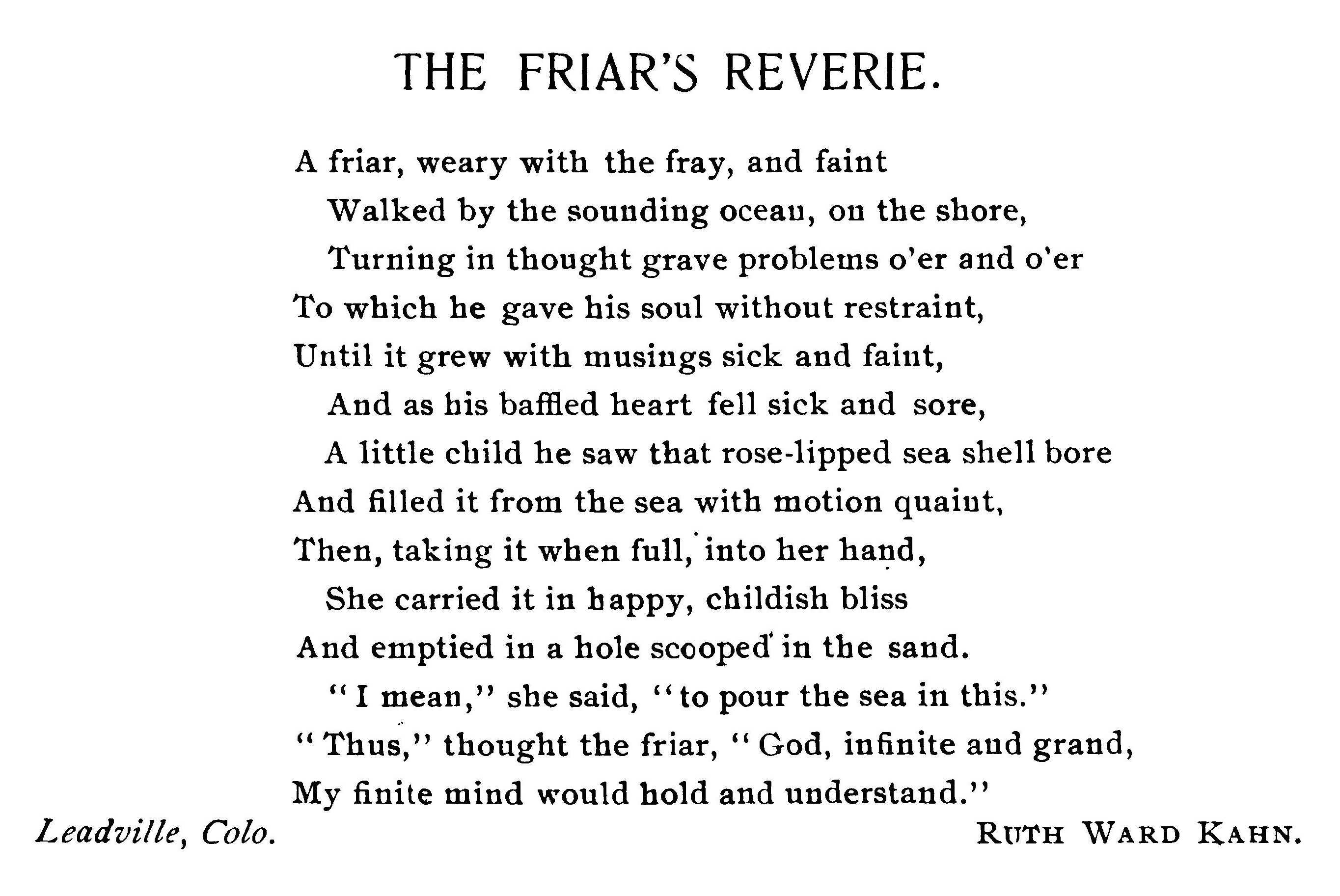
A poem titled, The Friar’s Reverie, by Ruth Ward Kahn published in the November 1895 edition of the American Jewess. [247]
Ruth Ward Kahn. The Friar’s Reverie. (Chicago, Illinois: The American Jewess. Volume 2, Issue 2). November, 1895. Page 72.
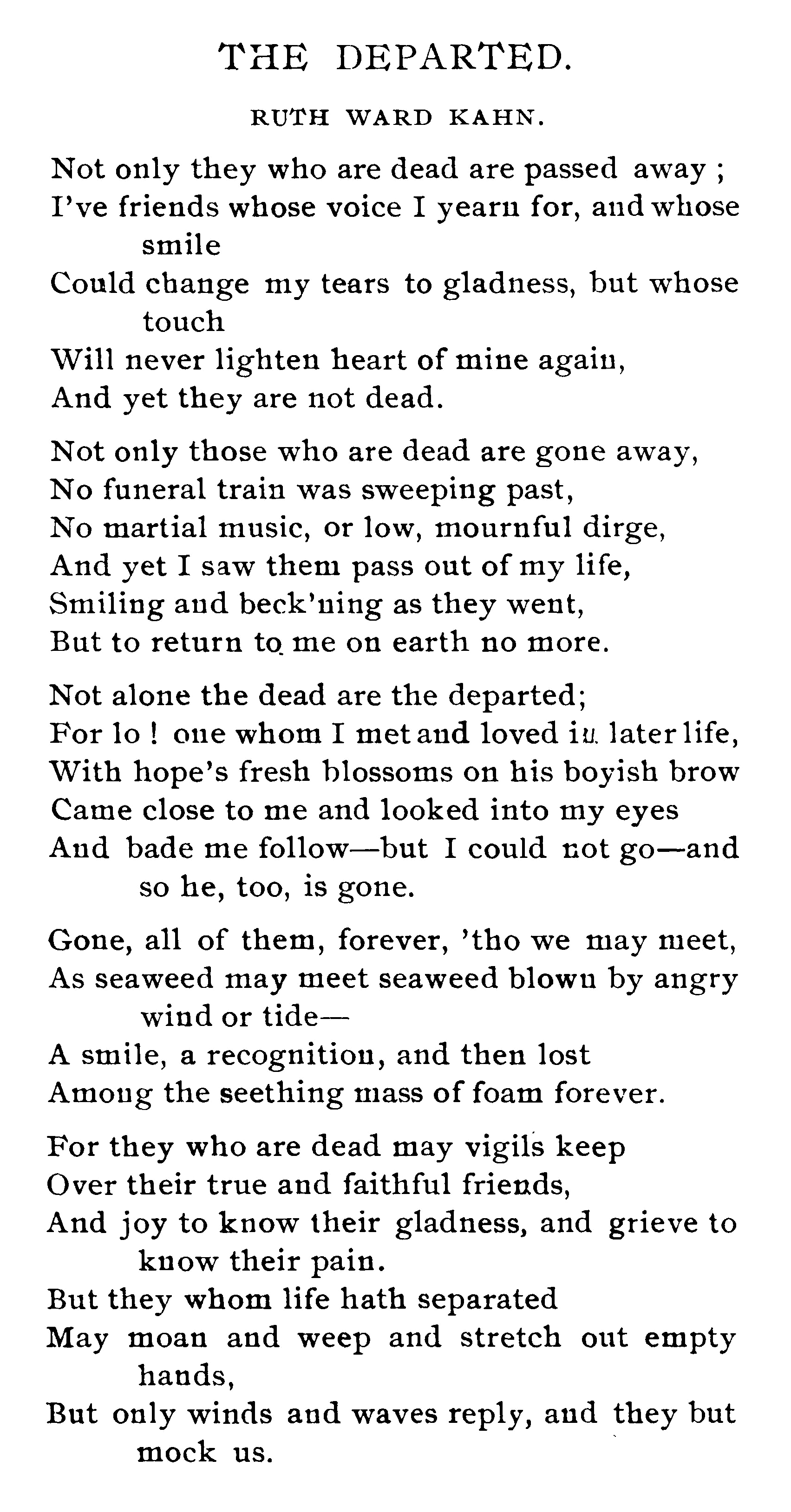
A poem titled, The Departed, by Ruth Ward Kahn published in the April 1895 edition of the American Jewess. [247]
Ruth Ward Kahn. The Departed. (Chicago, Illinois: The American Jewess. Volume 1, Issue 1). April, 1895. Page 20.
Beginning in the spring of 1895, Ruth W. contributed to a new magazine called The American Jewess. [248] According to digital archives of the magazine at the University of Michigan, Ruth W. contributed a total of five poems and one piece of prose to the magazine over the course of several years: four poems in 1895, one in 1897 and a prose piece in the form of a biography and an obituary for Frances Jacobs (Wisebart) [249] in 1898. [250] The magazine ceased publication in 1899.
Several weeks later, Dr. Lee was called to another suicide attempt on West Chestnut but unfortunately failed to revive the victim. [251] At the end of April, Lee testified to the affirmative in an assault case that he had seen injuries on the defendant. [252] In mid-July, Herman Kahn, Sydney Janowitz, Gracie Harwitz [253] and Rebecca Cohn [254] had joint Bar-Bat Mitzvahs at Temple Israel, followed by a reception at the Hotel Vendome (today’s Tabor Grand). Although the existing newspaper article on the confirmation is damaged and illegible, the event was well attended by the majority of Leadville’s Jewish and gentile population. Dr. Lee acted as the toast master. [255] At the end of July, Dr. Lee was elected as treasurer and secretary of the Lake County Medical Association. [256] The following month, Ruth W. traveled to Twin Lakes as a guest of Mrs. M. Leppel for several days. [257]
In September 1895, Ruth W. wrote a song for an inaugural rally to promote the future Ice Palace at the Tabor Opera House. The song was touted as “a composition of rare merit.” [258] While most injuries Dr. Lee treated stemmed from isolated incidents, an accidental explosion at the Belgian mine on Iron Hill in late September killed six men and injured four. As the company’s surgeon, Dr. Lee was first to arrive, and Dr. Sol and a third doctor named Johns were also called to assist. The miners’ primary injuries, according to the report, were caused by asphyxia. According to the report, Dr. Lee and the other physicians injected unconscious miners with “hypodermic injections of whiskey and other stimulants.” The cause of the explosion was reportedly caused by an attempt to thaw out a frozen 30-pound case of blasting powder. [259]
Dr. Lee again testified at the Lake County courthouse during the proceedings of a murder trial in October of 1895. He confirmed that he had performed the autopsy of a murdered man and detailed the wounds and abrasions he had found. [260] In late autumn, Ruth W. was active on the lecture circuits, charity meetings and teaching. Her early teaching engagements were in Kansas and St. Louis, and the subject matter usually related to women and Judaism. [261] In September, she visited North Platte, Nebraska and led a drive to raise money for scholarships for students in Leadville. [262] The same week Ruth W.’s lecture tour was announced, a reporter corrected a mistake he made regarding Dr. Sol and Dr. Lee. Dr. Lee had apparently lectured on physiology and anatomy, but the reporter mistook him for his cousin. Photos show the pair shared amazing familial similarities. Both Dr. Lee and Ruth W. were both considered authorities in their respective fields. [263]
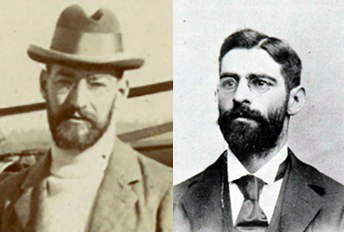
Cousins, Dr. Sol Kahn (Left) and Dr. Lee Kahn (Right), shared significant facial similarities. [264]
Jeffrey P. Grant. Kahn, Sol and Lee Facial Comparison. [Digital Image]. (Leadville, Colorado: Temple Israel Foundation, Temple Israel Collection). 2021.
H. Kahn, the successor to Isaac’s store on East 6th Street, continued operating the concern. In January 1896, the store sold souvenir spoons at a booth inside Leadville’s legendary Ice Palace. [265] Dr. Lee, who treated an abundance of ills and injuries, had a noteworthy case in January. A young man named Mike Riley was brought to the Leadville city jail from Ibex in mid-January. His fall off “the merry-go-round” while dressed in a “Queen Lil” costume knocked him out and he was taken unconscious to the jail. Dr. Lee revived Riley, who apparently was not guilty of any crimes. The reporter related that he was sent home “rejoicing”. [266] Queen “Lil” may have referenced the recently deposed Queen Liliuokalani, a result of the United States’ annexation of Hawaii in 1893, a widely-covered, timely topic. Given the fact that Riley was jailed, he was clearly a grown man; costume parties were popular in Leadville and Riley may have been drunk at the time.
Although the majority of Dr. Lee’s life concerned his duties as a physician, he was still mentioned in more trivial announcements. In early March of 1896, he was reported as present at a city council meeting asking permission to build a hitching post at the corner of 4th Street and Harrison Avenue. [267] Three days later, it was reported that Ruth W. was very sick and had been taken to Denver to recuperate at St. Luke’s hospital. [268] In early April, a Leadville newspaper announced that Dr. Lee invented, but did not patent, a new medical apparatus. The devise was “a new aseptic applicator and injector” that had a built-in syringe and drachm, instead of separate pieces. [269] Though illustrations of the device have yet to be uncovered, a description appeared in the April 4 edition of The Herald Democrat newspaper:
“To the many accomplishments that he is known to possess, Dr. Lee Kahn has lately added another, that of inventor. Of course,[professional] dignity prevents him taking advantage of his invention as other creators of new ideas do, by having it patented, which to do would not be considered good form by his professional contemporaries. The invention, which is received with much favor by the medical fraternity, is a new aseptic applicator and injector, consisting of an ordinary applicator made of virgin silver with an opening through its entire length, and a graduated one-drachm-syringe to fit the handle. It is used the same as any other applicator, with the exception that nothing is applied to the cotton, but what medicine is desired is drawn into the syringe and after the applicator is introduced the syringe is screwed to the handle and the medicament injected into the cotton.
Medical journals speak in the highest terms of Dr. Kahn’s invention, that has already won a high place in the opinions of the profession.” [270]
Throughout the remainder of 1896, Dr. Lee and Ruth W. garnered only a few mentions in local newspapers. Additionally, Isaac and Mina were not well documented during this period. Ruth W. became a member of the Chautauqua Institution during 1896 and strongly advocated for educational access; she raised funds for a full year’s tuition for two “Jewish girls” to attend Vassar and Harvard universities that same winter. [271]
In early 1897, Ruth W. lectured in Atlanta, and a report published in The Herald Democrat praised her speaking abilities and her beauty. [272] A few days later, she was back in Leadville and delivered another well-attended lecture about the Hawaiian Islands at the Presbyterian church on the corner of West 8th Street and Harrison Avenue. [273]
Dr. Lee demonstrated yet another example of the advancements in medical technology that same week in 1897. A doctor named Tropping bought a cut of pork tenderloin but “did not like the appearance,” so he gave the portion to Dr. Lee’s office for an examination. Apparently, Dr. Lee owned a microscope, and after a close inspection discovered that the cut hosted a number of trichinae, the virus associated with deadly trichinosis. Dr. Lee said that “once the animalcule had burrowed their way into the system the case was beyond medical aid.” Dr. Lee cautioned against undercooking the meat and emphasized that the appropriate cooking time would eliminate the risk of disease. [274]
In March of 1897, Isaac and Dr. Lee departed for California, although their purpose for the trip was unknown. Several weeks later a telegram said they were on Catalina Island engaged in recreational activities [275] The father and son returned to Leadville in the middle of May. [276]
During late June of 1897, a Leadville soap maker named Haines claimed to have developed a special formulation of soap that was less damaging than lye for laundry. The soap was advertised at H. Kahn’s store and sold for 10 cents a bottle. [277] It was a quiet summer in Isaac and Dr. Lee’s households. By the end of the year, primary family references were advertisements for the grocery store on East 6th Street and for Dr. Lee’s medical practice, still located at 501 Harrison Avenue.
By the end of 1897, Dr. Lee and his fellow Leadville physicians were preoccupied by a potential scarlet fever outbreak in the city. Dr. Lee had stepped down as city physician by 1897, and Dr. Cole now assumed the position; both Lee, Cole and other doctors testified about their opinions regarding the disease at a city council meeting in November. One of the Janowitz [278] children fell ill with what many believed to be scarlet fever, and Leadville attempted to prosecute fellow Jewish doctor Heimberger for failing to report the case. Dr. Lee as well as Doctors Bosanko, Crook and others testified that the boy was infected with rubella and not scarlet fever, while Dr. Cole and several other doctors said the sickness was in fact scarlet fever. The case was sent to the municipal judge, which ruled for defense. After a heated debate, the judge dismissed the charges against Heimberger and stated all precautions were observed but the actual disease in question was not identified. [279]
In January 1898, tragedy struck Dr. Lee and Ruth W. On January 15, Milo came down with rheumatic fever and was taken to Denver. [280] During the next several days, he wavered between improved and critical. On January 20, Milo’s condition crashed precipitously, and Dr. Lee departed Leadville for Denver on a midnight train:
Milo Kahn’s Condition Critical
Dr. Lee Kahn left on the midnight train for Denver in response to a message notifying him that his little son was much worse. The little lad it was thought was improving for the past few days, but the case took a change for the worse last evening. [281]
Milo never rallied over the next two weeks. He passed away on February 2, 1898 and was buried in Leadville’s Hebrew Cemetery on February 3. The funeral took place at Isaac’s store on East 6th, followed by a funeral procession to Evergreen Cemetery. [282] In a short obituary, a reporter claimed that five-year-old Milo fell into a ditch while playing and never recovered from the shock of the cold water. Milo’s passing marked the first in a series of deaths affecting all three generations of Isaac’s family within the following year.
In the spring, Ruth W. published a second, full-length volume of poems entitled The First Quarter. Unlike Gertrude, the book was a series of poems without a storyline. Some of the poems obviously depict life in Leadville such as Thoughts on Mt. Massive and The Storm as well as clear allusions to her son in Milo’s Faith and Motherhood. Most of the poems were probably completed shortly before the young boy’s death. [285]
In June of 1898, Maurice graduated Boston University Medical School with high honors, securing his new title as “Doctor Maurice Kahn.” [286]
During the summer of 1898, Dr. Lee treated a victim injured by a runaway horse, another with severe acid burns and a man suffering multiple gunshot wounds. During September, Dr. Lee published a short notice that advertised “two jacks for their keeping during the winter…” The term “jack” was not defined in the notice. It may have meant a jackrabbit, which was often kept as a source of food. A “Cousin Jack” was a common term that referred to Cornish laborers. [287]
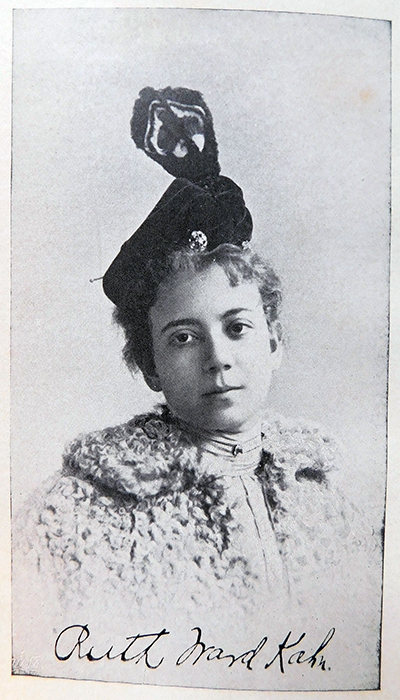
Photo of Ruth Ward Kahn in 1898 from the title page of her book titled, “The First Quarter”. [284]
Ruth Ward Kahn. The First Quarter. (Cincinnati, Ohio: The Editor Publishing Company). 1898. Page 1.
Mina was diagnosed with typhoid at the beginning of December but was reported to be “wide awake”. [288] The following day, a reporter interviewed Dr. Lee on the topic of lead poisoning after some smelter workers exhibited signs of neurological deterioration. Dr. Lee stated that lead was not a severe toxin but that high levels discovered in local smelter workers could affect the bowels and mind, especially in victims with poor kidneys. The report elaborated that a spike in lead poisoning cases during a large snowstorm in late November 1898 drew attention from many in the city. Due to the storm, the doors of the Arkansas Valley smelter were closed to reduce the dangerous draft of prevailing westerly winds. As a result, the ventilation was poor and lead dust settled on the tools and surfaces that workers absorbed. Dr. Lee was quoted as saying, “There is nothing so very serious about lead poisoning except that it causes the patient great inconvenience, and drastic purgatives have to be resorted to for relief….” [289]
On December 5, 1898, Mina succumbed to complications from her bout with typhoid. In keeping with the period’s tradition, Isaac, Herman, Lee, and other relatives assembled in Mina’s bedroom at the rear of the grocery store as she passed. Ensuing memorials and obituaries reported the matriarch to have been well known and respected. After Milo’s death in February, Mina’s was the second death in the family in 1898. The conclusion of Mina’s funeral notice read that Maurice was in Boston for medical school at the time but Maurice returned to practice in Leadville within a year. [290]
Mina’s funeral took place December 6 at Temple Israel. In addition to the Jewish service, an Eastern Star tribute was also included. Even at a time when hyperbole ran rife in newspapers, the accolades written about Mina were abundant. One reporter genuinely expressed that “…[Mina] set an example of high character, virtue and benevolence for all within the radius of her acquaintance.” [291] After her death, a substantial amount of mining property that Mina had partnered in with Walter Harlan, who had also recently passed, was auctioned off by John Dunn by court order on July 10, 1901, to satisfy the claims of her estate. [292]
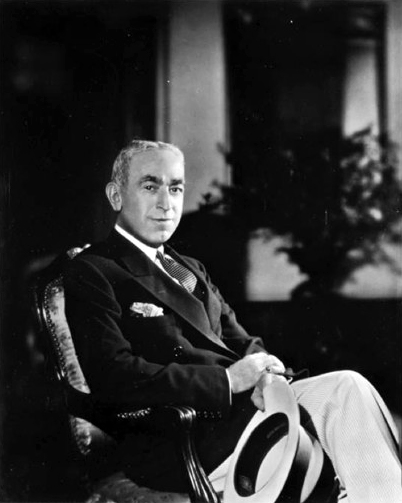
Dr. Maurice Kahn in the 1920s or 1930s. [293]
Dr. Maurice Kahn. (Leadville, Colorado: Temple Israel Foundation; Temple Israel Collection). 2021.
On December 23, 1898, Isaac published the first notice of closure of his grocery store. As mentioned earlier, the store was controlled by Henrietta Kahn and managed by other relatives for much of the 1890s. After nearly two decades of owning and operating the business, the death of his wife and other circumstances probably convinced him to sell and close the store for good. [294] However, according to city directories, Isaac continued living in the house attached to the grocery at 506 East 6th Street for several years.
Dr. Lee treated the victim of an assault on December 27. The master mechanic of the Ibex mining company was attacked by two laborers who beat him with lead pipes and fists. He was brought down to his Leadville residence at the Delaware Block and placed under Dr. Lee’s care. The mechanic’s wounds were considered relatively severe. [295]
The New Year of 1899 passed quietly. Newspapers did not mention Dr. Lee, Ruth W., Isaac, or other members of his family other than the grocery closing-out sale. At the end of January, another disease outbreak engendered controversy among Leadville’s doctors. On January 28, city officials received a report of smallpox. Fearing an outbreak, a vaccination program was implemented as well as the construction of a “pest house” to quarantine victims. Dr. Lee and Dr. Ballin were the primary doctors assigned to the vaccination program, according to the report. [296]
Grim headlines heralded the February 26, 1899, issue of The Herald Democrat. Dr. Lee experienced an “obstruction of the bowels” and underwent an operation to remove it. His father Isaac, Ruth W. and family members were there to wish him well on the risky emergency procedure. The reporter, as well as many Leadville surgeons, were optimistic he would survive. Dr. Maurice got a telegram about the operation in Boston and immediately left for Leadville. But Dr. Lee did not recover. He passed away at 7:25 a.m. on February 27 at the age of 32:
DIED AT DAYBREAK
Dr. Lee Kahn Succumbed to Saturday’s Operation
Dr. Lee Kahn died at his room in the old post office building at 7:25 a. m. Sunday.
For three weeks previous he had been feeling badly but continued to his practice regularly until last Thursday morning when he was so ill as to be unable to leave his bed. Drs. A. J. McDonald and Jeannotte were called in and on Friday Dr. Ballin entered the case. Dr. McDonald and Dr. Kahn himself had already diagnosed the case as being obstruction of the bowels, and Dr. Ballin concurred in and confirmed the diagnosis. Everything known to the profession was done for him in the succeeding forty-eight hours, and meanwhile nearly every physician in the city had seen him in obedience to the professional and social solitude inspired by the case. Dr. Kahn followed the practice of his attendant physicians in his case with intelligent interest and when they had exhausted every resource short of operation he urged the latter himself as a last resort while at the same time expressing his belief of a fatal termination.
At 4 p. m. Saturday the operation was performed, the conditions found verified the diagnosis and the obstruction was removed. Dr. Kahn rallied nicely from the opiates and appeared to be doing excellently until about 11 o’ clock the same night when there was a relapse and it was recognized that recovery was impossible. He was entirely conscious to the last, thanked his physicians for their efforts on his behalf and passed quietly away after affectionate adieus to his afflicted wife and friends who surrounded the couch of the dying man.
Dr. Lee Kahn was born in Morrison, ILL., July 19, 1867 and was therefore in his thirty-second year. He came to Leadville with his parents in 1879, attended our public schools for six years, and then went to Rush College to study medicine, graduating in 1889. He entered upon the practice of his profession in this city, marrying Miss Ruth Ward in May, 1890, and has at all times been prominent in his profession as well as in social circles. He was examiner for United States pensions for five years past, as well as examiner for several local insurance and beneficiary associations. At the last meeting of the National Medical association he was elected as one of the secretaries of that body and had already engaged rooms in connection with attendance at its annual meeting in May next. He also contemplated a European trip for which he had engaged bertha to sail on July 1.
His wife, his aged father, Mr. I. Kahn of 506 East Sixth and two brothers survive Dr. Lee Kahn: One of the latter, Maurice, was telegraphed for and is now on his way from Boston and expected to reach here on Tuesday. Interment will be deferred pending his return.
Death has lain his cold hand heavily upon this family during the recent past. Only thirteen months ago Dr. Lee’s little son was taken, a bright and lively child, in whom the affections of his parents and grandparents were warmly entwined. Mrs. I. [Mina] Kahn, the doctor’s mother, died in December. His own death completes a chain of loss in three generations that falls heavily upon the family and that invited the deepest sympathy from the entire community.
[297]
Dr. Lee’s funeral took place during a blizzard on the afternoon of March 1, 1899. The winter of 1898-1899 would be remembered for heavy snow and raging blizzards; snowfall records remain unbroken to this day. The fact that Dr. Lee died and was buried during such a natural event was probably a surreal circumstance for the young doctor’s family:
LAID TO REST
___
Burial of Dr. Lee Kahn With Impressive Ceremonies.
___
The funeral of the late Dr. Lee Kahn occurred yesterday afternoon from Temple Israel. Despite the fearful storm that was raging at the time a great many people called to view the remains which were lying in state during the afternoon at the residence of the deceased, while crowds of people wended their way to the temple to pay their last respects to one whose friends were countless. The edifice was crowded to suffocation and hundreds of people were unable to gain admission.
The services at the temple were brief, but very impressive and rendered more beautiful by the touching choral demonstration. The service was conducted by Mr. Adolph Shayer. The floral offerings were very numerous and handsome and included a number of set pieces from different lodges to which deceased belonged and a “Gates Ajar” from the Leadville Medical society. The different lodges of which deceased was a member were largely represented as was also the medical fraternity of the city. The pallbearers were Dr. Ballin, Dr. Law, Dr. Galloway, Dr. McLean, Dr. Whitmore, and Dr. A.J. McDonald.
The choir was composed of Mrs. Geo. E. Taylor, soprano; Miss Laura Lancaster, alt;, and John R. Lea, tenor; under the direction of Judge William H. Nash, organist. They rendered the following selections: Hymn, “Nearer My God to Thee,” choir. Solo, Miss Hattie Cohn, “Flee as a Bird to Yon Mountain.” Duet, Mrs. Taylor and Mr. Lead, “O Morning Land.” Solo, Mrs Taylor, “Beyond the Smiling and the Weeping.”
Arrangements had been made in advance for digging out the road to the cemetery and as a result the large funeral cortege was able to escort the remains to their final resting place.
To the wife, the father, and two brothers of the deceased as well as to the other relatives of the family all of whom are so well known here the sympathy of the community is extended in this hour of their sad affliction. Of the deceased naught but kind words are spoken. He was a Leadville boy in every sense of the word as he has spent the greater part of his life in this city. He ever had a kind word for everyone and that his friends are legion is demonstrated in the universal expression of sorrow over his sudden demise. [298]
Ruth W. was devastated. Her son, mother-in-law and husband died within the course of one year. A poem entitled In Joaquin’s Eyes was published in mid-March and noted the final publication by Ruth Ward Kahn in a Leadville newspaper. [299] Her movements after 1900 are vague, but it’s clear that she departed for Europe in late May. The Herald Democrat reported at the end of May, “Mrs. Ruth Ward Kahn sails May 26 for Holland, steamer Amsterdam, for a trip through Germany and France. She will spend the winter in Madrid, Spain.” Ruth W. applied for a passport in Denver on May 24, 1899, and claimed she would return “within 2 years” from her travels in Europe. [300] Ruth W. submitted poems to newspapers from Europe throughout 1899 and 1900, including one submission to a Grand Junction newspaper in the winter of 1900. [301] A popularly circulated poem entitled Compensation was published in the New York Times in February of 1900. [302] The first stanza read:
Better to mourn our dead
Than never know how sweet
The lisping words of child
Or the patter of little feet
Better to mourn I say
Than never to know the care
Of tender trusting souls
That God Himself sent there [303]
Later biographies and existing documentation are missing for Ruth W.’s life after 1901, and her death location and later life events are unknown. She did not appear in the 1900 census, but curiously appeared in a 1901 Newark, New Jersey city directory as a “poetess” living at 57 Liberty. [304] The last documented trace of her was a re-print of Compensation in The Buffalo Enquirer in August of 1901. [305] In contrast to her vivid, energetic and productive life in Leadville, Ruth W.’s sudden disappearance may have stemmed from the losses she suffered during her years in the Carbonate City. As advances in document access improve, information may shed light on the remainder of Ruth W.’s life, her burial place, and later movements. Perhaps she changed her name and married again. Given proper documentation, we could follow her trail. For now, her later life remains an enigma, and her poems and life in Leadville are the only evidence of her amazing contributions to the history of the city.
As Lee and Ruth Ward Kahn’s story in Leadville concludes, Maurice takes up in his brother’s stead. On March 8, 1899, The Herald Democrat published the basic distributions from Dr. Lee’s will in a probate notice:
The Kahn Will Filed For Probate.
The will of the late Dr. Lee Kahn was admitted to probate in the county court yesterday afternoon. There were present the witnesses of the signing of the will, and also those left beneficiaries. By the terms of the will Jacob A. Kahn [306] is named as executer. To Maurice Kahn is left the medical library and also the surgical instruments, together with $1,000 in cash.
Dr. Kahn’s portion of the estate left him by his mother, is left in turn to be divided equally between his brothers Maurice and Herman Kahn. The residue and balance of all his property is left to his wife Ruth Ward Kahn. [307]
On March 23, 1899, Dr. Maurice Kahn published a short notice stating that he had taken over his brother Lee’s medical practice at 501 Harrison Avenue, Rooms 9 and 10. Dr. Maurice assumed the responsibilities of Dr. Lee, both professionally and socially, quickly after his brother’s death. One of Dr. Maurice’s first patients was Fred Bollman, who fractured his skull in an ax fight in late May. [308] Similar to Dr. Lee, Dr. Maurice treated many common and atypical injuries during his medical tenure in Leadville. In mid-September 1899, Dr. Maurice was called to a children’s orphanage on East 5th Street following a report that one of the children was eating glass. Upon Dr. Maurice’s arrival, a seven-year-old boy demonstrated to the doctor and an assembled crowd how he chewed on a piece of window glass. Several other boys attempted the same but failed. Dr. Maurice, while obviously concerned for the boy’s health, harbored doubts that he actually swallowed any of the material. The manager of the orphanage said the boy had suffered stomach cramps, which passed quickly. Dr. Maurice concluded that the boy did not swallow the glass, but simply chewed it and created the illusion of eating it. Later, the boy admitted he had seen a circus freak perform the stunt and had learned to replicate it. [309]
After Isaac closed his grocery store, Herman Kahn signed on as a clerk for the Colorado Southern Railroad but never appeared in newspapers as frequently as his brother Maurice. [310] In October, a horse threw Isaac from his cart as he was crossing a railroad track near Evergreen Cemetery. The report read that a train suddenly turned a corner and frightened Isaac’s horse, which bolted. Isaac fell from the cart, fractured several ribs, and Dr. Maurice treated his father’s wounds. [311] Several days later, Dr. Maurice cared for County Judge Parker’s gunshot wounds for several weeks. Although the judge was unable to speak, Dr. Maurice surmised that he suffered less when resting in an upright position due to breathing issues related to asthma. [312] Dr. Maurice was undoubtedly a perceptive doctor.
Throughout the remainder of 1899 and early 1900, Dr. Maurice responded to a myriad of conditions ranging from gunshot wounds to mine accidents while overseeing the condition of the judge and his father Isaac. Like his brother, Dr. Maurice treated victims of amputations, falls, explosions, and domestic fights. At some point in 1899, Dr. Maurice was either appointed or elected as Lake county physician, a position he held through 1900 and was passed to his cousin, Dr. Solomon Guthman Kahn. [313] In August, Dr. Maurice’s younger brother Herman, resigned his job as a Colorado & Southern Railroad ticket agent and took a job at a local coal distribution company. [314] The 1900 census surveyed Isaac’s household at 506 East 6th Street during the early summer. Residents confirmed the following occupants: Isaac, a sixty-three-year-old grocer, Herman E. Kahn, a 17-year-old student, and a 40-year-old Canadian servant named Elizabeth Churchfield. [315] Dr. Maurice earned $100 fairly regularly throughout the year, which was his monthly stipend as the county physician. [316] In late October, Isaac suffered another accident while driving his cart. His horse was startled by a wild dog on Harrison Avenue and 3rd Street and ran over a large pile of dirt. Isaac was thrown from his cart and knocked unconscious. A nearby shopkeeper took Isaac into her parlor and revived him. Dr. Maurice arrived later and brought his father to his residence on East 6th Street. [317] Dr. Maurice earned payment as county physician until February 1901; by April, his cousin Dr. Sol Kahn was again appointed to the position. [318]
Dr. Maurice continued practicing medicine out of Lee’s old office at the Post Office Block during the summer of 1901 into 1902. [319] Unlike previous years, the movements and everyday lives of Herman, Isaac, and Dr. Maurice are rather shrouded at this time. Herman probably graduated from high school during the early spring of 1902, and by September began studying dentistry in Boston at Harvard University. [320]
In early 1903, Isaac married a woman named Phillipina Hoefeld in Chicago; they returned to Leadville in late March. [321] In late June, Herman came home for the summer break from his studies at Harvard. [322] At the end of the summer in 1903, Leadville doctors, including Dr. Maurice, hosted a visiting group of Denver physicians. The Lake County Medical Association hosted a banquet for the group at the Hotel Vendome. Despite his connections in the Cloud City, Maurice relocated to Denver in mid-November 1903. [324] It turned out to be a brief absence and soon he was back in Leadville. In 1904, Isaac left his home at the grocery store at 506 East 6th Street and moved to a house at 222 East 9th Street. [325] Dr. Maurice visited Leadville regularly over the summer of 1904 and returned permanently by September.
Dr. Maurice, as did his brother Lee, married a non-Jewish woman. His bride was named Gertrude Berryman and her family was also in the medical profession. A closer look at the family into which he married shows that the Berrymans were Presbyterians and spent their first years in the Front Range mining camp of Silver Plume, where children Gertrude and Charles were born in 1883 and 1884 respectively. James Berryman was an immigrant from England, and his wife Hattie was born in Wisconsin. They came to Leadville with Gertrude and Charles at the end of 1886. Between 1887 and 1899, James Berryman was employed as a miner, bartender and teamster around the bustling city of Leadville.
Due to James’ job transitions and income, the family often moved around the city. In February of 1899 (the same month Dr. Lee Kahn passed away), Gertrude’s mother Hattie was elected superintendent of the Lake County Hospital, first known as the “Poor House,” located at 419 Elm Street. As was common at the time, the hospital also became their residence. [328] Gertrude and Charles probably participated in and witnessed many of the duties their parents performed at the hospital between 1899 and 1905. It is likely that Maurice met Gertrude while he worked at the hospital.
The Berrymans oversaw the County Hospital until January of 1905. [329] James and Hattie moved to 500 West 8th Street and operated a dairy farm there for the remainder of the year. [330] James died in 1911 and Hattie took over the coal supply company James founded. Hattie retired from business in 1912 and moved from Leadville soon after with a new husband.
Gertrude and Dr. Maurice probably met in late June of 1905. The Herald Democrat on June 26, 1905 elaborated, “Mr. and Mrs. I. Kahn, Dr. Maurice Kahn and Miss Berryman (Gertrude) spent yesterday on an outing three miles up the Arkansas River.” [331]
On August 19, 1905, Colorado Governor Jesse Fuller McDonald appointed Dr. Maurice to the rank of captain, and promoted him to Assistant Surgeon of the state militia. [332] He and Gertrude would continue their courtship through 1905. At the end of December, they attended a dinner at the Hunter residence together and Maurice hosted a card night that Gertrude attended. [333] In addition to his social successes, Dr. Maurice was listed among the doctors who had served St. Vincent Hospital during 1905, indicating he was no longer based out of his brother’s office at 501 Harrison Avenue. [334] Though few Jews in Leadville directly engaged in mining, during the summer of 1905 Isaac began a short-lived mining venture on French Mountain and planned to prospect an existing tunnel on his Gold King claim. The property was noted to have once been quite prosperous. [335]
In August of 1905, Dr. Maurice was appointed by Governor McDonald as a captain and assistant surgeon in the state militia. [336] A few weeks later, yet another runaway accident injured Isaac. Dr. Maurice took him from the accident site on Harrison Avenue to rest at his house on East 9th Street. [337] On Thursday, October 5, 1905, Maurice addressed the Colorado State Medical Society on the subject of “Compound Fracture of the Vault with Loss of Brain Tissue” during the organization’s annual state meeting held in Colorado Springs. [338]
At the end of 1905, Isaac departed for a long trip to “the east” and Dr. Maurice finally sold the family grocery store on East 6th Street on December 13, 1905. Andrew Meyer, a German immigrant and butcher, purchased the store and houses for $200. [339] As we saw earlier in this study, Meyer’s name remained on the building until the 1940s and probably endured until the building’s demise in the mid-20th mid-century. By the time the store was sold, Isaac had possessed the building in some capacity for 26 years. The Kahn patriarch probably built the edifice in late 1879, cementing its family history up to that point. The final year in which Isaac appeared in a Leadville City directory was 1905 [340] and he moved to Chicago in 1909. [341]
Gertrude and Dr. Maurice married in January of 1907. The ceremony took place at Temple Israel and the attendees were limited only to those who purchased tickets, suggesting their popularity and solid reputation in Leadville. The notice for their wedding was titled: Two Well Known Young People of City Happily United Last Evening. The ceremony was performed by Judge Cavender and Adolph Schayer supervised the religious component. The ceremony was filled with music. An orchestra played Schubert’s serenade, Mendelsohn’s Wedding March, and the Bridal Chorus from Lohengrin. The couple hosted a reception at their residence at 815 Harrison Avenue that evening, and went to Colorado Springs, St. Louis, and Kansas City for their wedding trip. [342] A week before the wedding, Maurice relocated his office and residence to 815 Harrison Avenue. [343]
After 30 years in Colorado, Isaac moved to Chicago in 1909. He was affectionately listed as part of the rugged group who were later known as “79ers,” pioneers of early Leadville. While he made several visits to Leadville, he never returned permanently. [344] His second wife, Philippina, died in 1913, and he married for a third time in 1914. In September of 1915, the venerable patriarch breathed his last and passed away in that city. [345]
Dr. Maurice conducted a thriving medical practice in Leadville throughout the late 1900s and early 1910s. According to the 1910 United States Census, Gertrude and Dr. Maurice did not have children and lived alone at 815 Harrison Avenue. However, similar to other successful families before the advent of household appliances, the Kahns employed a domestic servant. 22-year-old Hannah McHale. [346]
According to a 1913 newspaper report, Maurice and Gertrude had been away from Leadville since December 12, 1912. Dr. Maurice had experienced a “nervous breakdown” while in Chicago and was confined to a hospital for some weeks. In the middle of January, Gertrude and Dr. Maurice stopped for a short time in Leadville before going on to California to speed Dr. Maurice’s recovery. [347] They returned in late March of 1913. [348] Throughout the rest of the year, Dr. Maurice traveled to Denver, Glenwood Springs, Chicago, and “the east” including Washington D.C. His practice was still listed in the Leadville city directory during 1913 [349] and 1914 [350] despite his absences.
Social columns throughout 1914 chronicle Dr. Maurice’s visits to Denver and other cities. In January of 1914, Dr. Maurice published a lengthy essay in The Herald Democrat on the subject of the risks and benefits of surgery. Even in the early 20th century, surgery was still eyed with suspicion. Dr. Maurice addressed these fears with reasoned professionalism in his January 1, 1914, contribution to The Herald Democrat newspaper:
Header of an article in The Herald Democrat by Maurice Kahn titled Operations on Thursday, January 1, 1914. [351]
Operations. (Leadville, Colorado: The Herald Democrat). Thursday, January 1, 1914. Page 19.
Surgical failure is, in many cases, a result of the lack of appreciation of what surgery can accomplish. Be it known, that in no other branch of the curative art is success so marked. Could we approximate but within shooting range of the success achieved by surgery, in so-called medical diseases and physicians would go wild with joy. Take for example, so mild a disease as measles, which, when occurring in an adult is considered by many a joke and exposes the patient to ridicule, has a mortality rate that would appall a surgeon should his timely operated appendix cases show a similar percentage of deaths. To be sure, every surgeon loses some late operated cases of appendicitis, but taken early, that is within the first few hours of an attack, and a good surgeon would probably not lose one case in five hundred. But the last cases, the neglected cases, those presenting complications, are the ones which swell the mortality rate and outrage the reputation of appendicitis operations. These should not be classified as appendicitis, but should be grouped under the compilation linking procrastination to failure. Fortunately the education of some to a relaxing sense of the dangers of delay and the safety reposing in early and timely operative interference, has reduced the number of late cases coming to the operating room, with a corresponding increase in favorable results; but far too many deaths are still due to the time lost in overcoming fear or dread of the operation.
Many there are who fear operations, some going to a senseless extreme, as in the following case: A man who had suffered for years from stomach trouble of a significant type, clearly a case of ulcer, was taken with sudden, excruciating pain in the abdomen accompanied by other symptoms. A surgeon was called, made a diagnosis of perforation, advised immediate operation, stating that this means alone could life be saved. The wife replied, “You know, doctor, we abhor operations and do not believe in them.” All influence that could with reason be brought to bear was futile, and they both remained firm in their refusal to give consent to operation. About three hours prior to death, the wife, self-accusing and regretful, asked that her husband be operated. Of course it was too late to even hope to accomplish any benefit; death was riding space and already reaching for its victim. But think of the odium attaching to surgery had the surgeon acceded to the importunities of the inconsolable wife with her prejudiced mind, who learned too late and at what terrible cost, the havoc her inflexible bias wrought. Similar cases can be cited by the hour by every surgeon the world over. Happily, such prepossession is gradually yielding to a more enlightened state, but too slowly for the welfare of the present generation. Few perhaps, would not be so radical as to say they did “not believe in surgery,” yet there are too many who have an inordinate fear of operations, tho these are to be found chiefly among those who are unfamiliar with the almost perfect technique of present day operating.
Those most familiar with operations and their results are of course, the surgeons themselves. How do they feel about operations when applied personally? This is best answered by citing an enlightening case. Recently, a very good friend of mine, a surgeon of rare skill, had been operating all morning. Toward the late afternoon he felt pain, characteristic of appendix trouble, and within each hour, as soon as a colleague could reach the hospital, he was on the table undergoing the same operation he himself had so many thousand times performed. Why did he desire to be operated on with such precipitate haste? Because his vast experience had taught him as it does every surgeon, that the length of time intervening between the onset of appendicitis and the operation is in inverse proportion to the chances of recovery; hence, he was disinclined to assume a single unnecessary hazard, not even waiting for his devoted wife to reach him which would delayed the operation only two hours. This and many similar hasty operations performed on surgeons and members of their families indicate unerringly that they, the ones best informed on the subject, are the very ones who most promptly submit to operation when such procedure is indicated; in some cases actually demanding it.
It is regrettable that the laity does not realize the fact that safety in all surgical conditions reposes in prompt and early operation. For illustration take cancer itself, the most dreaded perhaps of all surgical affections. Let a surgeon have all these cases at the very beginning of the disease, and instead of a high death rate which is now common to all clinics, the mortality rate will fall so rapidly that no other argument will be required, if ever a defense were needed for surgical intervention. At the present time the chief active factor preventing surgeons from having these cases at their incipiency is the failure of the public to appreciate the importance of certain early signs of this disease; they disregard the small nodule appearing in the breast because it causes no pain, not even discomfort; the “cold sore” on the lip which refuses to heal and is painless can not possible be anything serious, they think. “I have had many just like this one, except that this is a bit rebellious to treatment; tho maybe I have not given it sufficient care.” So do people delude themselves until the favorable time for surgical procedure has passed and the almost hopeless late stage of the disease is well advanced. Or consider for instance, a case of ulcer of the stomach (commonly designated “sour stomach,” “dyspepsia,” “indigestion,” “stomach trouble,” and the like), which has resisted all medical and remedial measures for months or even years. Surgery offers not only the means of curing the ulcer and relieving the patient of the distressing symptoms of this condition, but further relieves him of subsequent liability of cancer. I wonder if so many cases of stomach ulcer would persist in refusing operation at a safe period if they knew that over seventy per cent of cancers of the stomach develop from ulcer of that organ? This lack of understanding of surgical conditions in general is not the fault of the medical profession. They have striven hard and long, early and late, in school and out, endeavoring to educate the public, and be it said to the credit of the public, some are learning to observe important indications of disease; but many, lo, too many are still indifferent or too skeptical regarding the truth of a surgeon’s statements, too often assuming that his desire to operate is actuated by sordid motives rather than by philanthropic instincts. However, the people are learning, and when they fully realize that danger and death are making merry and dance with glee over the delayed and tardy cases, then will surgery indeed surprise the world with the wonders of its successful achievement.
Many of the uninformed think the surgeon has an actual affinity for operating merely for the fun of it, and probably every surgeon has been designated a “butcher” by those thoughtless individuals who unwarrantably assume that he operates solely for the pleasure of “cutting up some one:” in this connection I recall an incident that came to my notice not long ago. A surgeon advised a young woman to enter the hospital where she might receive better care than was possible in her own home, and also permit more accurate observation of the case by those trained for the purpose. Upon telling a friend of the doctor’s advise, the friend promptly replied, “Don’t you go to the hospital under any circumstance; if you go to sleep up there, Dr. Blank will have half of your insides cut out by the time you wake up;” thus implying that the doctor’s desire to operate would prompt him to even steal an operation if consent thereto could not be obtained. As is well known the law effectually protects all against any such ridiculous procedure; and furthermore, I believe no surgeon, properly styled, ever willfully subjected anyone to an unnecessary operation.
Certainly every surgeon is fond of his profession, otherwise he would not be a good operator, for the same law governs such work as governs all work. No man ever attained eminence in any line of work he disliked. Excellence in any art means love of that art, and this is as true of the art of surgery as it is of the art of sculpture. But love of surgery implies love of mankind and connotes a watchful care for the protection of, and not a disregard for human life. The surgeon who is pleased to operate relishes not so much the operating itself, but does delight to see health restored as a consequence of his skill; loves to see the roses return to the wan cheek of the long suffering mother, that she may give the maternal care to her dependent children; loves to see the strength return to the distracted father, that he may give the much needed support to his family; loves to see the returning bloom of health to an only child, the comfort and joy of adoring parents; these are the things that make a surgeon’s heart beat with gladness for the joy and comfort that he has brought to others.
The patient’s lack of confidence in the surgeon is trust of the correctness of the diagnosis, hence, doubt as to the necessity of operation with its consequent postponement, often sacrifices life which prompt interference would rescue. Unless a patient has the degree of confidence in the surgeon’s ability to abide by his advise regardless of his own fears or opinions, then there is no justification for interviewing that surgeon. To consult a surgeon should presuppose an absolute faith in his diagnostic acumen, an unswerving trust in his discernment and an unwavering trust in his discernment and an unwavering reliance in his skill to perform whatever his judgment determines. Less than this should preclude consultation.
Surgical failures can in most cases be eliminated by the wise conduct of patients themselves. Give surgery a “fair field and no favors” and following every tournament she will be found at the stand wearing the laurel crown of victory. To accomplish this, however, surgery should be enlisted early in the disease, prior to the development of irremediable complications, for surgical success often depends on early operative procedure. It may be said that practically every so-called surgical disease is curable; that is to say, there is a time in every surgical case when a cure is possible; very early in some, whereas others will permit of considerable delay. However, the deduction is clear, that no one not qualified by special training, and least of all the patient, should lightly assume the responsibility of delaying an operation, knowing that when surgery does fail it is found almost always attributable to delay.
In March of 1915, Dr. Maurice and Gertrude left Leadville. A farewell party took place in the middle of March and concluded with a chorus of Auld Lang Syne. [352] Dr. Maurice and Gertrude lived in Los Angeles until their deaths in 1950 and 1953 respectively. [353]
Between 1879 and 1914, Isaac and Mina Kahn and their sons profoundly influenced Leadville. Their story is a compelling one. From grocers to doctors, Lee, Maurice, Herman, and Jacob and their wives served their city and lived active lives. From the frenetic days of ’79 through the troubles of the 1890s and the uncertainty leading up to the First World War, few families impacted the early society of Leadville more than the Kahns.
[See the rest of the footnotes on the other respective pages or a complete list with the bibliography.]
34 Michael Harrington. Find A Grave. [database and images]. Memorial Page for Isaac Kahn (18 Jul 1836–26 Sep 1916). [Find A Grave Memorial no. 18472229]. (Leadville, Lake County, Colorado, USA: Hebrew Cemetery). 2019.
35 Sale Of Lode Claims. Leadville, CO: Herald Democrat. July 10, 1901. P7.
36 Ancestry.com. Illinois, Marriage Index, 1860-1920. [database on-line]. Provo, UT, USA: Ancestry.com Operations, Inc., 2015.Original data: Illinois State Marriage Records. Online index. Illinois State Public Record Offices.
37 Harrington, Michael. [database and images]. Memorial Page for Dr Lee Kahn (19 Jul 1867–26 Feb 1899). [Find A Grave Memorial no. 18472239]. Leadville, CO: Hebrew Cemetery.
38 Find A Grave. [database and images]. Memorial Page for Herman E Kahn (1883–5 Mar 1952). Find A Grave Memorial no. 122431615, citing Fairmount Cemetery, Denver, Denver County, Colorado, USA. 2019.
39 Passed to Rest. Leadville, CO: Herald Democrat. November 17, 1889. P6.
40 Year: 1920; Census Place: Denver, Denver, Colorado; Roll: T625_162; Page: 1B; Enumeration District: 265.
41 Ancestry.com. Illinois, Deaths and Stillbirths Index, 1916-1947 [database on-line]. Provo, UT.
42 Year: 1870; Census Place: Mount Pleasant, Whiteside, Illinois; Roll: M593_290; Page: 203B. [Family History Library Film: 545789].
43 Year: 1900; Census Place: Leadville, Lake, Colorado. Page: 1; Enumeration District: 0049; FHL microfilm: 1240125.
44 Rocky Mountain Photo Company. Leadville From the East. [Image] (Denver, Colorado: Western History Collection, Denver Public Library). 2021.
45 Hotel Arrivals. (Leadville, CO: Leadville Daily Evening Chronicle). February 17, 1879. P3.
46 Clark, Root and Anderson. Denver, CO. 1879. P88.
47 Augustus Koch. 1879 Birdseye View of Leadville. (Washington, D.C.: Library of Congress). 1879.
48 Frights on the Road. (Leadville, CO: Leadville Daily Evening Chronicle). April 26, 1879. P4.
49 Sanborn Fire Insurance Map from Leadville, (Lake County, Colorado. Sanborn Map Company). 1883.
50 Lenten Pleasures. (Leadville, CO: Leadville Weekly Democrat). February 28, 1880. P5.
51 Transfers. (Leadville, CO: Leadville Weekly Herald). December 25, 1880. P3.
52 Marion Post Wolcott. 1941.
53 To Quit Business. (Leadville, CO: Herald Democrat). January 5, 1899. P8.
54 Lake County, US Census Index For 1860, 1870 And 1880. (Historical Research Cooperative. Leadville, CO; USA). 1985.
55 Corbett and Ballenger. Leadville, CO; USA. 1882. P312.
56 Corbett and Ballenger. Denver, CO; USA. 1880. Pp. 209 & 344.
57 Corbett and Ballenger. Leadville, CO; USA. 1883. P163.
58 Corbett and Ballenger. Leadville, CO; USA. 1884. P150.
59 Corbett and Ballenger. Leadville, CO. 1886. P155.
60 National Archives and Records Administration (NARA); Washington, D.C.; Consolidated Lists of Civil War Draft Registration Records (Provost Marshal General's Bureau; Consolidated Enrollment Lists, 1863-1865); Record Group: 110, Records of the Provost Marshal General's Bureau (Civil War); Collection Name: Consolidated Enrollment Lists, 1863-1865 (Civil War Union Draft Records); NAI: 4213514; Archive Volume Number: 7 of 7
61 Ancestry.com. Illinois, Deaths and Stillbirths Index, 1916-1947. [database on-line]. Provo, UT.
62 Hebrew Ladies Benevolent Association. (Leadville, CO: Carbonate Chronicle, January 20, 1883). P5.
63 Purim. (Leadville, CO: Leadville Daily Herald). March 23, 1883. P4.
64 St. Patrick’s Eve. (Leadville, CO: Carbonate Chronicle). March 24, 1883 P7.
65 Odd Fellow’s Anniversary Ball. (Leadville, CO: Carbonate Chronicle). April 28, 1883. P1.
66 Social Salad. (Leadville, CO: Carbonate Chronicle). May 19, 1883. P1.
67 Eastern Star Sociable. (Leadville, CO: Carbonate Chronicle). December 1, 1883. P12.
68 Personal Points. (Leadville, CO: Leadville Daily Herald). December 23, 1883. P11.
69 Bal Masque. (Leadville, CO: Carbonate Chronicle). February 23, 1884. P4.
70 Jewish Festival. (Leadville, CO: Leadville Daily Herald). March 12, 1884. P4.
71 Night School. (Leadville, CO: Leadville Daily Herald). February 3, 1884. P1.
72 Corbett and Ballenger. Leadville, CO; USA. 1884. P150.
73 Chamber of Commerce. (Leadville, CO: Carbonate Chronicle). June 7, 1884. P1.
74 The Hebrew Festival. (Leadville CO: Leadville Daily Herald). June 13, 1884. P4.
75 Corbett and Ballenger. Leadville, CO. 1885. P149.
76 Last Sad Rites. (Leadville CO: Carbonate Chronicle). October 10, 1885. P4.
77 Central School. (Leadville, CO: Leadville Daily Evening Chronicle). February 20, 1886. P4.
78 Piano and Organ Lessons. (Leadville, CO: Herald Democrat). February 20, 1886. P4.
79 Corbett and Ballenger. Leadville, CO. 1885. P149.
80 Central School. (Leadville, CO: Leadville Daily Evening Chronicle). March 17, 1886. P4.
81 Corbett and Ballenger. Leadville, CO. 1886. P155.
82 For more information on David May and his family, please visit: http://jewishleadville.org/may.html
83 For more information on the Monheimer family, please visit: http://jewishleadville.org/monheimer.html
84 For more information on the Berheimer family, please visit: http://jewishleadville.org/bernheimer.html
85 For more information on the Mooney family, please visit: http://jewishleadville.org/mooney.html
86 Noted Silver Wedding. (Leadville, CO: Herald Democrat). May 25, 1886. P2.
87 Festival and Hop. (Leadville, CO: Leadville Daily Evening Chronicle). June 10, 1886. P3.
88 The Third Hall in Use. (Leadville, CO: Herald Democrat). December 2, 1886. P4.
89 Surprise Party. (Leadville, CO: Leadville Daily Evening Chronicle). March 12, 1888. P2.
90 Personal. (Leadville, CO: Leadville Daily Evening Chronicle). August 31, 1888. P4.
91 The Schools Close. (Leadville, CO: Leadville Daily Evening Chronicle. April 28, 1888. P2.
92 His Skull Fractured. (Leadville CO: Leadville Daily Evening Chronicle). December 13, 1888. P3.
93 Trepanning is a method of relieving pressure on the brain by drilling a hole in the skull. The practice has been used since ancient times for medical applications.
94 Young Kahn Better. (Leadville, CO: Leadville Daily Evening Chronicle). December 17, 1888. P4.
95 Birthday Party. (Leadville, CO: Leadville Daily Evening Chronicle). February 1, 1889. P3.
96 Personal. (Leadville, CO: Leadville Daily Evening Chronicle). March 2, 1889. P3.
97 Ballenger and Richards. Leadville, CO; USA. 1899. P275.
98 A Pleasant Occasion. (Leadville, CO: Leadville Daily Evening Chronicle). March 5, 1889. P2.
99 For more information on the Hyman family, please visit: http://jewishleadville.org/hyman.html
100 For more information on the Heimberger family, please visit: http://jewishleadville.org/heimberger.html
101 For more information on the Schloss family, please visit: http://jewishleadville.org/schloss.html
102 For more information on the Friedlander family, please visit: http://jewishleadville.org/friedlander.html
103 For more information on the Simon family, please visit: http://jewishleadville.org/simon.html
104 Pleasant Party. (Leadville, CO: Carbonate Chronicle). March 25, 1889. P3.
105 Amputated. (Leadville, CO: Carbonate Chronicle). April 29, 1889. P7.
106 Intellectual Baseball. (Leadville, CO: Leadville Daily Evening Chronicle). June 8, 1889. P3.
107 A Broken Arm. (Leadville, CO: Herald Democrat). July 3, 1889. P3.
108 I. Kahn. (Leadville, CO: Herald Democrat). July 14, 1889. P8.
109 I. Kahn. (Leadville, CO: Herald Democrat). December 17, 1889. P5.
110 Mining Lease. (Leadville, CO: Herald Democrat). July 25, 1889. P4.
111 Ballenger and Richards. Leadville, CO. 1890. P182.
112 For more information on the Monheimers see http://jewishleadville.org/monheimer.html
113 Rough on Rats. (Leadville, CO: Leadville Daily Evening Chronicle). August 10, 1889. P4.
114 Class Meeting. (Leadville, CO: Leadville Daily Evening Chronicle). September 9, 1889. P3.
115 The Assembly. (Leadville, CO: Herald Democrat). October 3, 1889. P4.
116 Election of Officers. (Leadville, CO: Leadville Daily Evening Chronicle). October 4, 1889. P1.
117 The Simcha Torah Ball. (Leadville, CO: Carbonate Chronicle). October 28, 1889. P1.
118 Passed to Rest. (Leadville, CO: Herald Democrat). November 17, 1889. P6.
119 Deaths and Burials. (Leadville, CO: Leadville Daily Evening Chronicle). November 19, 1889. P4.
120 Personal Mention. (Leadville, CO: Leadville Daily Evening Chronicle). November 27, 1889. P4.
121 Positive Facts. (Leadville CO: Carbonate Chronicle). December 2, 1889. P4.
122 Resolutions Of Condolence. (Leadville, CO: Herald Democrat). December 11, 1889. P2.
123 Resolutions Of Condolence. (Leadville, CO: Herald Democrat). December 11, 1889. P2.
124 Pleasantly Remembered. (Leadville, CO: Herald Democrat). January 7, 1890. P4.
125 Personal Mention. (Leadville, CO: Herald Democrat). January 21, 1890. P4.
126 Leadville References. (Leadville, CO: Herald Democrat). February 8, 1890. P5.
127 A New Dancing Club. (Leadville, CO: Herald Democrat). March 21, 1890. P8.
128 The Iron Was Hot. (Leadville, CO: Herald Democrat). March 25, 1890. P8.
129 Mining and Real Estate. (Leadville, CO: Herald Democrat). April 16, 1890. P5.
130 A Saw Mill Sensation. (Leadville, CO: Herald Democrat). April 27, 1890. P8.
131 Ballenger and Richards. Leadville, CO. 1890. P154.
132 Elizabeth Willard Frances. A Woman of the Century; Fourteen Hundred-Seventy Biographical Sketches Accompanied by Portraits of Leading American Women in all Walks of Life. (Buffalo, NY: Moulton). 1893. P428.
133 In the Social World. (Leadville, CO: Herald Democrat). December 7, 1890. P5.
134 In The Social World. (Leadville, CO: Leadville Daily Evening Chronicle). December 8, 1890. P4.
135 In The Social World. (Leadville, CO: Herald Democrat). December 7, 1890. P5.
136 Jottings. (Cincinnati, OH: The American Israelite). May 29, 1890. P7.
137 Positive Facts. (Leadville, CO: Herald Democrat). June 7, 1890. P7.
138 A Happy Wedding. (Leadville, CO: Herald Democrat). January 13, 1891. P8.
139 Some People You Know. (Leadville, CO: Herald Democrat). June 15, 1890. P5.
140 Notes. (Cincinnati, OH: The American Israelite). April 2, 1891. P6.
141 Is A Convert to Judaism. (St. Louis, MO: St. Louis Post Dispatch). October 20, 1895. P24.
142 Is A Convert to Judaism. (St. Louis, Mo: St. Louis Post Dispatch). October 20, 1895. P24.
143 Aspen Arrivals. (Leadville, CO: Herald Democrat). April 26, 1890. P1.
144 A Quiet Social Week. (Leadville, CO: Herald Democrat). May 11, 1890. P4.
145 In the Social World. (Leadville, CO: Herald Democrat). December 7, 1890. P5.
146 Is A Convert to Judaism. (St. Louis, MO: St. Louis Post Dispatch). October 20, 1895. P24.
147 A Painful Accident. (Leadville, CO: Herald Democrat). August 2, 1890. P5.
148 New Hay. (Leadville, CO: Herald Democrat). July 20, 1890. P6.
149 Perils of Powder. (Leadville, CO: Leadville Daily Evening Chronicle). August 26, 1890. P2.
150 Meletarian Society. Leadville, CO: Herald Democrat. November 9, 1890. P5.
151 Our Seats of Learning. (Leadville, CO: Herald Democrat). November 19, 1890. P5.
152 In the Social Whirl. (Leadville, CO: Herald Democrat). December 14, 1890. P5.
153 Personal Mention. (Leadville, CO: Herald Democrat). December 28, 1890. P4.
154 Ruth Ward Kahn. (San Francisco, CA: The San Francisco Call). June 28, 1891. P12.
155 With Ancient Rite. (Honolulu, HI: The Hawaiian Gazette). February 10, 1891. P6.
156 For more information on the Schloss family, please visit: http://jewishleadville.org/schloss.html
157 A Happy Wedding. (Leadville, CO: Leadville Daily Evening Chronicle). January 13, 1891. P3.
158 Hotels and Personals. (Leadville, CO: Herald Democrat). January 20, 1891. P5.
159 Expresses Sorrow. (Leadville, CO: Herald Democrat). January 21, 1891. P8.
160 Our Poets. (Cincinnati, OH: The American Israelite). February 12, 1891. P1.
161 A Silver Wedding. (Leadville, CO: Herald Democrat). January 22, 1891. P5.
162 The Club Dance. (Leadville, CO: Herald Democrat). January 24, 1891. P4.
163 Ballenger and Richards. 1890. Provo, UT. 2011. P154.
164 Social and Literary. (Leadville, CO: Herald Democrat). February 18, 1891. P8.
165 The Lively Avenue. (Leadville, CO: Herald Democrat). February 20, 1891. P5.
166 Around Town. (Leadville, CO: Herald Democrat). February 24, 1891. P1.
167 A Gay Week in Society. (Leadville, CO: Herald Democrat). March 15, 1891. P5.
168 Ferry’s Frantic Feats. (Leadville, CO: Herald Democrat). March 26, 1891. P4.
169 Honors to Authoress. (Leadville, CO: Herald Democrat). March 29, 1891. P8.
170 Hotels and Personals. (Leadville, CO: Herald Democrat). March 29, 1891. P4.
171 Memorial Day. (Leadville, CO: Leadville Daily Evening Chronicle). May 30, 1891. P4.
172 Ruth Ward Kahn. Gertrude. [preface]. Chicago, IL: Block Publishing and Printing Co. P8.
173 Preferment. (Leadville, CO: Leadville Daily Evening Chronicle). August 4, 1891. P2.
174 Sheriff’s Sale. (Leadville, CO: Herald Democrat). August 18, 1891. P5.
175 Bought At Sheriff’s Sale. (Leadville, CO: Herald Democrat). August 26, 1891. P5.
176 New Fashions. (Leadville, CO: Herald Democrat). September 6, 1891. P3.
177 Bought At Sheriff’s Sale. Leadville, CO. 1891. P5.
178 Place to Buy Eatables. (Leadville, CO: Herald Democrat). September 6, 1891. P8.
179 Ballenger and Richards. 1892. 2011. P156.
180 Ballenger and Richards. Leadville, CO. 1894. P152.
181 A Rare Chance. (Leadville, CO: Herald Democrat). January 7, 1899. P8.
182 With the Recorder. (Leadville, CO: Herald Democrat). September 12, 1891. P5.
183 Prices Talk. (Leadville, CO: Herald Democrat). October 29, 1891.
184 Ancestry.com. U.S., City Directories, 1822-1995 [database on-line]. Provo, UT, USA: Ancestry.com Operations, Inc., 2011.
185 Fac Simile of the Official Ballot. (Leadville, CO: Herald Democrat). November 1, 1891. P12.
186 The Election In Lake. (Leadville, CO: Herald Democrat). November 4, 1891. P4.
187 Flag Exercises. (Leadville, CO: Herald Democrat). November 5, 1891. P4.
188 Ballenger and Richards. Leadville, CO; USA. 1892. P156.
189 Sewed Him Up. (Leadville, CO: Herald Democrat). February 2, 1892. P4.
190 Buried Under A Slide. (Leadville, CO: Herald Democrat). February 7, 1892. P2.
191 She Took Strychnine. (Leadville Daily Evening Chronicle). February 10, 1892. P4.
192 Dr. Lee Kahn Has Moved. Leadville, CO: Herald Democrat. February 18, 1892. P2.
193 Some Understandings. (Leadville, CO: Leadville Daily Evening Chronicle). March 23, 1892. P2.
194 Brakeman Injured. (Leadville, CO: Leadville Daily Evening Chronicle). April 5, 1892. P2.
195 Some Social Matters. (Leadville, CO: Herald Democrat). June 5, 1892. P5.
196 Irving A Watson. Physicians and Surgeons of America. (New Hampshire). 1896. P646.
197 Christening Ceremonies. (Leadville, CO: Herald Democrat). July 12, 1892. P6
198 Ballenger and Richards. 1892. 2011. P156.
199 For more information on Ben Davies and his family please visit: http://jewishleadville.org/davies.html For more information on Ben Davies, his extramarital affair with Clementine Raabe and subsequent removal as Temple Israel’s cantor, please visit: http://jewishleadville.org/raabedaviesraabeaffair.html
200 For more information on Dr. David Heimberger and his family, please visit: http://jewishleadville.org/heimberger.html
201 Christening Ceremonies. (Leadville, CO: Herald Democrat). July 12, 1892. P6.
202 Broke His Arm. (Leadville, CO: Herald Democrat). July 23, 1892. P3.
203 Terrible Tale of Woe. (Leadville, CO: Herald Democrat). September 11, 1892. P2.
204 Temple of Fame. (Leadville, CO: Herald Democrat). September 27, 1892. P5.
205 An Inhuman Brute. (Leadville, CO: Herald Democrat). November 15, 1892. P4.
206 At Home Party. (Leadville, CO: Herald Democrat). December 18, 1892. P5.
207 County Commissioners. (Leadville, CO: Leadville Daily Evening Chronicle). December 20, 1892. P2.
208 Irving A. Watson. 1896. P646.
209 Warner Takes a Slide. (Leadville, CO: Herald Democrat). January 29, 1893. P8.
210 She Hates Americans. (Leadville, CO: Leadville Daily Evening Chronicle). February 1, 1893. P4.
211 Aldermanic Board. (Leadville, CO: Herald Democrat). May 3, 1893. P8.
212 Society Fluttering’s. (Leadville, CO: Leadville Daily Evening Chronicle). May 5, 1893. P1.
213 Town Tattle. (Leadville, CO: Leadville Daily Evening Chronicle). May 8, 1893. P2.
214 Hit with a Tent Pin. (Leadville, CO: Herald Democrat). May 11, 1893. P8.
215 Berries And Ice Cream. (Leadville, CO: Leadville Daily Evening Chronicle). June 16, 1893. P1.
216 An Attempted Suicide. (Leadville, CO: Herald Democrat). June 17, 1893. P5.
217 Two Deaths in a Day. (Leadville, CO: Herald Democrat). July 6, 1893. P8.
218 George M. Welling, ed.. Grover Cleveland, Message on the Repeal of the Sherman Silver Purchase Act August 8, 1893. 2012.
219 Wanted to End it All. (Leadville, CO: Herald Democrat). August 19, 1893. P3.
220 Why They Give Thanks. (Leadville, CO: Herald Democrat). December 1, 1893. P2.
221 The Feast of Chanuka. (Leadville, CO: Herald Democrat). December 12, 1893. P8.
222 The Elocutionary Recital. (Leadville, CO: Herald Democrat). January 30, 1894. P2.
223 Fouled With Butcher Knife. (Leadville, CO: Herald Democrat). February 13, 1894. P6.
224 Out In the Big Storm. (Leadville, CO: Carbonate Chronicle). February 26, 1894. P3.
225 Week of Brightness. (Leadville, CO: Herald Democrat). March 11, 1894. P3.
226 The Eastern Star. (Leadville CO: Leadville Daily Evening Chronicle). April 14, 1894. P1.
227 Personal Mention. (Leadville, CO: Leadville Daily Evening Chronicle). April 24, 1894. P1.
228 The Round of Gaiety. (Leadville, CO: Herald Democrat). April 29, 1894. P7.
229 For more information on the Leppel family, please visit: http://jewishleadville.org/leppel.html
230 For more information on the Janowitz family, please visit: http://jewishleadville.org/janowitz.html
231 For more information on the Gross family, please visit: http://jewishleadville.org/gross.html
232 For more information on the Angerman family, please visit: http://jewishleadville.org/angerman.html
233 A False Rumor. (Leadville CO: Leadville Daily Evening Chronicle). May 22, 1894. P4.
234 Herald Democrat. (Leadville, CO: Herald Democrat). August 16, 1894. P4.
235 Doctor vs. Mute. (Leadville, CO: Leadville Daily Evening Chronicle). August 18, 1894. P3.
236 Pleasure of the Hour. (Leadville, CO: Herald Democrat). August 19, 1894. P7.
237 Friends and Neighbors. (Leadville, CO: Leadville Daily Evening Chronicle). September 17, 1894. P4.
238 Ballenger and Richards. Leadville, CO. 1895. P160.
239 A Saloon Brawl. (Leadville, CO: Herald Democrat). October 19, 1894. P5.
240 Her Left Arm was Run Over. (Leadville, CO: Herald Democrat). November 27, 1894. P4.
241 Ushered in the New Year. (Leadville, CO: Leadville Daily Evening Chronicle). January 7, 1895. P4.
242 A Medical Point of View. (Leadville, CO: Herald Democrat). January 29, 1895. P6.
243 Ming Lease Filed. (Leadville, CO: Herald Democrat). February 9, 1895. P8.
244 Physicians and Surgeons. (Leadville, CO: Herald Democrat). February 10, 1895. P4.
245 Lake County Medical Society. (Leadville, CO: Herald Democrat). February 24, 1895. P8.
246 Republican Primaries. (Leadville, CO: Herald Democrat). March 3, 1895. P8.
247 Ruth Ward Kahn. The Departed. (Chicago, IL: The American Jewess. Volume 1, Issue 1). April, 1895. P20.
248 The American Jewess. St. Louis, MO: St. Louis Post Dispatch. March 22, 1895. P7.
249 For more information on the Wisebart family, see http://jewishleadville.org/wisebart.html
250 Ruth Ward Kahn. Among The Departed. (Ann Arbor, MI.). 2021. PP. 158-163.
251 He Was Tired of Life. (Leadville, CO: Herald Democrat). April 2, 1895. P6.
252 Now Knows Where He Is At. (Leadville, CO: Herald Democrat). April 30, 1895. P6.
253 For more information on Gracie Harwitz and her family, please visit: http://jewishleadville.org/harwitz.html
254 For more information on Rebecca Cohn and her family, please visit: http://jewishleadville.org/cohn.html
255 Four Taken Into The Fold. (Leadville, CO: Herald Democrat). July 13, 1895. P5.
256 The Medical Society. (Leadville, CO: Herald Democrat). July 20, 1895. P5.
257 Simmering of Society. (Leadville, CO: Leadville Daily Evening Chronicle). August 5, 1895. P3.
258 First Gun for the Palace. (Leadville, CO: Herald Democrat). September 17, 1895. P8.
259 Six Men Killed. (Leadville, CO: Herald Democrat). September 27, 1895. P1.
260 Inquest Held Yesterday. (Leadville, CO: Herald Democrat). October 13, 1895. P6.
261 Social Silhouettes. (Leadville, CO: Herald Democrat). October 20, 1895. P4.
262 Minor Mention. (North Platte, NE: North Platte Semi-Weekly Tribune). September 17, 1895. P4.
263 Rounders Walks and Talks. (Leadville, CO: Herald Democrat). October 25, 1895. P5.
264 Jeffrey P. Grant. Kahn, Sol and Lee Facial Comparison. [Digital Image]. (Leadville, CO: Temple Israel Foundation, Temple Israel Collection). 2021.
265 The Exhibits. (Leadville, CO: Herald Democrat). January 5, 1896. P1.
266 Took A Tumble. (Leadville, CO: Herald Democrat). January 16, 1896. P1.
267 The City Council Session. (Leadville, CO: Leadville Daily Evening Chronicle). March 4, 1896. P4.
268 Whirl of Social Gaiety. (Leadville, CO: Herald Democrat). March 8, 1896. P5.
269 A Local Invention. (Leadville, CO: Herald Democrat). April 4, 1896. P7.
270 A Local Invention. 1896. P7.
271 Ruth Ward Kahn Enrolls In Chautauqua. (Cincinnati, OH: American Israelite). March 26, 1896. P5.
272 Not A Certainty. (Leadville, CO: Herald Democrat). January 26, 1897. P6.
273 A Charming Trip to the Tropics. (Leadville, CO: Herald Democrat). January 29, 1897. P8.
274 Cook It Well Before You Eat It. (Leadville, CO: Herald Democrat). February 9, 1897. P8.
275 Personal Mention. (Leadville, CO: Herald Democrat). March 14, 1897. P6.
276 Returned. (Leadville, CO: Herald Democrat). May 12, 1897. P6.
277 Haine’s Washing Fluid. (Leadville, CO: Herald Democrat). June 28, 1897. P6.
278 For more information on the Janowitz family, please visit: http://jewishleadville.org/janowitz.html
279 Was The Case Scarlet Fever? (Leadville, CO: Herald Democrat). November 17, 1897. P2.
280 Milo Kahn’s Condition. (Leadville, CO: Herald Democrat). January 15, 1898. P2.
281 Milo Kahn’s Condition Critical. (Leadville, CO: Herald Democrat). January 20, 1898. P5.
282 Michael Harrington. Find A Grave. [database and images]. Memorial Page for Milo Kahn (Unknown–2 Feb 1898). [Find A Grave Memorial no. 18472246]. Leadville, Lake County, CO: Hebrew Cemetery. 2019.
283 Will Be Buried Today. (Leadville, CO: Herald Democrat). February 3, 1898. P3.
284 Ruth Ward Kahn. The First Quarter. (Cincinnati, OH: The Editor Publishing Company). 1898. P1.
285 Society. Leadville, CO: Herald Democrat. May 29, 1898. P7.
286 Society. (Leadville, CO: Herald Democrat). June 26, 1898. P7.
287 Wanted. (Leadville, CO: Herald Democrat). September 24, 1898. P6.
288 The World of Society. (Leadville, CO: Herald Democrat). December 4, 1898. P6.
289 Lead Poisoning And The Snowstorm. (Leadville, CO: Herald Democrat). December 5, 1898. P2.
290 Death of Mrs. Kahn. (Leadville, CO: Herald Democrat). December 6, 1898. P1.
291 Laid to Final Rest. (Leadville, CO: Herald Democrat). December 8, 1898. P8.
292 Sale Of Lode Claims. (Leadville, CO: Herald Democrat). July 10, 1901. P7.
293 Dr. Maurice Kahn. (Leadville, CO: Temple Israel Foundation; Temple Israel Collection). 2021.
294 To Quit Business. (Leadville, CO: Herald Democrat). December 23, 1898. P8.
295 A Deadly Assault. (Leadville, CO: Herald Democrat). December 27, 1898. P8.
296 Are Two to Two and One Out. (Leadville, CO: Herald Democrat). January 28, 1899. P1.
297 Died at Daybreak. (Leadville, CO: Herald Democrat). February 27, 1899. P6.
298 Laid To Rest. (Leadville, CO: Herald Democrat). March 2, 1899. P8.
299 In Joaquin’s Eyes. (Leadville, CO: Herald Democrat). March 18, 1899. P4.
300 National Archives and Records Administration (NARA); Washington D.C.; Roll #: 526; Volume #: Roll 526 - 20 May 1899-31 May 1899 Ancestry.com. U.S. Passport Applications, 1795-1925 [database on-line]. Lehi, UT, USA: Ancestry.com Operations, Inc., 2007. Original data: Selected Passports. National Archives, Washington, D.C.
301 Ruth Ward Kahn. Grand Junction, CO: The Daily Sentinel. January 21, 1900. P1.
302 Ruth Ward Kahn. Compensation. New York, NY: The New York Times. February 3, 1900. P6.
303 Kahn. Compensation. The New York Times, February 3, 1900.
304 J.H. Baldwin. A Complete File Of Directories Of All The Principal Cities Of The County Of Essex, New Jersey. (Newark, NJ: Holbrook Newark Directory Co). 1901. P685.
305 Compensation. The Buffalo Enquirer. August 5, 1901. P3.
306 Note: Jacob A. Kahn is the son of Marx Kahn and the cousin of Dr. Lee Kahn. His selection as executor is likely for his business acumen as Jacob A. was a high-ranking executive for the Baer Bros. Mercantile Co.
307 The Kahn Will Filed For Probate. Leadville, CO: Herald Democrat. March 8, 1899. P2.
308 Bollman Better. Leadville, CO: Herald Democrat. May 28, 1899. P2.
309 Around the City. (Leadville, CO: Herald Democrat). September 16, 1899. P8.
310 Ballenger and Richards. Leadville, CO; USA. 1899. P180.
311 Runaway Resulted Seriously. (Leadville, CO: Herald Democrat). October 25, 1899. P7.
312 Justice Parker Steadily Improving. (Leadville, CO: Herald Democrat). November 1, 1899. P8.
313 County Commissioners. (Leadville, CO: Herald Democrat). May 2, 1900. P3.
314 Change at C&S Office. (Leadville, CO: Herald Democrat). August 24, 1900. P8.
315 United States of America, Bureau of the Census. Twelfth Census of the United States, 1900. Washington, D.C.: National Archives and Records Administration, 1900. T623, 1854 rolls.
316 Vote On Bond Issue. (Leadville, CO: Herald Democrat). October 2, 1900. P8.
317 Mr. I Kahn Injured. (Leadville, CO: Herald Democrat). October 24, 1900. P8.
318 To Stamp Out The Disease. (Leadville, CO: Herald Democrat). April 19, 1901. P7.
319 Wanted. (Leadville, CO: Herald Democrat). June 27, 1901. P9.
320 Public School Column. (Leadville, CO: Herald Democrat). September 28, 1902. P2.
321 Personal Mention. (Leadville, CO: Herald Democrat). March 29, 1903. P10.
322 Personal Mention. (Leadville, CO: Herald Democrat). June 28, 1903. P9.
323 Enjoyed Hospitality of Leadville Doctors. (Leadville, CO: Herald Democrat). August 31, 1903 P2.
324 Personal Mention. (Leadville, CO: Herald Democrat). November 15, 1903. P5.
325 Ballenger and Richards. Leadville, CO; USA. 1904. P182.
326 For more information on Gertrude Berryman please visit: http://jewishleadville.org/berryman.html
327 James Berryman Has Gone To Leadville, Where He Intends To Locate For The Future. (Silver Plume, CO: Silver Standard). October 30, 1886. P5.
328 New Poor Inspector. (Leadville, CO: Herald Democrat). February 8, 1899. P8.
329 Mrs. Berryman Retires. (Leadville, CO: Herald Democrat). January 23, 1905. P6.
330 Ballenger and Richards. Leadville, CO. 1905. P76.
331 Personal Mention. (Leadville, CO: Herald Democrat). June 26, 1905. P6.
332 Colorado News Items. (Leadville, CO: Twin Lakes Miner). August 19, 1905. P2.
333 Society. (Leadville, CO: Herald Democrat). December 31, 1905. P10.
334 St. Vincent’s. (Leadville, CO: Herald Democrat). January 1, 1906. P18.
335 Birdseye Promising. (Leadville, CO: Herald Democrat). June 28, 1905. P1.
336 Colorado News Items. (Leadville, CO: Twin Lakes Miner). August 19, 1905. P2.
337 Mr. Kahn Injured. (Leadville, CO: Herald Democrat). September 6, 1905. P6.
338 William N. Beggs M.D. and W. Cameron Johnson M.D. The Colorado Medical Journal and Western Medical and Surgical Gazette, Vol XI. Denver, CO: The Colorado Medical Journal. 1905. Pp 321,323.
339 Quit Claim Deed. (Leadville, CO: Herald Democrat). December 14, 1905. P6.
340 Ballenger and Richards. Leadville, CO. 1905. P180.
341 Society. (Leadville, CO: Herald Democrat). May 9, 1909. P7.
342 Berryman-Kahn Temple Marriage. (Leadville, CO: Herald Democrat). January 22, 1907. P5.
343 Removal Notice. (Leadville, CO: Herald Democrat). January 11, 1907. P8.
344 Personal Mention. (Leadville, CO: Herald Democrat). May 1, 1914. P4.
345 Isaac Kahn. (Leadville, CO: Herald Democrat). September 23, 1915. P5.
346 Year: 1910; Census Place: Leadville Ward 3, Lake, Colorado; Roll: T624_121; Page: 12A; Enumeration District: 0071; FHL microfilm: 1374134
347 Personal Mention. (Leadville, CO: Herald Democrat). January 15, 1913. P3.
348 Personal Mention. (Leadville, CO: Herald Democrat). March 26, 1913. P5.
349 JH Ballenger and Richards. Ballenger & Richard’s Thirty-Third Annual City Directory: Containing a Complete List of the Inhabitants, Institutions, Incorporated Companies, Manufacturing Establishments, Business, Business Firms etc. in The City of Leadville for 1913. (Leadville, CO: Ballenger and Richards Publishers.1913). P155.
350 JH Ballenger and Richards. Ballenger & Richard’s Thirty-Fifth Annual City Directory: Containing a Complete List of the Inhabitants, Institutions, Incorporated Companies, Manufacturing Establishments, Business, Business Firms etc. in The City of Leadville for 1914. (Leadville, CO: Ballenger and Richards Publishers.1914). P156.
351 Operations. (Leadville, CO: Herald Democrat). January 1, 1914. P19.
352 Said Goodbye to Dr. Kahn. (Leadville, CO: Herald Democrat). March 19, 1915. P3.
353 Tommy Neatherey. Find a Grave. [database and images]. Memorial Page for Maurice Kahn (29 Jun 1886–2 Aug 1953). [Find a Grave Memorial ID 32441846]. Oklahoma City, OK: Fairlawn Cemetery.
[See the rest of the footnotes on the other respective pages or a complete list with the bibliography.]
Bibliography

To cite any of the information in this biography, please use the following reference.
AUTHORS: Matt Hulstine, Trevor Mark, Jeffrey P. Grant
CONTRIBUTORS: Janice Fox
EDITOR: William Korn and Andrea Jacobs
SOURCE: Jewish Surnames/Kahn
PUBLISHED BY: Temple Israel Foundation. Leadville, CO; USA. 2022.
STABLE URL: http://www.jewishledville.org/kahn.html