MAX KAHN LINEAGE
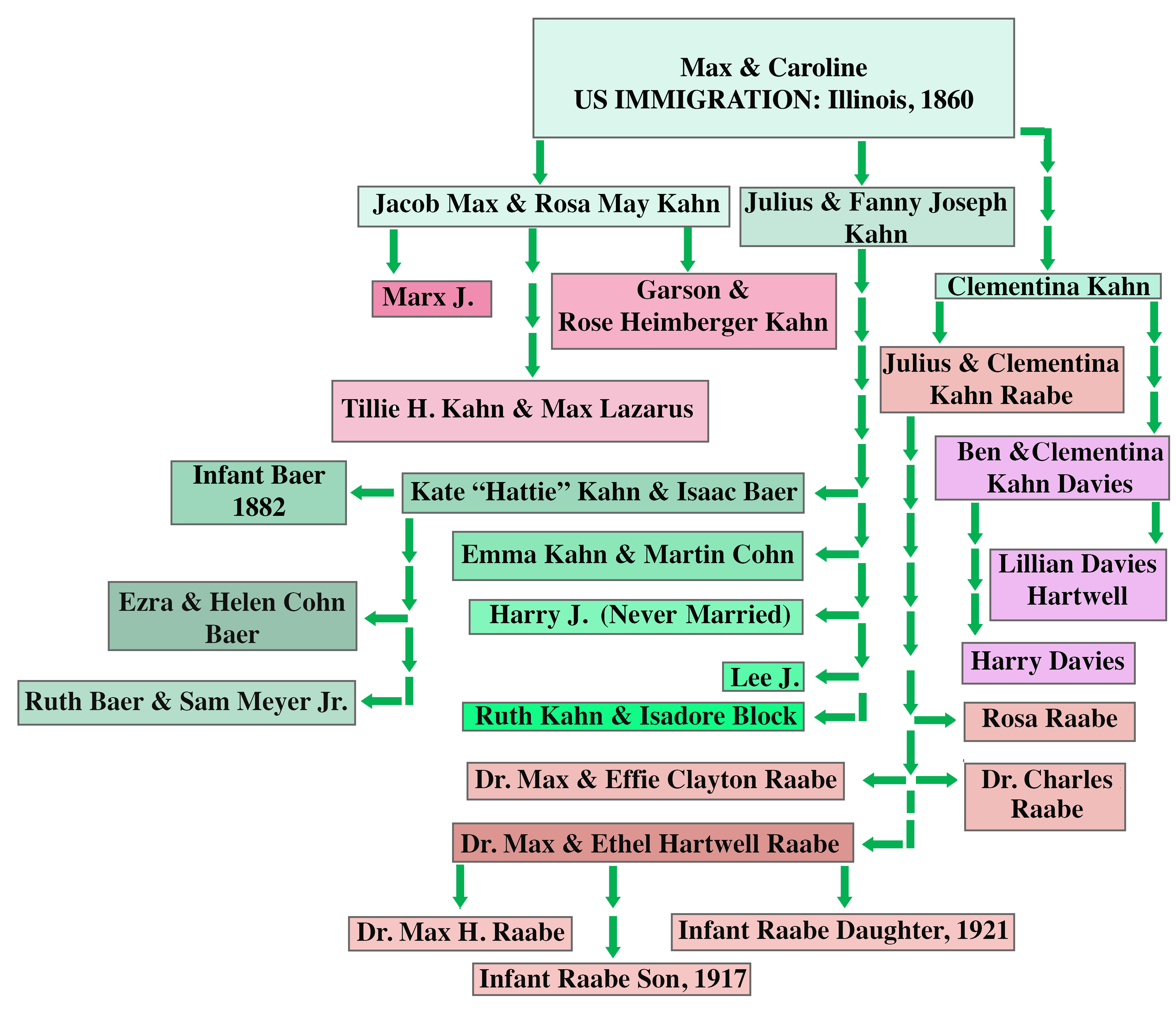
Ancestry tree chart for the Max branch of the Kahn Family. [4]
Jeffrey P. Grant. Lineage Chart for the Leadville Kahn Family. Leadville, Colorado: Temple Israel Foundation. 2021.
Marx Kahn
Birth: Hessen, Germany, 1831
Died: Salt Lake City, October 12, 1916
Fanny Guthman Kahn
Born: Hessen, Germany, 1841
Died: Leadville, October 5, 1899
Wife of Marx Kahn
Carrie Kahn Mayer
Born: Morrison, Illinois, October 6, 1864
Died: Salt Lake City, April 12, 1954
Daughter of Marx and Fanny
Dr. Solomon Guthman Kahn
Born: Morrison, Illinois, February 7, 1867
Died: Los Angeles, June 21, 1954
Son of Marx and Fanny
Lillie Rose Kahn
Born: Denver, September 25, 1875
Died: Salt Lake City, April 9, 1954
Wife of Dr. Sol
Ralph M. Kahn
Born: Leadville, December 23, 1898
Died: Los Angeles, January 30, 1995
Son of Lille and Dr. Sol
Mathilda “Tillie” Kahn
Born: Mount Pleasant, Illinois, December 4, 1869
Died: Salt Lake City, August 6, 1960
Daughter of Marx and Fanny
Jacob A. “Jake” Kahn
Born: Illinois, July 16, 1872
Died: Salt Lake City, November 18, 1961
Son of Marx and Fanny
Edwin Kahn
Born: Illinois, November 30, 1874
Died: Los Angeles, CA, February 23, 1960
Son of Marx and Fanny
May Kahn Baer
Born: Illinois, May 5, 1878
Died: San Mateo, CA, August 27, 1970
Daughter of Marx and Fanny
Marx Kahn was born in Germany in 1830. He was the brother of Isaac Kahn, who also had a family in Leadville. [354] Fannie Guthman was born in Germany during 1841. [355] The couple married in Chicago during April of 1861 and moved shortly later to the town of Morrison, Illinois. [356] During 1864 their first known child, Carrie, was born. Marx and Fannie had a large family (colon) Solomon was born in 1867, Tillie in 1869, [359] Jacob in 1872, [358] Edwin in 1875 and May in 1878. [359] Marx’s obituary noted his arrival in Leadville as 1880, [360] and it is likely that only he and his eldest son, Solomon Kahn, were residing in the city when the household was first established [361] at 506 East 6th Street. [362] This is confirmed by the 1880 United States Census, where Fannie was listed at the family home at Morrison, Illinois living with her father-in-law, Moses Kahn, and the couple’s other four children. [363] A mention in Marx Kahn’s obituary also notes that he and Sol arrived in Leadville in 1879, which is likely accurate. A rather succinct reference appears in a 1909 newspaper article, pinpointing the arrival date of Marx, Fannie and Sol Kahn in Leadville as March 11, 1879. [364] This precise documented date establishes the three as the second part of the extended Kahn family to arrive in Leadville; Marx’s brother, Isaac Kahn, was documented residing in Leadville a month earlier. [365]
The following year, Marx moved his residence to 500 East 10th Street, where he also set up his business; this is probably when Fannie and the rest of the children arrived in the city permanently. [366] It was not uncommon for Leadville retailers to change addresses, but remarkably this was not the case with Marx. His grocery remained at 500 East 10th Street all the way up to its disappearance from city directories after 1907. [367] This, and the fact Marx’s store is highlighted favorably in a 1902 The Herald Democrat article, suggests his grocery enjoyed substantial stability and popularity in Leadville for its duration. Kahn’s grocery was described as “One of the pioneer and well established business houses of the city.” [368] It was not long before Marx Kahn’s grocery store became entwined in the fabric of the city. As with any other successful retail enterprise, Marx’s prosperity made him the target of occasional nefarious distractions:
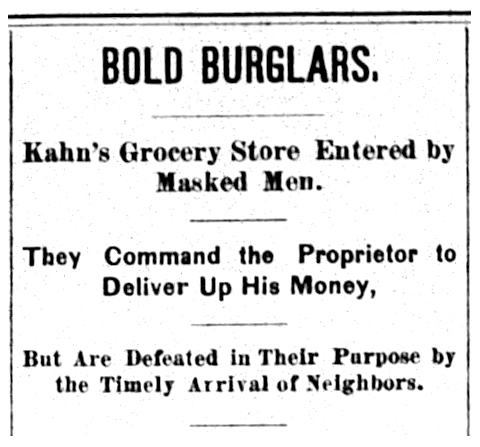
Header of an article in the Leadville Weekly Herald titled Bold Burglars on Saturday, Thursday, March 26, 1881. [369]
Bold Burglars. Leadville, Colorado: Leadville Weekly Herald. Saturday, Thursday, March 26, 1881. Page 3.
Kahn’s Grocery Store Entered By
Masked Men.
___
They command the Proprietor to
Deliver up his money,
___
But Are Defeated in Their Purpose by the Timely Arrival of Neighbors.
___
One of the boldest attempts at robbery ever recorded in this vicinity, occurred about half past ten o’clock Saturday evening, at Kahn’s grocery store, situated at number 500 East Tenth street, at the corner of Hazel.
At about the hour mentioned, Mr. Kahn, proprietor of the store, was sitting with his wife in the rear of the establishment preparing to close business for the day, when a stranger entered and asked Mr. Kahn if he had any cod fish balls. While engaged in conversation with this man, and not dreaming that his intentions were of a criminal nature, two masked men suddenly made their appearance, and, with drawn revolvers, commanded Mr. Kahn to deliver up his money. Having nothing with which to protect himself, and there being no other alternative but to submit, Mr. Kahn threw up his hands and resigned himself to his fate.
In the meantime the man who had first entered seized Mrs. Kahn for the purpose of preventing her from making any outcry which might attract the attention of passers-by and defeat the robbers in accomplishing their [objective]. Notwithstanding this, however, Mrs. Kahn managed to cry “murder!” several times in an exceedingly loud voice, and was twice knocked to the floor by a revolver in the hands of the villain who had sought to quiet her. He was about to strike the prostrate woman again, when Mr. Kahn, who up to this time had remained quiet, tore himself away from his captors, stepped between his wife and her assailant and prevented him from accomplishing his intentions.
By this time the cries of Mrs. Kahn, together with those of her little daughter, who had witnessed the proceedings and made her escape through the back door, aroused the neighbors in the vicinity, among whom was Mr. Dimick and son, who immediately hastened to the scene for the purpose of ascertaining the cause of the trouble. The robbers had, by this time, become aware of the approach of the relief party, and not desiring to run the risk of capture, the trio made good their escape, so that by the time the neighbors made their appearances their services were not required.
Fortunately the robbers secured nothing, but the attempt was a most bold and daring one, and one which Mr. Kahn does not care to see repeated for some time. The robbers have not been seen since, and there is no clue to their identity or whereabouts. [369]
A number of newspaper articles suggest that the area surrounding Marx’s store was becoming a problem for the city, with the burglary only symbolizing that these crimes were increasing in severity and frequency. Reports suggest that muggings along East Tenth Street were becoming the progressive norm as several other stores had been burglarized and a “…pedestrian had his head cut open with some instrument.” The hopeful solution to this crime wave was to assign a policeman to the tenth street beat, thus increasing the presence of authority and helping to stem the flow of criminal activity. [370]
The Kahns were quite involved with both the Jewish community and the Leadville community at large. Fourteen-year-old Tillie Kahn performed a recitation of Poor Jilted Jonathan at an event for the Y.M.C.A. on February 16, 1883. [272] Marx read from the Torah during Rosh Hashanah services on October 5, 1883, [373] and served as the Temple Israel congregation’s secretary during its most notable year in 1884, when the synagogue was conceived and constructed. [374]
Sol and Tillie attended Clay Wilson’s birthday party at his parents’ home on July 18, 1884. [375] Carrie, Jake, Sol, and their cousin, Emma Kahn, attended the 16th birthday party in honor of Theresa Sonneberg [376] at her parent’s home on April 13, 1885. [377] On July 31, the congregation celebrated Jake’s Bar Mitzvah at Temple Israel. At the congregation’s annual meeting on September 18, Marx was elected vice president of the Temple Israel congregation. [378]
Marx’s success as a grocer helped pave the way for his son, Solomon, to eventually become a physician. At first, Solomon worked as a clerk for his father in 1886 [380] but during 1888 he was listed as a student of Dr. O. H. Simmons. [381] The following year Sol was instructed by Dr. Galloway, [382] and in 1890 he graduated from the University of The City of New York where he also served briefly as a resident physician. Dr. Sol was also noted to have “contributed to medical literature” in his day. [383]
Jake’s debate team received less flattering criticism at a meletarian club exercise on February 22, 1887. Jake successfully argued in the affirmative on the topic “That a Person Can Learn More by Traveling Than Reading.” However, a newspaper reporter viewed school debates as “…seldom interesting…” and felt that if “…the young men looked more thoroughly into their subject, the affair would have been more satisfactory…” [384]
During the meletarian program at the Central School on February 8, 1888, Jake delivered a recitation. [385] On April 26, Jake argued for the affirmative on the resolution “That a child is influenced more by outside influences than by home influences,” during a debate to close the Leadville public school year. Unfortunately for Jake, the decision went in favor of the negative argument presented by his cousin, Maurice Kahn. [386] On December 3, 1888, both May and Edwin gave popular recitations at Temple Israel’s Chanukah festival at City Hall. [387]
On July 28, 1889, Jake attended a luncheon hosted by Hattie Howe at her home along with Tillie, May, Jake, Edwin and their cousin Maurice Kahn. [388]
Tillie and Jake were in attendance at a surprise birthday party for Kate Cogswell at her parents’ home on February 11, 1890. [389] On June 16, 1890, Dr. Sol played catcher for the physician’s team in a round of baseball in which Leadville’s lawyers defeated the local doctors 26-25 despite a late, 13-run sixth inning that rallied the medical team. [390] Tillie and Lee Kahn were at a surprise birthday party in honor of Leah Harris at the Schayer [391] home on August 27, 1890. [392]
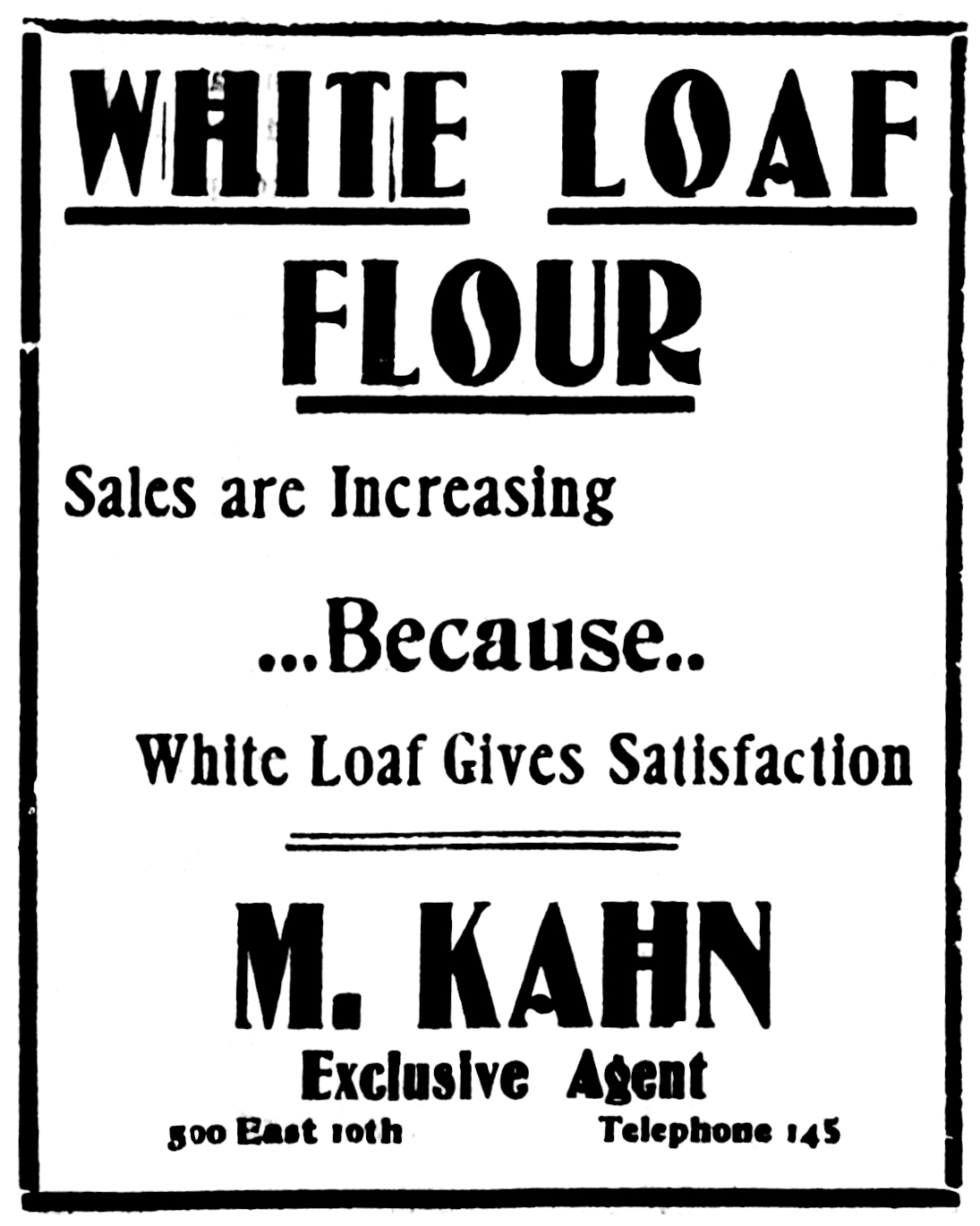
Advertisement for M. Kahn promoting White Loaf flour in The Herald Democrat on Thursday, September 24, 1903. [371]
White Loaf Flour. Leadville, Colorado: The Herald Democrat. Thursday, September 24, 1903. Page 5.
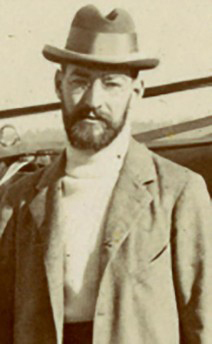
Detail photo of Dr. Sol Kahn taken in 1895. [393]
Courtesy, Beck Archive of Rocky Mountain Jewish History, Special Collections, University of Denver Libraries
Thyria Wilson, National Council of Jewish Women, Denver Section, Kosher Picnic at Leadville, Colorado, 1895 July 28. University of Denver Libraries. 2021.
It is likely that Sol left Leadville for a very brief period to formalize his medical education, evidenced by various documents from this era showing he continued to list his official address as Leadville between 1890 [394] and 1893 while in New York, [395] Chicago and Germany. [396] Sol studied at the Columbia College medical school in New York City during 1889 and trained under Dr. Galloway’s tutelage when in Leadville. [397] Dr. Solomon Guthman Kahn graduated from medical school after only two years of study in March of 1890 and was then appointed resident surgeon for St. Mark’s Hospital in New York City. [398] His first business listing in Leadville appears during 1891, when he is listed as “Dr. Solomon Kahn at 21 Union Block at 425 Harrison Avenue” and recorded as the “Leadville’s City Physician.” [399]
In 1891, shortly after returning to Leadville as a certified physician, Dr. Sol Kahn contributed to a whimsical feature in the Herald Democrat newspaper that explains “How Doctors Are Made:”
…that gentleman [Dr. Sol] explained the process of development from the raw, green and unsophisticated country youth to the full-fledged sawbones armed with a sheepskin, and a big stock of conceit, to do battle with death in all its myriad forms-a period of evolution requiring from three to four years.
“Well,” said the doctor, “when the young man goes to study medicine in New York, it is presumed he is a man in his aims and ambitions. He may be verdant, but he is supposed to have brought enough sense with him to teach him to take care of himself. The college requires that he be possessed of an ordinary literary education, and it is the rule that he has spent a year under the tutorage of some reputable physician. When he enters the college, therefore, he possesses fairly general knowledge of the subject and isn’t like one groping in the dark. The work of the student during three years he remains in college consists of listening to didactic lectures on anatomy, physiology, Materia medica, principles and practices of medicine, obstetrics and gynecology; clinics, dissection, operative surgery, practical chemistry, and actual obstetrical work. The series of lectures are given in the order named, but are, of course, combined with clinical work, dissecting room practice and continue throughout the entire course. In the first year the student is expected to become thoroughly grounded in anatomy. He is now introduced into the dissecting room, or rather, introduces himself into that supposed chamber of horrors. There is a professor in charge of the room and you are given a ‘part.’ What is a part? Well, to begin with, the college secures its supply of ‘stiffs’ from the morgue and there are any quantity at all times available. The college puts them in the pickling vats and then when needed they are brought up to the dissecting room and each table supplied with one. Five students are assigned to each body, each student being given a part on which to operate. One student takes the head, one an arm with portion of the body, another a leg with portion of the body, and the other two the other leg and arm. After five bodies have been dissected you see the student has gone thoroughly over the entire human anatomy.
“Now, you mustn’t suppose that the student has an instructor standing over him all the time to give him pointers. Not at all. He must find out for himself by standing about for a day or so, while he watches the ‘other fellers’ handle the knives. If he has been smart, he has already selected a boarding house filled with ‘medicals’ and ‘chummed’ with a second-termer, who has been through the mill. He can then obtain a few practical points as to how to begin work on his part. This, with the books and a little common sense, enables him to go ahead, and he is soon slashing away on a carcass as merrily as the oldest among them. The second and third termers are only too glad to help. Of course they naturally look down on the first year fellows with a sort of lordly superiority, and love to air their superior knowledge by showing the boys who are not posted. This, of course, is good practice for them.
“In the clinic lectures the subject is brought into a sort of amphitheater, where he is exhibited before the students and the demonstrating proceeds to call down a half-dozen or so young men who examine the patient and are asked to tell what the trouble is and the reason for thinking as they do. The demonstrator then proceeds to tell just what is the matter with the man, the method of treatment and other points. Patients for the clinic are plentiful. Surgical cases are sent to one department, general practice cases to another, and each in turn are brought before the students.
“In operative surgery all the operations known to the science are performed on cadavers. When real operations are performed they are generally done at the hospitals, and notice to that effect sent to the colleges. Those who so desire can witness these operations, and it is of great practical value to see them performed, as the physicians who have the work in charge are men of the highest standing in the profession.
“As the student draws near the end of his career in college he is given practical instruction in obstetrics and midwifery. Lectures on medical ethics and hints as to professional etiquette follow, all of which the student drinks in at the fountain of wisdom with the balance of the mental pablum. And then he gets his sheepskin”
“And now you see,” concluded the doctor, throwing away the stump of his cigar “how we kids come to be doctors. They are ground out by the hundred every year, and not such bad doctors, either…” [400]
The following article, which appeared in the June 6, 1891 edition of the Leadville Daily Evening Chronicle, proffers insight into some of the more realistic issues Dr. Sol would be charged to handle as city physician in a frontier mining town:
TO END HER LIFE
A Dissolute Young Woman Attempts to End Her Life Saturday.
About 3 o’clock Saturday morning, Dr. Sol Kahn was summoned to room 13, over 210 Harrison Avenue, to attend a young Cyprian who was suffering from an overdose of morphine. It seems that a girl named Lilly Blome, an employee of Saville’s variety theater, laid off Friday night to take in the town. She was drinking heavily all night, and was suddenly taken with a fit of despondency, and determined to drown her sorrows in the dark waters of the river Styx. She procured a box of morphine, and silently stole away from the man with whom she was running about, and repaired to the solitude of her boudoir, there to administer with her own hand its fatal potion which was to cast a human soul into the fathomless depths of oblivion.
Her lover, suddenly missing his partner, started for her room, and upon arriving at the door, loud groans were heard issuing from someone inside. The door was broken open, and the young woman was found lying on the bed, and suffering from the effects of the deadly drug.
Dr. Kahn remained at the place until after 7 o’clock, Saturday morning, working hard and faithfully in order to save the rash young woman’s life. She was then pronounced out of danger, and with proper attention will probably recover. [401]
On March 13, 1891, Edwin was elected Sergeant at Arms of the Melatarian Society at the Central School [402] and as the new school year opened in September, he was elected the club’s new president. On April 15, Edwin performed the character of Sam Beslem in the Central School’s presentation of the comedy The Assessor. [404] On November 1, 1891, Edwin and his cousins Maurice and Lee attended a birthday party for Maud Greenfield at her parents’ home on 414 East 10th Street. [405] Tillie addressed a meeting of the Chautauqua Circle at the Y.M.C.A. December 6, on the subject of “Social Institutions of the United States.” [406]
On November 13, 1891, the following appeared in The Herald Democrat newspaper:
His Head Cut.
John Roos, while engaged in a scrap yesterday in the Austrian colony, on lower Front street, was struck on the head with a beer glass, inflicting a large gash in the skull. Dr. Sol Kahn dressed the wound. [407]
Dr. Sol’s position as Leadville’s city physician exposed him to the darker side of Leadville’s collective, which often left him tending to the victims of the day’s societal ills such as mining accidents, [408] police incidents, [409] suicide attempts, substance abuse, [410] and the occasional posthumous medical examination — behavior that typically ran rampant in Western mining communities. On January 2, 1892, Dr. Sol testified in the manslaughter trial of Richard Pitts, who stood accused of killing 300-pound M.J. Berry. According to reports, Pitts slapped Berry, who fell to the floor and died soon after. The autopsy revealed that Berry had actually died from heart failure as a result of his obesity and the case was dismissed. [411] On January 28, 1892, Dr. Sol responded to the needs of an inmate at the city jail:
A Serious Affliction. Dr. Sol Kahn was summoned to the city jail yesterday to attend a man named William McCall, who is suffering from cellulitis in the face. The affliction is the result of McCall being cut on the cheek and over the right eye during a recent State street scrap, and may turn into blood poisoning. [412]
Just weeks later another article provides an example of some of the emotional challenges that accompanied many of Dr. Sol’s duties with an unfortunate degree of regularity:
HER THIRD ATTEMPT.
___
Madame Enault, a State Street Courtesan, Again Becomes Tired of Life.
For the third time during her disreputable career in this city, Madame Enault attempted suicide Sunday night. The madame occupies a small two-room dive at 129 State street, and, as is customary with the lascivious ladies in her neighborhood, enjoys the distinction of having a lover, who basks in her smiles and appropriates her ill-earned money to his own selfish desires. But her lover occasionally gets out on a toot, to which Madame Enault is quite averse. For that reason she swallowed a large dose of morphine late one night last November, but failed to remember that her groans might attract the attention of her neighbors, which proved to be the case. Dr. Sol Kahn was hurriedly summoned, and as promptly responded, and upon hearing that the madame had attempted suicide once before, he administered some antidotes, which had the effect of making Mrs. Enault very sick at the stomach, and caused her to repent her rash action in very terrible terms.
But the lesson proved fruitless, however, as on last Sunday night the madame again came to the conclusion that life was but an empty dream after all, and resolved to end it at once by the familiar morphine route. With that end in view, Mrs. Enault again swallowed an overdose of the deadly potion, and lay down to pass away in peace. But her dream was not to be realized, however, for when the narcotic had become sufficiently diffused throughout her system, she accordingly began to moan and groan in a pitiful manner. A woman living next door heard the sounds, and, entering the room, found the unfortunate woman tossing about the bed in agonizing pain. Taking the situation at a glance, she saw that Madame Enault had taken poison, and at once dispatched a messenger for a physician.
During several months past a number of fair State street damsels have engaged passage on the morphine route, but have been recalled from their respective destinations by the timely arrival of a physician. When the bills for services rendered were presented by the physicians, with but a few exceptions the latter were told to look elsewhere for their money, the debtors probably following the old adage that it is better to owe a person money than to cheat him out of it.
The physicians have naturally become timid of this sort of business, and when called upon in behalf of Madame Enault Sunday night, they invariably asked for their fees in advance. As no money was forthcoming, the friends of the unfortunate woman were thrown upon their own resources to pull her through. It so happened that one of the women who was present had once been the principal actress in a similar escapade, and her knowledge on this occasion stood her well in hand. She forced hot, strong coffee and other emetics down the madam’s throat, which soon produced the desired effect. The victim was walked about the room and by morning was sufficiently recovered to be left alone. [414]
Suicides by morphine in this era, particularly by women, were frequent not only in Leadville but throughout the United States. Dr. Sol was fortunate to have rescued another disparaged soul on the night of December 9, 1892, when a jilted Hazel Louis availed herself of this consequence and Dr. Sol “…treated the heartbroken Hazel to a decoction that had made her feel as though she had swallowed an earthquake. The vigorous treatment, however, had the desired effect, and when the doctor bid her adieu, it was with the assurance that, if she would not trifle with morphine again, her chances for living to an old and ripe age were as brilliant as the evening star.” [416]
On March 11, 1892, Edwin was elected vice president of the Leadville Meletarian Society. [417] Tillie threw a rather large, entertainment-filled reception for her friend, Dinah Sinsheimer, who was visiting from Chicago. Many from Leadville’s Jewish community were in attendance. [418] Both May and Edwin successfully completed their academic year at Leadville’s Central School on May 12. [419] On October 5, Tillie moved on from her position with Fred Butler and was hired as clerk at the Beggs Dry Goods concern. [420] Dr. Sol, affiliated with the Silver Camp No. 12 of the Woodmen of the World society, served on the reception committee for the organization’s annual ball held November 11, 1892 at City Hall. [421]
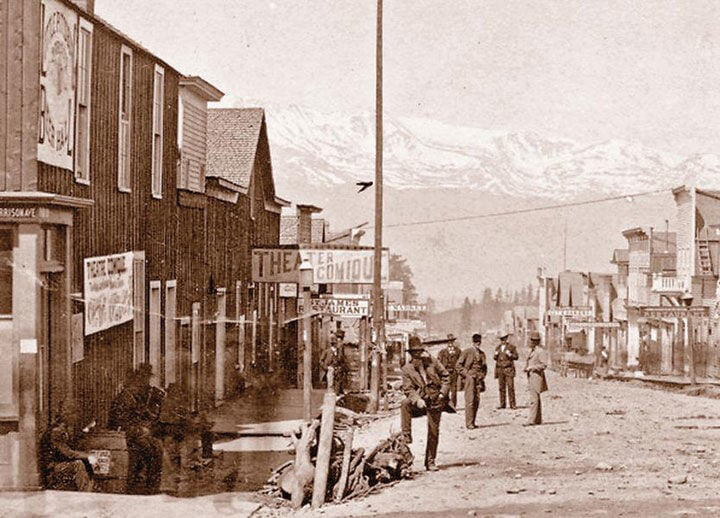
State Street in Leadville, circa 1878. Renamed in 1879 as West 2nd Street, the original moniker held with locals well into the twentieth century and served as Leadville’s red-light district into the 1920s. The text with the photo also adds that “it had a reputation for wickedness and contained theaters, restaurants, bars, and bordellos”. [415]
State Street. Leadville, Colorado: The Herald Democrat. Wednesday, November 21, 2018. Page 6.
On August 17, 1892, Dr. Sol tended to wounds suffered by Tony Church, who had the misfortune of getting into a bar fight in Percoe’s Saloon at 220 Elm Street. Church was stabbed multiple times during the melee, including a deep gash to his neck that caused grave concern. Dr. Sol successfully treated Church and his assailant was quickly arrested. [422] Dr. Sol was then called to help find a home for an orphaned infant quite literally abandoned on a local housewife’s doorstep. [423] On September 18, Edwin was again elected president of the Central School’s Meletarian society. [424] Tillie attended a ladies’ luncheon hosted by her cousin, Ruth Ward Kahn, at her home on December 18. [425]
Edwin addressed the audience at the joint installation for the Grand Army of the Republic and the Women’s Relief Corps at Taylor Hall on January 5, 1893. [426] Dr. Sol was shown to be living in Leadville on a 1893 application for a United States Passport he filed at Chicago. [427]
In his capacity as city physician, Dr. Sol Kahn attended James Regan, a new resident of the jail who had been suffering from alcoholic dementia and was found at the corner of Harrison and Chestnut lost in a psychotic episode, insisting that he had been fighting “…monkeys and devils throughout the day.” Dr. Sol ordered Regan to be “…locked up and cared for.” [428] On September 4, after spending the summer with her parents, Carrie returned to her husband in Cincinnati accompanied by Tillie. [429]
The following item appeared in the September 15, 1893 edition of The Herald Democrat Newspaper:
OFF FOR EUROPE
___
Dr. Sol G. Kahn Is Now on His Way to Europe
Dr. Sol G. Kahn is now speeding toward the land of the rising sun, and will soon be on the briny, on his way to Europe. After the doctor’s graduation from a prominent medical college of New York, he came to Leadville, and soon afterward secured the appointment of city physician. The rapid strides of medical science are such that the ambitious young M.D. came to the conclusion that a year’s study in the great European centers of medical science would be of inestimable value to him. He will take a regular post-graduate course of lectures, and pursue his studies along special lines. [430]
Dr. Sol was listed as a member of the Lake County Medical Society for 1894. [431] The organization had been in flux prior to that time, and had not held a formal meeting since 1888. [432] On July 4, 1894, a group of small boys threw a firecracker under Dr. Sol’s horse. The horse jumped and fell, resulting in serious injury and was destroyed. [433] Tillie and Dr. Sol attended a family dinner party hosted by Ike Kahn on December 29, 1894, and a few days later, a New Year’s Eve party hosted by Dr. Lee Kahn. [434]
Jake Kahn worked for some of the more prominent Leadville Jewish entrepreneurs. In 1894 he was a clerk in his father, Marx Kahn’s, grocery store. [435]
By 1898, he was a bookkeeper for liquor merchant Adolph Schayer [436] and in 1899 he began a lengthy career [437] with the Baer Mercantile Company. [438] The Kahns and Baers were deeply intertwined; both Jake’s cousin, Hattie Kahn, and his sister, May, would marry Baer brothers. From 1900 on, Jake would frequently travel on business for the benefit of the Baer Mercantile Company to oversee their interests all across the American West. [439] May performed in the chorus for the elocutionary recital at the Tabor Opera House on January 28, 1894. [440] Both Edwin and his aunt, Ruth Ward Kahn, performed recitations at a musical hosted by the Heimbergers at their home on March 4. [441] On June 10, May and Leah Rachofsky’s [442] Bat Mitzvahs and Phillip Grossmayer’s [443] Bar Mitzvah were celebrated at Temple Israel; all three were under Superintendent Carrie Kahn Mayer’s tutelage. [444]
Carrie Kahn Mayer, [445] Marx’s eldest daughter, enjoyed an auspicious tenure in Leadville. Carrie’s marriage to Ephraim “Sam” Mayer in Cincinnati, likely during 1887, [446] was relatively brief due to his death in 1894. The union produced two children: Walter in 1888 and Evelynn in 1890. Carrie and her children returned to Leadville in late 1894 and took up residence at 204 West 8th Street. [447]
On January 28, 1895, a council of local physicians that included Dr. David Heimberger, Dr. Lee and Dr. Sol, engaged in a debate on the efficacy of oral consumption of fine sand as a treatment for dyspepsia. Many interesting opinions on the subject were voiced that evening and few argued against the idea. The group used a case study of a local miner, C. C. Stockton, who suffered from chronic symptoms that affected his appetite and led to a substantial amount of weight. Stockton’s ingestion of sand was claimed to have positive results as explained by Dr. Boyd:
“…Last August he [Stockton] began to take a teaspoonful of fine sand every morning, just after eating. Three days later, improvement was marked in the way of appetite and capability of digesting food. After having continued the treatment for a week, to use the patient’s own expression, ‘I could eat all on the table without the slightest bit of discomfort.’ August last the patient’s weight was 140 pounds, at present it is 160, and he says that he feels rejuvenated in every way.”
“The question is not whether sand is good in some forms of dyspepsia, for if you gentlemen feel as I do concerning the danger attending its administration, it will not be prescribed for this or any other malady…”
“…The danger of appendicitis is not the only one that menaces the sand eating patient. The violent irritation, even if it does not bring about inflammation or ulceration, unquestionably causes an active hyperemia, [448] which, if long continued, will superinduce great thickening of the walls of the stomach. The increase of the encroachment upon the glandular system causes atrophy, and the patient may be left in a much worse condition than originally…”
Dr. Sol’s opinion was quoted as saying he “…believed the patient to have been suffering from atony [449] with dilatation…” and “…that remedies much less dangerous could have been used with equally good results…” Dr. Lee Kahn agreed with Dr. Boyd but had fewer concerns about the danger of contributing to appendicitis. To be clear, no physician in attendance that evening felt that the consumption of sand as a therapeutic for dyspepsia was by itself prudent without, at minimum, the introduction of supplemental treatments to mitigate the likelihood of gastrointestinal damage from the consumption of sand. [450]
On March 2, 1895, The Herald Democrat reported that Dr. Sol was consulted in the case of Edward A. Howard, a local carpenter who had contracted a serious infection:
…Mr. Howard was in the employ of H.C. Dimick, the contractor, and while at work last Monday a week, cut a small gash in one of his fingers with a chisel. Nothing more was thought of the small wound than wrapping the end of the injured finger with a piece of muslin. Howard continued to labor at his bench until Thursday of last week, when he complained of excessive pain in his hand and arm, which were greatly swollen and had a purple hue. Dr. Bosanko was called, and tried to allay the pains. On Monday long gashes were cut into the swollen arm, and the case became so serious that it was necessary. Dr. Bosanko called to his assistance Doctors D’Avignon, Meiere and Sol Kahn, and the surgical operation was performed at 9 o’clock yesterday morning. The patient failed to rally from the effects and died at the hour stated [4 o’clock P.M.]… [451]
Emil Mayer, cousin of Carrie’s husband Sam Mayer of Cincinnati, came to Leadville in March of 1895 to seek the aid of Dr. Sol after an 11-day treatment at Glenwood Springs, Colorado failed to cure his chronic insomnia. [452]
On June 26, 1895, Dr. Sol led the Grand March for the annual Strawberries & Ice Cream Festival hop presented by the Ladies Hebrew Benevolent Association at City Hall:
…The incomparable Dr. Sol. Kahn led the grand march with the air of a French diplomat and had for his partner Miss Carrie Koch, a noted Denver beauty, sweet as she is beautiful… [454]
On July 28, 1895, Dr. Sol and Dr. Lee attended a kosher picnic held in honor of Jewish Women’s advocate Sadie American, who spoke on behalf of the National Council of Jewish Women the day before at Temple Israel. [455]
Amelia Friedlander (Cohn), [456]
Alfred Hoffman, [457]
Reinhold Rosendorf. [458]
On ground: Sadie Herman Sands, [459] Dr. Sol Kahn, Sol Garrett, [460] Martha Kaliski, [461] Mathilda Baer, [462] Sadie American, [463] Carrie Kahn Mayer [464] and Grace Diamond.
The sign held by Miss Friedlander reads “This Way To The Kosher Picnic;” the word “Kosher” is written in Hebrew. Courtesy, Beck Archive of Rocky Mountain Jewish History, Special Collections, University of Denver Libraries. [465]
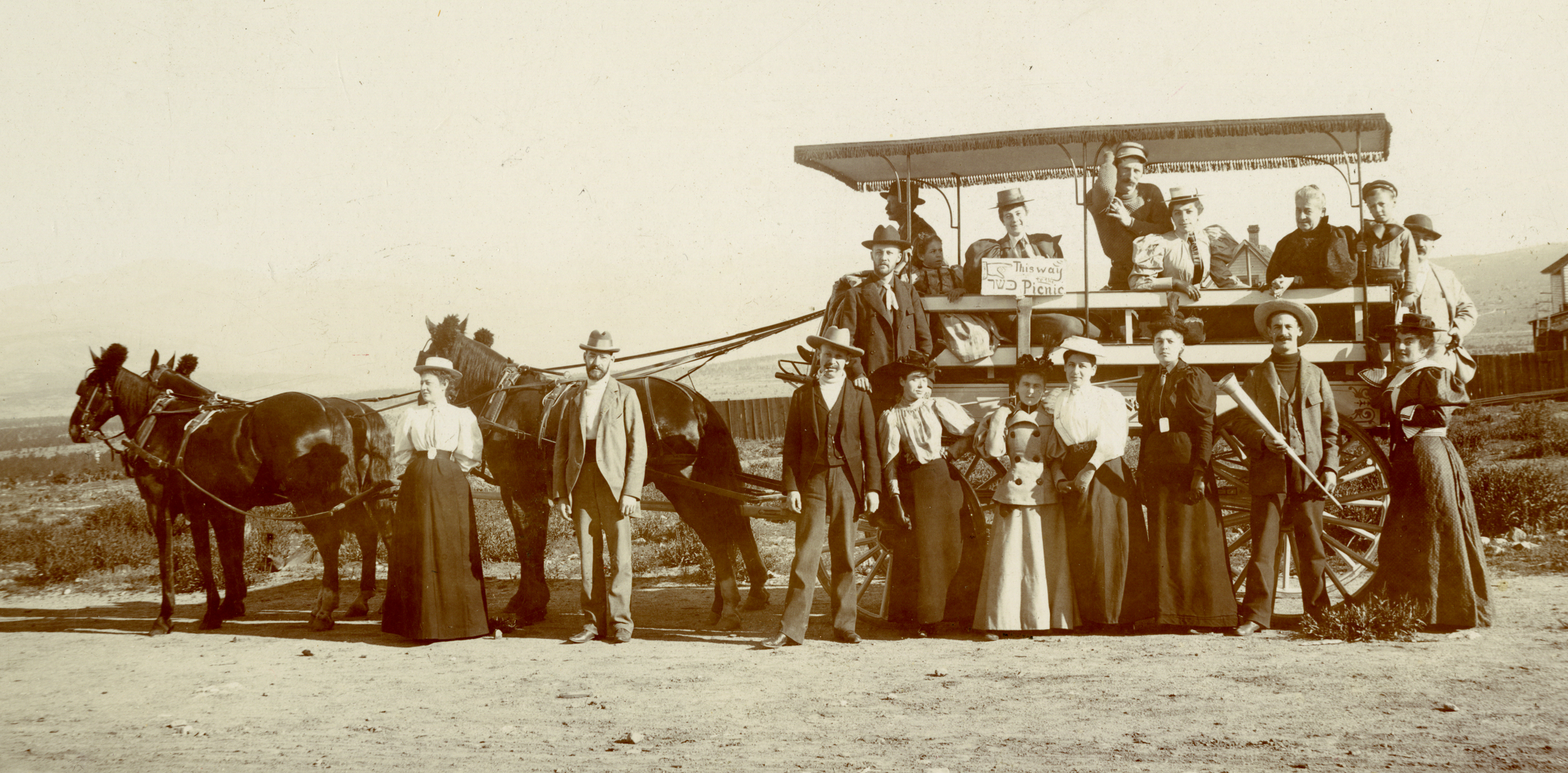
Somewhere on the western outskirts of Leadville, July 28, 1895. [465]
Thyria Wilson, National Council of Jewish Women, Denver Section, Kosher Picnic at Leadville, Colorado, 1895 July 28. University of Denver Libraries. 2021.
Dr. Sol was called to attend to the aftermath of a serious train accident on August 16, 1895. It seems that Julius Grosser, the 26-year-old brother of Bruno Grosser, [466] a Leadville cigar and liquor clerk, who had jumped from a moving train near Tennessee Pass, roughly eight miles northwest of Leadville. Grosser fell to the ground and his arm was crushed by the vehicle’s wheels. Grosser was brought to the city with an arm so badly fractured that Dr. Sol deemed that amputation was a necessity. During the surgical procedure, it was discovered that “…the fracture was so complete that no bones had to be cut…” Bruno Grosser lived only an hour after his surgery [467] and is interred at Leadville’s historic Hebrew cemetery. [468]
Dr. Sol was a pallbearer at the funeral for Dr. Fredrick D’Avignon on November 11, 1895. [469] The 10th-grade class at Leadville High School received higher than normal arithmetic marks that autumn, and May led all the students with her perfect marks. [470]
The Leadville Daily Evening Chronicle commented on Dr. Sol’s contribution to the local school children and their knowledge of anatomy:
…The new instructor was secured by the board of education and the cost was $40. It is evidently a skeleton of a new woman, for the rounder could not tell to what sex it belonged. The new object lesson in anatomy was secured by Dr. Sol Kahn, who occasionally gives a lecture to the school children on bones, of which he is very fond. [471]
A field day took place for Leadville’s medical professionals at the Crystal Rink inside Leadville’s magnificent Ice Palace on the night of February 19, 1896. The local pharmacists, dentists and physicians were pitted against one another in stimulating demonstrations of their winter athletic prowess:
…The race open to the doctors, dentists and druggists was the first on the list. Dr. Sol Kahn was the favorite, and when he stripped, with his white sweater and white woolen knee breeches, the boy gave him the college yell. Mr. George Nicolai brushed up in line, but was feeling a little weak about the knees, while Harvey Brown tried to jump the game. Charley MacKenzie, an old Leadville boy, was given position on the outside of the track, and very little notice was taken of him. When the word was given, Sol Kahn made some magnificent strides, and any one of which would have taken him across the Hellespont, [473] while Harvey Brown went into the air at the bend and lost one of his skates. Those who know Harvey’s disposition to “renig,” say that he did this on purpose to give an excuse for his performance. Anyway, Harvey Brown’s ill luck or whatever you may call it, was a great disappointment to a bevy of young ladies, who were betting perfumery cases on Harvey coming in a winner. Sol Kahn had a claque who blew their bazoos in his favor, but the Kansas sufferer ran like a prairie on fire and burned Dr. Kahn up on the finish. The race was given to MacKenzie and Kahn finished second. The prize was a $25 medal. [474]
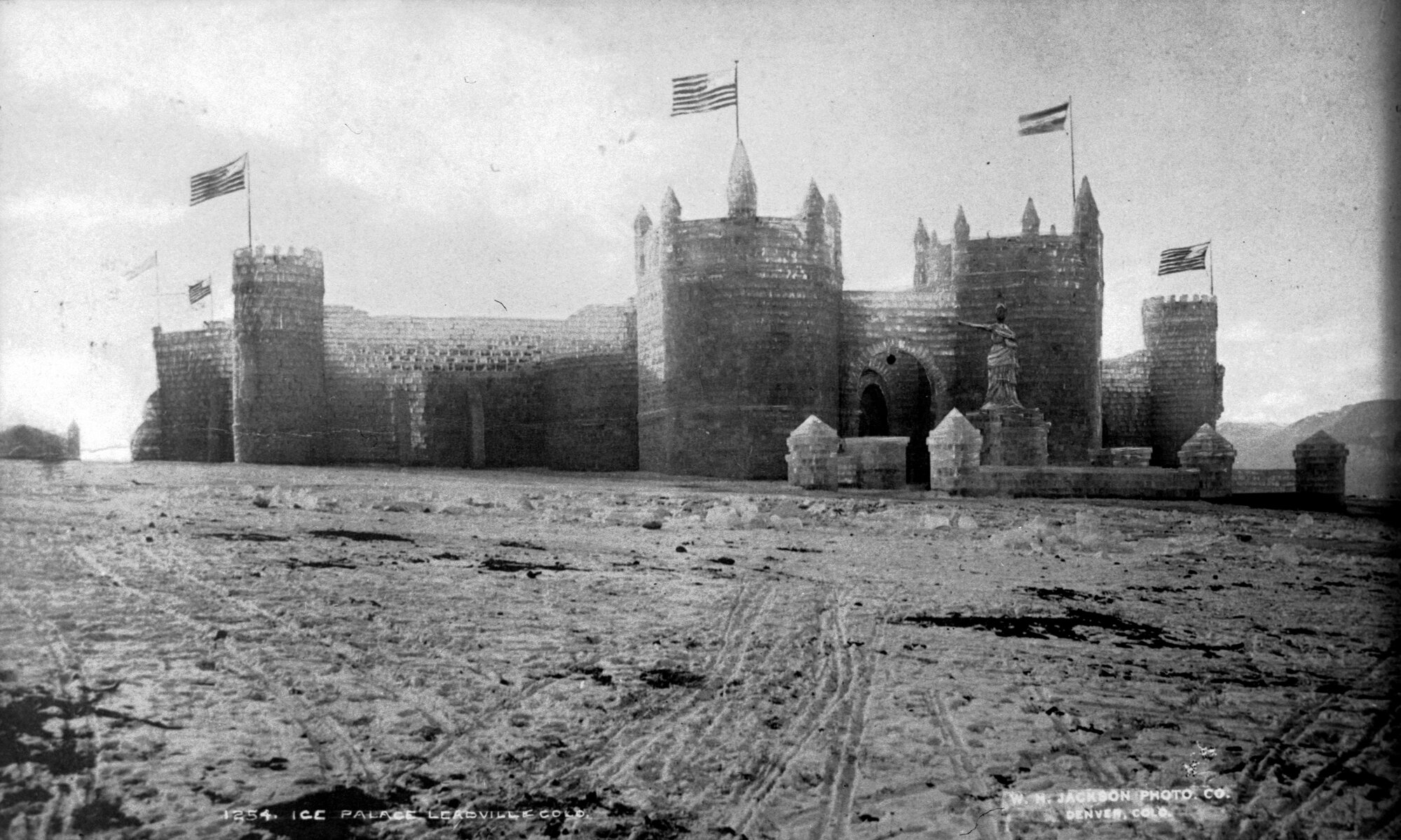
This William Henry Jackson photograph shows the grandeur of Leadville’s Ice Palace during 1896. The ground where this structure stood is still an open space in Leadville known as “Ice Palace Park.” [472]
Rocky Mountain Photo Company. Leadville From the East. [Image] (Denver, Colorado: Western History Collection, Denver Public Library). 2026.
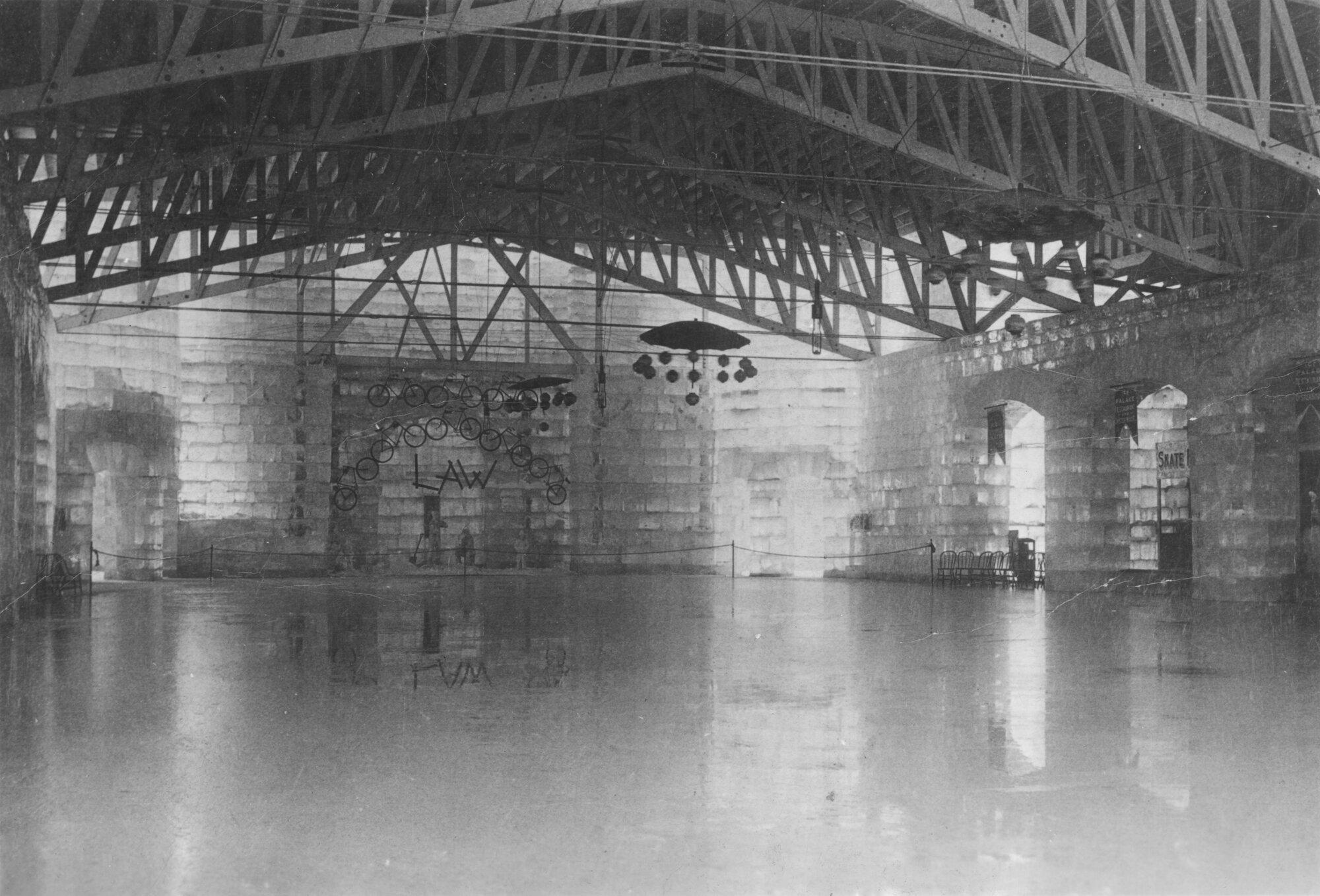
Interior photograph of the Crystal Rink at Leadville’s Ice Palace in 1896. [475]
Ice Rink in the Leadville Ice Palace Special Collections. [Image File: ZZR710000261]. (Denver, CO: Denver Public Library Special Collections). 2021.
On June 9, 1896, Edwin addressed the guests at the first annual banquet for the Leadville High School Alumni Association at the Vendome Hotel. [476] On October 5, Jake and his cousin, Sol Guthman, [477] left Leadville for a weeklong stay in Denver. [478] Dr. Sol, an active mining investor, incorporated the Hahn’s Peak and Leadville Mining & Investment Company with Charles F. Saunders and T.S. Schlesinger on January 10, 1896. The company capitalized with a $1,000,000 valuation and Dr. Sol was fully engaged in managing the operation. [479]
On January 11, 1897, a contest between Aspen and Leadville high schools pitted May arguing in the affirmative in a debate against Robert Browne on the resolution “…That Immigration Should Be Further Restricted by Law.” The event was extremely popular and all 290 seats available at the Knights of Pythias Hall sold out in less than one hour. [480] It was later reported that the debate was resolved in May Kahn’s favor. [481]
In January of 1897, Dr. Sol served as an usher for the wedding joining Louis Cohn and Amelia Friedlander in matrimony. [482] Shortly afterward he relocated his practice to 120 West 7th Street, a move likely prompted by his wedding to Ms. Lillie Rose of Denver on February 7, [483] of that year: [484]
He Picked A Denver Rose
Dr. Sol G. Kahn of This City was Married to Miss Lillie Rose of Denver, Yesterday.
The Event Solemnized At The Residence of Dave May, With a Brilliant Gathering of Leadville and Denver Friends Present.
Denver, Feb. 7.-One of the most brilliant weddings of the season occurred in this city today when Dr. Sol. G. Kahn of Leadville, and Miss Lillie Rose, of Denver, were solemnized at the residence of Mr. David May, on Colfax Avenue, attended by a number of Denver’s most prominent citizens, the assembled being swelled by a contingent of well known Leadville people.
The ceremony was performed by Rev. Dr. Freidman, at 3 o’clock. Immediately after, the bridal party was conveyed in carriages to the home of the bride’s father, 1415 Vine street, where a brilliant reception was held, followed by a magnificent banquet.
The beautiful home of Mr. Rose [485] was charmingly decorated with flowers for the occasion, the effect being heightened by the blaze of scores of vari-colored electric lights.
The banquet consisted of twelve courses and lasted from 4 to 7 o’clock. A number of toasts were responded to as follows: “The Bride and Groom.” Dr. Friedman; “Parents of the Bride and Groom.” David May; [486] “Denver and Leadville.” Dr. D.H. Dougan; “Meditations of a Bachelor.” J. Plessner; “The Ladies.” Lee Wolf; [487] “Reminiscences.” Adolph Schayer. [488] In addition, there were a number of happy impromptu speeches, and every one bubbled with mirth and merriment.
The bride is the daughter of Samuel Rose, a well-known and substantial businessman of this city, and is a most charming and accomplished young lady. Dr. Kahn is well known in medical circles, and is a prominent member of the medical fraternity of the Cloud City.
The bridesmaids were Misses Tillie Kahn and Irma Rose, and the groomsmen E. Katz [489] and Jacob Kahn.
Among the Leadville people present were: Mr. and Mrs. I Kahn, Mr. A Baer, [490] Mrs. Harry May and children, Mr. and Mrs. M. Kahn, Mr. and Mrs. J.O. Heimberger, [491] Misses Tillie and May Kahn, Dr. D.H. Dougan, Jacob Kahn, Al Hoffman, [492] E. Katz, I. Freedheim, [493] M. Sommers, Adolph Schayer, Edwin Kahn.
Dr. and Mrs Kahn left for Glenwood and Salt Lake in the evening for a week’s bridal tour. [494]
The couple returned to Leadville on Valentine’s Day 1897 and took rooms at the Vendome Hotel. [495] The Leadville connection between Lillie Rose and Sol Kahn appears to have been a lengthy and familial one. Samuel Rose, Lillie’s father, appears in the 1879 and 1880 Leadville city directories as a partner [496] in the law firm Hughes, Wilborn & Rose and coincides with Marx and Sol’s first arrival in Leadville around 1880. [497] The trio operated the firm in Denver under the same name during the early 1880s. [498] Dr. Sol and Lillie maintained a close relationship with Lillie’s sister Irma and her husband M.D. Barnett. In fact, the entire Marx and Fannie extension of the Kahn clan would travel to Denver in March of 1898 to attend Irma’s wedding. [499] Although the Barnetts lived in Denver and the Kahns resided in Leadville, the couples often enjoyed long visits at each other’s homes. [500] Lillie was an avid Whist player who frequently took first prize in local contests and regularly attended games in Denver with her sister. [501]
On March 26, 1897, Dr. Sol was called to a construction accident at the Brusk Tunnel involving Western Union telegraph workmen. Anxious to complete a telegraph cable, a crew entered the smoke-filled tunnel, where as many as five locomotives had passed through in the preceding hours. As a result, workers were overwhelmed by copious amounts of coal gas. This proved fatal for the Western Union foreman, H.E. Jennison:
… When the news of the accident reached the city a special engine was sent out with Dr. Sol Kahn, the Midland physician, on board. Dr. Kahn found the other men all right, but Johnson was beyond the reach of Medical aid. Coroner Nelson took charge of the remains, and will hold an inquest this morning. The inquest appears to be necessary in view of the importance of ascertaining just what caused Mr. Johnson’s death, and also as to whether engines were burning coal or coke. There is supposed to be a very stringent rule on the Midland that engines must use only coke going through the tunnel. Mr. Johnson was a resident of Omaha, and about 60 years of age. [502]
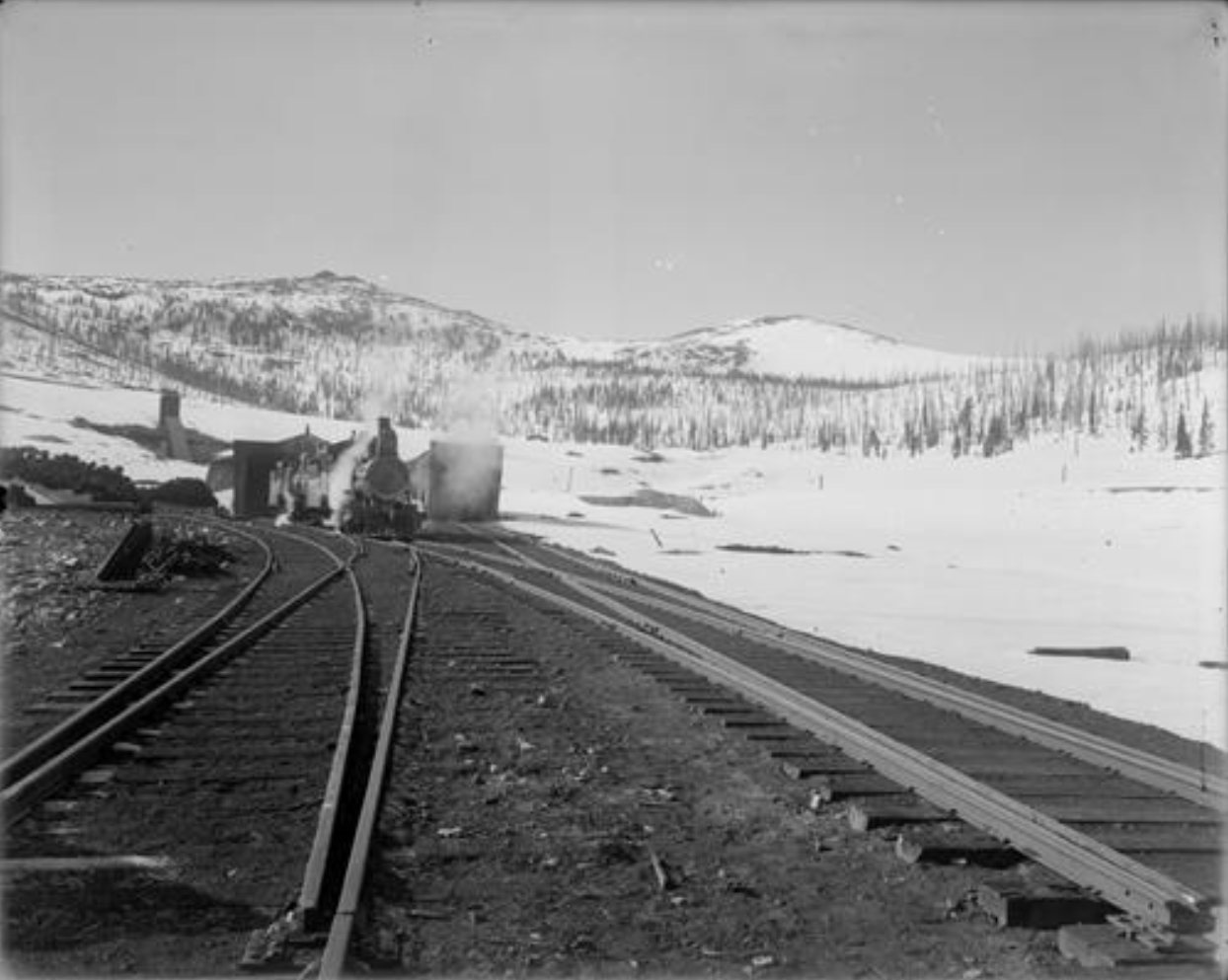
Photos of the Busk Tunnel from its period of operation are scarce. The tunnel was built for the Colorado Midland Railroad in 1891 and closed briefly in 1897 when the company went bankrupt. It soon returned to railroad use until 1922, when it was converted to auto traffic. The tunnel closed to traffic in 1943, but has been used continually to divert water across the Continental Divide to the Arkansas River Valley. Here, a locomotive passes through the eastern entrance to the two mile-long tunnel circa 1891-1910. [503]
Harry H. Buckwalter. Colorado Midland R.R. [Image ID: 90.156.404]. Denver, CO: History Colorado Online Collection; Hart Research Center. 1997.
On May 3, 1897, Dr. Sol was called to an emergency at the Little Johnny Mine where John Hudson had attempted suicide by drinking a full bottle of carbolic acid (Phenol). [504] Although the chemical severely burned Hudson’s throat and he was unable to speak, Dr. Sol quickly assessed the situation and determined the cause. He immediately administered anesthetic to soothe Hudson’s pain and a short time later he was stabilized and transported to Sisters’ hospital. [505] May and Tillie served as human playing cards in a game of “Living Whist” presented at the Weston (Tabor) Opera House on June 14. [506] On September 21, 1897, the following appeared in The Herald Democrat newspaper:
Willie Pitts Injured.
Willie Pitts, aged about ten years, was riding a broncho pony yesterday and racing with another lad, similarly mounted. Turning the corner of Pine and Elm streets young Pitts was thrown and rendered unconscious, Dr. Sol Kahn took the boy to his home in his buggy. [507]
In the spring of 1898, James G. Ryder, A.K.A., James McClurg, an alleged serial forger, tried to cash a check allegedly endorsed by Dr. Sol at the Carbonate Bank. The teller refused payment, suspecting that the check was a forgery. Ryder was held at the bank until law enforcement arrived. It was quickly determined that the teller, Fred K. Porter, was correct in his assessment — Dr. Sol was out of town, Ryder was wanted in various counties around the state for other forgeries and when searched, he was holding five other checks all endorsed by Kahn. Ryder could not raise bail and was held over to the district court on May 19. [508] As further testimony revealed, Dr. Sol was not out of town that day but was busy, which would contribute to Ryder’s downfall. It seems Ryder’s rather elaborate scheme was to present Sol’s clerk with a written offer from an insurance company asking the good doctor to serve as their local medical examiner in Leadville. The clerk took the information to Sol, who told him to accept the offer and signed the letter for him. Ryder took the letter and copied the clerk’s rendition of Dr. Solomon Kahn’s endorsement to create the forgery on his checks. Ryder was ultimately convicted on August 3. [509] On June 12, 1898, Doctors Lee and Sol Kahn attended the American Medical Association seminar in Denver. [510]
On August 2, the following item appeared in The Herald Democrat Newspaper:
SHOT IN THE HAND
__
A Ten-Year-Old Boy Injured While Fooling With A Revolver.
Earl, the 10-year-old son of William Motley of 286 East Seventh Street, was badly injured after being shot in the hand Monday morning. The boy found a revolver in an alley, and while examining it, not supposing it to be loaded, he pulled the trigger. An explosion followed, and the bullet struck him in the palm of the left hand, ranging up, and was extracted from the wrist by Dr. Sol G. Kahn.
[511]
On September 27, 1898, with the aid of Leadville’s The Herald Democrat newspaper, Jake shared a letter written to him by his cousin, Captain Sol. A. Guthman of a Pennsylvania regiment serving in Manila during the Spanish American War:
Dear Jake:- We arrived in Manila bay on the afternoon of July 16 and made a landing on the 18th. We went into a camp on a very pretty piece of land about four miles from Manila. Our trip from Honolulu was very tame and uneventful. The sea was as smooth as glass all the way, and the only disagreeable part of the voyage the very poor food that we received, but think the least said about that the better, and I am sure the government is not trying to rob us, but somebody is surely making a big stake out of this thing, as the grub we receive on board the boat was hardly enough to keep a dog alive.
Well, Manila was finally forced to surrender on Aug. 13, and I will try to explain to you how this victory was brought about. We began our campaign the day after landing here and it was very hard work for twenty-six days and sometimes very dangerous. Too much credit cannot be given to the leaders of this campaign as it was owing to their magnificent head work and strategy that we gained such a glorious victory with such little loss of life. On July 19 we began throwing up our breastworks. The first were for the reserve at a distance of about 1,200 yards from the Spanish firing line. Our next work was to throw up the entrenchments 200 to 500 yards from the enemy and most of this work had to be done at night as it was too close to be comfortable. To protect us from surprises somebody had to be kept in the trenches all the time so every morning one regiment would take charge of the trenches and keep a sharp lookout for twenty-four hours when they were relieved by another regiment.
On the night of July 21 the Pennsylvania regiment was in the trenches; the night was very dark and about 2,000 Spaniards tried to take them by surprise. They crawled up slowly and were only discovered when they ran into the pickets who had been stationed about fifty yards from our firing line. He gave the alarm by firing his gun and then began a very hot battle. Our men had all the best of it as they were behind their breastworks and the enemy were not. They fired volley after volley into them and killed about 300 and wounded about 800 more. Ten of the Pennsylvania boys were killed outright and about thirty more were wounded. Among those killed was a captain who, by his bravery and presence of mind saved the entire regiment from annihilation although he lost his own life. He had his company stationed along a part of the firing line and although the Spaniards were being mowed down they kept up a steady advance and some of the Pennsylvania boys got scared and began to retreat. Their captain saw this movement and he knew what it meant if the Spaniards ever crossed the trenches so he drew his six shooter and climbed up on top of the breastworks and called to his men saying, “For God’s sake, don’t leave me this way, boys, at the same time firing his revolver into the enemy. The boys at seeing this brave act, rallied around their captain, and drove the Spaniards back. It was at this place that eight of the Pennsylvania boys were killed and about twenty wounded. The captain received a bullet through the brain and died the next day. His name was Grant, of E. Co., and his name surely deserves to go down in history.
The Utah battery was also on the line that night and did very good work. We could hear the firing down at the camp and within ten minutes after the first volley was fired about 800 soldiers were marching double time to the assistance of the Pennsylvania regiment. It was raining very hard and was very dark besides, but it did not take us over thirty-five minutes to get to the front. The Colorado regiment as usual was first, but were too late to take part in the fight, as the Spaniards had already been driven back. We got back to camp about 4 o’clock next morning and we were all wet to the skin. Our cook made coffee for us and those of us that had any dry clothes put them on. We rested for about an hour and then had breakfast. It was our turn to relieve the Pennsylvania regiment, so we took our rations for twenty-four hours and at 6 o’clock we were on the march again, back to the firing line. We worked hard all day bettering our position and our trenches and about 9 o’clock that night the Spaniards tried to do the same thing that they had done the night before. We discovered them before they were fifty feet away from their own tranches and we gave them such a severe trouncing that they never fired a shot after that, until the day that Manila surrendered. Our company was not on the firing line but was held in reserve, but, when the firing began, eighteen of our men were sent to reinforce G. Co., as their position was nearest to the enemy. I was one of the eighteen and only eight of us got to the firing line. The bullets were flying around us pretty thick and ten of the boys got scared and hid themselves behind trees and bushes until the next morning. The rest of us hastened up to the firing line and we got there in time to take part in the battle. I fired forty-one shots into the enemy that night and I am sure that I shot some of them, but I do not know how many. The full number of dead and wounded that night will never be known, but we have learned since coming here that out of one whole company all that is left is the captain and ten privates. There are over 3,000 wounded Spanish soldiers in the hospitals here and since we have been here the deaths are at the rate of twenty for each day.
The grand “finale” occurred on the 13th day of August, 1898. Our batteries were all in their positions the night before and all the different infantry regiments left the camp at 5:30 a.m. and marched to the front loaded down with 200 rounds of ammunition and a can of roast beef and enough hard tack to last forty-eight hours. Our position was on the extreme left and we got there about 7 o’ clock. We were next to the beach and not over 400 yards from the Spanish fort. [U.S.N. Commodore George] Dewey had his fleet lined up in front of the city on the bay. The Utah battery was stationed right next to our company. The other batteries and regiments were strung along on the right. I do not know the exact order. Dewey opened the ball promptly at 9:30 a.m. with a shot from one of his six inch guns. That was the signal to start and the different batteries began the bombardment on land and Dewey kept up his firing from the bay. The Spaniards were taken by storm and completely routed; at 10:20 the firing from the big guns ceased and we all climbed over our entrenchments and began the advance movement. The Spaniards were scared to death and fled in all directions. We captured their fort and hoisted a United States flag over it at just 11:30. We kept up a steady fire on the fleeing Spaniards and crowded them in all directions and we marched clear up to the walls of old Manila with our banners flung and our band playing, “A Hot Time In Old Town.” At 1 o’clock the white flag appeared over the wall of the city and such cheering that followed you never heard. Everybody went crazy. We marched into the city, headed by our band which played “Yankee Doodle,” “Star Spangled Banner,” and other national airs, and our colonel planted a large flag in the main part of the city, after having pulled down the Spanish flag, and having received the formal surrender of Manila by Gov. General Augusti [Spanish Army General Basillio Augustin, the Spanish appointed military governor of the Philippines]. [512] After this we were marched into a large empty lot next to the river and we all sat down and ate our canned “horse” and hard tack while our officers were out looking for quarters for us. It was 10 o’clock before we found a place to rest in a large church and as we had been on the go since 4 o’clock in the morning, we were all tired enough to sleep very soundly: of course a guard was kept all night to protect us from surprise. Since that time our duties have been very light although we have to guard and patrol in all parts of the city to keep peace and protect property. The day after the Spanish soldiers were marched back to the city and were all disarmed at our brigade headquarters. They were then allowed the freedom of the city. Guards are stationed at all entrances to the city and weapons of all kinds are taken from insurgents and others before they are allowed to enter the city.
It is very, very hot here and it rains very often and very hard but I have been in perfect health all the time and I expect to remain that way. Give my love to all the folks and to all inquiring friends and please write to me.
Yours affectionately,
SOLLY. [513]
Edwin Kahn left Leadville on October 2,1898, to attend the business college at the University of Cincinnati. [514] Lillie and Sol welcomed their only child, Ralph, [515] on December 23:
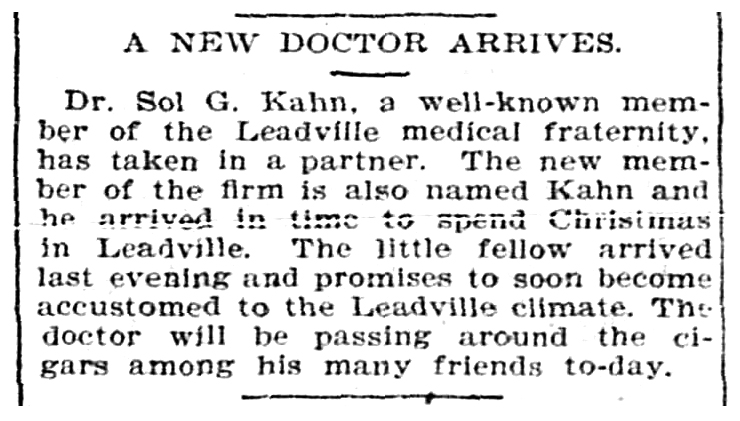
Small article creatively announcing the arrival of a new baby, Ralph, in Leadville to Solomon Kahn. [516]
A New Doctor Arrives. (Leadville, Colorado: The Herald Democrat). December 24, 1898. Page 8.
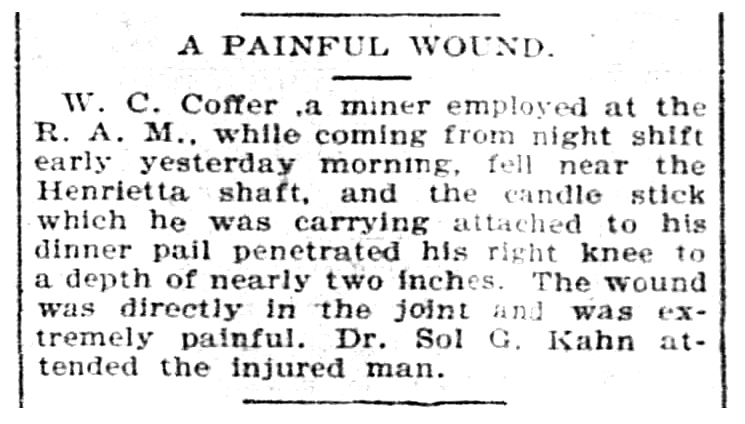
Small article describing Solmon tending to a wounded miner, W.C. Coffer, in the Henrietta Shaft of the R.A.M. [519]
A Painful Wound. (Leadville, Colorado: The Herald Democrat). February 9, 1899. Page 8.
Marx owned multiple properties around the city and functioned as a landlord in some capacity. Late in 1898, as his children left home for their own pursuits, he listed the four-bedroom family home at 513 East 10th Street for rent, while advertising another three-bedroom home for lease at 1012 North Alder. [517] In 1899 Dr. Sol and his family moved their home to 120 West 8th Street, while his practice returned to 425 Harrison Avenue. [518]
At the 20th annual Purim Ball held at Armory Hall on February 11, 1899, Lillie, Dr. Lee and Jake all served on the reception committee. [520] On September 3, Temple Israel congregants elected their officials as they did annually:
On September 9, 1899, May, Tillie, Jake and Edwin all attended the birthday party for Hattie Cohn [522] at her parents’ home.
On October 13, 1899, Fanny Kahn passed away and her funeral was held at the Temple Israel synagogue on October 15. [524] Her remains were interred in the Leadville Hebrew Cemetery. Her obituary appeared in the October 14, 1899 edition of The Herald Democrat newspaper:
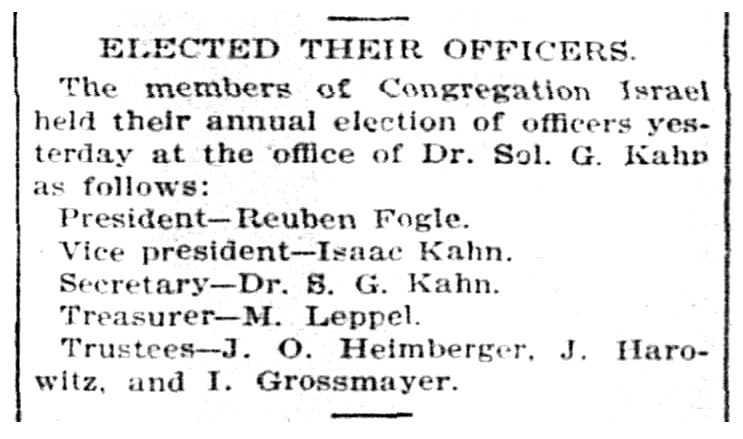
Announcement in 1899 that the members of Congregation Israel held their annual election of officers and listing the elected positions. Isaac Kahn became the Vice President, while Solomon became the Secretary. [521]
Elected Their Officers. (Leadville, Colorado: The Herald Democrat). September 4, 1899. Page 6.
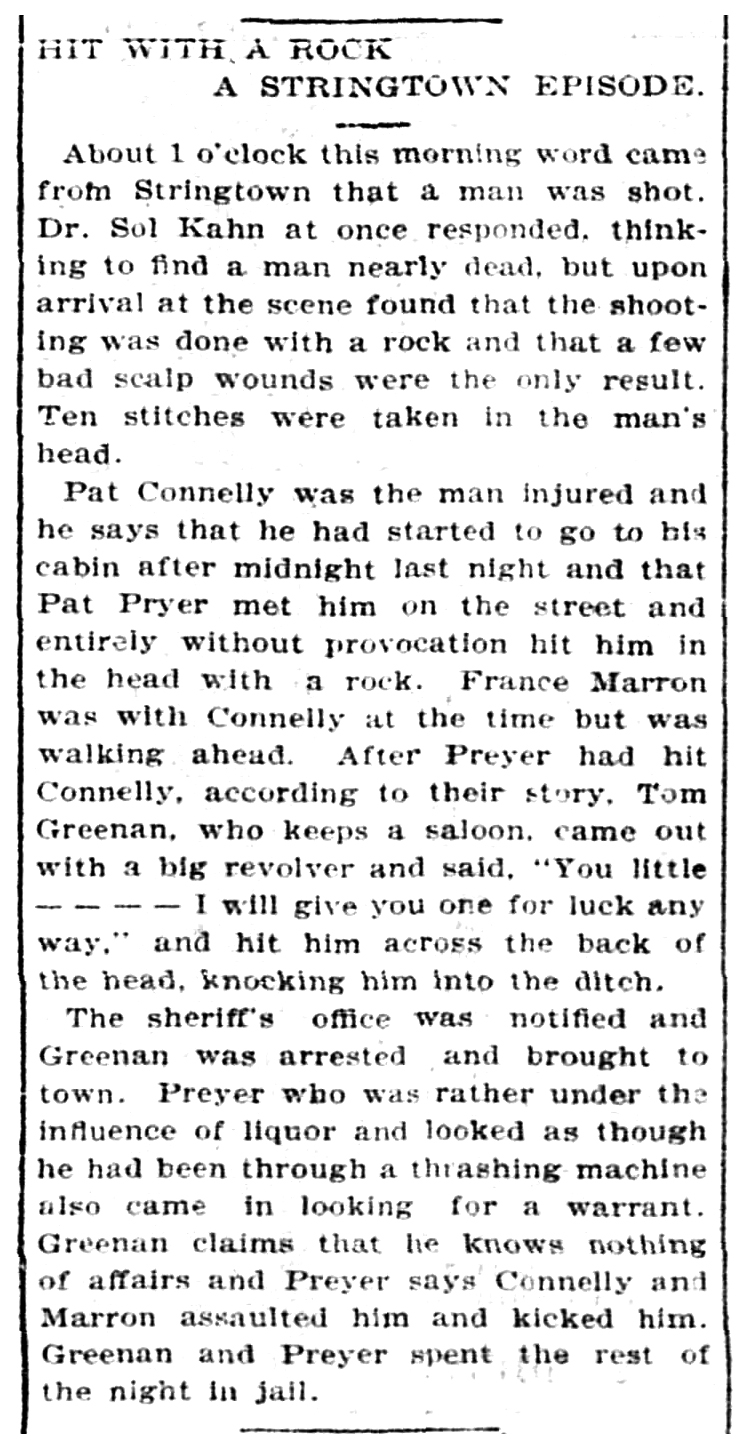
Article telling about Solomon responding to a man, Pat Connelly, “shot” in Stringtown, a rock hit on the head with minor injuries. [523]
Hit With A Rock A Stringtown Episode. (Leadville, Colorado: The Herald Democrat). September 18, 1899. Page 6.
MRS. MARX KAHN DEAD AND MANY MOURN
AN HONORED LIFE.
Mrs. Marx Kahn died at 7 o’clock yesterday morning at St. Luke’s hospital in Denver. She had been operated upon at 9 o’clock Thursday morning, and it was believed that she rallied quickly. Death, however, came very suddenly yesterday, and she passed peacefully away. The remains will be brought to Leadville for internment and will arrive this morning. The funeral will occur to-morrow afternoon at 2 o’clock at Temple Israel, and will be under the direction of the Colorado Chapter No. 2, Order of the Eastern Star, of which the deceased has long been an honored member.
Mrs. Kahn has been indisposed for days at a time during the past year, but with that indomitable energy and zeal displayed throughout her life, she would cast aside these ailments and appear among her friends and family, as cheerful and apparently as well as ever. But the family noted gravely the growing weakness and ailment of the parent and when about ten days ago she was taken to Denver by her son, Dr, Sol G. Kahn, they felt very much alarmed and looked at the situation ruefully.
In Denver it was declared that the patient must undergo an operation, and all of the family who could leave went to that city to be present at the critical time. The husband; Mr. Marx Kahn, Mrs. Carrie Mayer, Misses Tillie and May Kahn. Dr. Sol G. Kahn and wife and Dr. Maurice Kahn were present at the hospital and were quite encouraged when the patient successfully passed through the awful ordeal. But the hope of recovery was of short duration, and even more quickly than she rallied from the operation did the patient show signs of weakness, after a very satisfactory night, and expired suddenly Friday morning.
The hand of death had fallen heavily on the family of the Kahns, who are among the pioneer residents of Leadville. It had been less than a year since the sister of the deceased, Mrs. Isaac Kahn, passed away, and a short time before that both Dr. Lee Kahn and his little son died. Mrs. Marx Kahn mourned deeply the loss of her sister, and while inward signs of grief were seldom exhibited, the gnawing at the heart of this dear, good soul was indeed a constant menace to her health.
The news of the death of Mrs. Marx Kahn will be received with universal regret. She was beloved in all circles; she had no enemies and her friendship was that of true sincerity. Her family was very dear to her, but she exhibited the same warm token of regard for her friends. She never had a harsh word to utter against any one and in the hour of trouble she was ever ready with her assistance. It was such little deeds of kindness, such consuming words in time of need, such geniality and honesty toward one and all, that endeared Mrs. Kahn to the community and that have made for her and her family a large circle of warm friends, who grieve with the bereaved ones in an inconsolable loss. The home life of the deceased was a happy one. Surrounded by a devoted husband and family, the home circle was ever a cheerful one and the bright light that has been extinguished will leave a darkness-a barrenness-that time alone can render less gloomy.
Mr. and Mrs. Marx Kahn and family came to Leadville in 1880. They are located at 506 East Tenth Street, where they have ever since resided and where, with combined energy, they have established their large business. The couple married April 26, 1861, in Chicago and moved to Morrison, Ill., where they resided until 1880, when they came to Colorado and to Leadville. The M. Kahn Family, with the exception of Carrie Mayer, who after her marriage, resided in Cincinnati until the death of her husband, has resided continuously in Leadville, and are all located here now. They are Mrs. Carrie Mayer, Dr. Sol G. Kahn, Misses Tillie and May Kahn, and Messrs. Jacob and Edwin Kahn.
The deceased was a member of Colorado Chapter No. 2, Order Eastern Star, and of the Hebrew Ladies Benevolent association, and both societies realize deeply the loss they have sustained. They join with the community at large in extending to the bereaved family, the sincere condolence which alleviated and softens the wounds in the hour of sorrow, but which cannot be healed excepting by the softening influence of time.
[525]
On October 15, 1899, the Ladies Reading Club announced that it was suspending all of its sessions for one month in recognition of the fallen Fannie, one of their founding members. [526] On November 20, Lillie contributed a reading of her paper, Character Sketches of Some Feudal Barons, to the Woman’s Club’s exploration of French history. [527]
On December 22, 1899, while traveling on a westbound train to Salt Lake from Leadville, a freight train crashed into the rear engine of the passenger train, wrecking three locomotives, several freight cars, a Pullman, and injuring as many as 20 passengers and crew. Jake was fortunate to escape without injury. [528]
During 1900, Tillie found herself in the employ of M.J. Frantz’s Ladies Bazaar at 407 Harrison Avenue. [529] In February Tillie accompanied Miss Frantz on a three-week trip to New York City to replenish the store’s stock. [530] In March of 1900, Dr. Sol took delivery of a new horse team and buggy that raised envious eyes on the streets of Leadville:
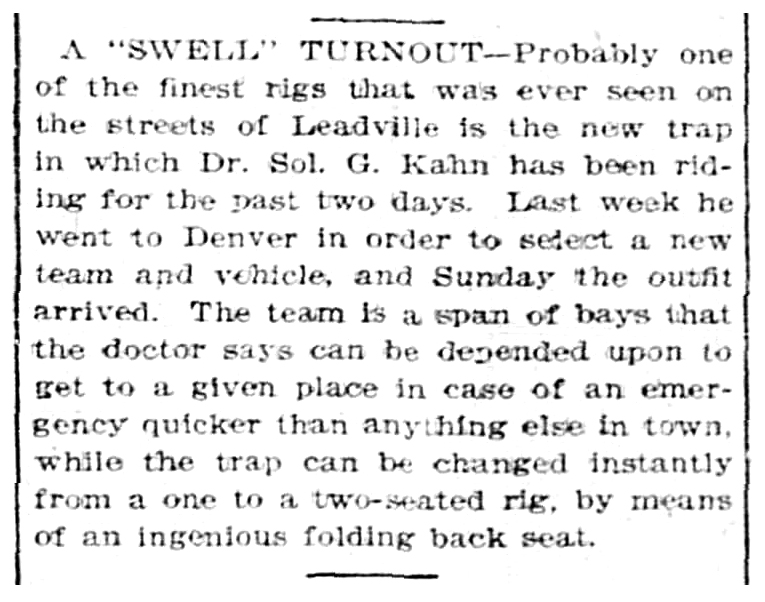
Small article reporting that Sol Kahn recently gained a new trap and team of bay horses. A trap is a light carriage with springs, and bay refers to a horse that is usually reddish or brown with a black mane and tail. [531]
A Swell Turnout. (Leadville, Colorado: The Herald Democrat). March 15, 1900. Page 8.
On May 14, 1900, Dr. Sol purchased the home of Margaret S. Todd, located at 118 West 8th Street, for $1,750. [532] There is no indication the family ever used this property as their residence, [533] although the Kahns did live at several residences in this two-block area of 8th Street. Jake, Dr. Sol and Ruth Kahn were all present at a party in honor of Nettie Goldsmith [534] Pelta [535] at the home of Celia Pelta Block [536] on July 21. [537]
On January 13, 1901, Dr. Sol was elected “physician” [538] at a meeting of the Violet Circle. [539] On March 8, Dr. Sol returned to Leadville after two months of post-graduate study in New York City. [540] While it’s unclear when Sol’s first stint as the Leadville City Physician ended, it appears that he held the office at least twice; his second term was noted in April of 1901:
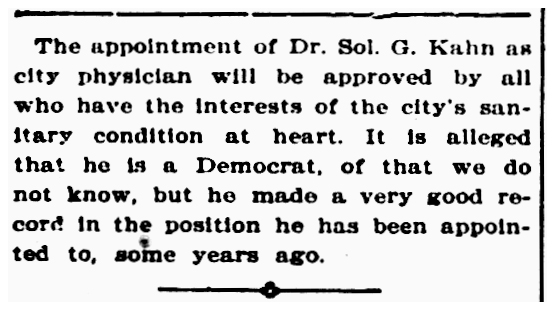
Short snipped article noting that Sol Kahn was appointed as city physician. [541]
The Appointment… (Leadville, Colorado: The Herald Democrat). April 16, 1901. Page 4.
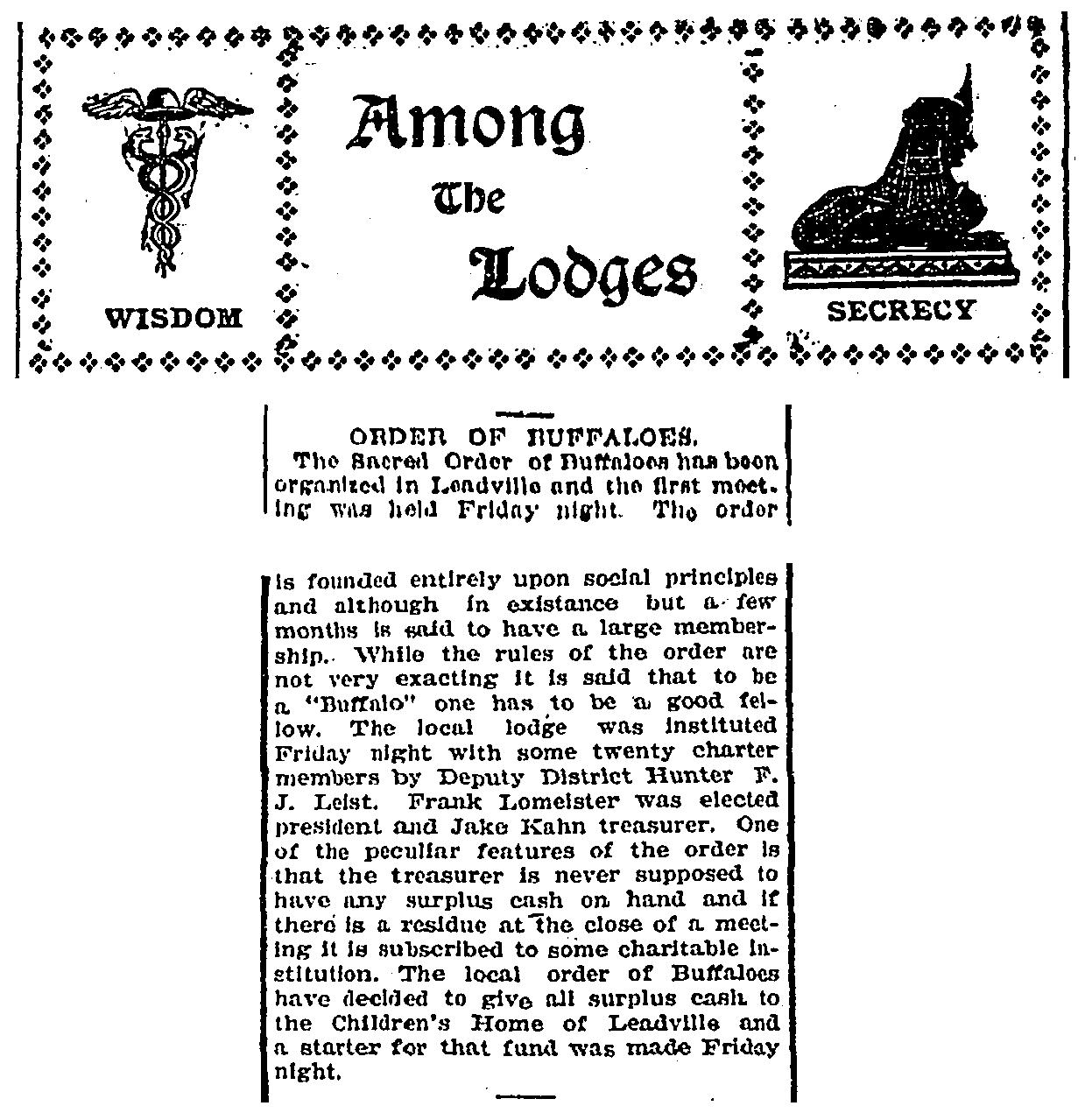
The Sacred Order of Buffaloes was established in Leadville in March of 1901 with Jake Kahn elected as Treasurer. [542]
Order Of Buffaloes. (Leadville, Colorado: Carbonate Chronicle). March 18, 1901. Page 8.
Dr. Sol spent the first few months of 1901 in New York taking a post-graduate course and returned to Leadville on March 8, [543] to cope with a growing public health crisis. During the spring of 1901, as city physician, Dr. Sol was asked to manage the city’s response to an outbreak of scarlet fever and diphtheria threatening the public health that now bordered on an epidemic. At a meeting on April 18, city officials under Dr. Sol’s leadership issued “…a circular for the information and guidance of the public in cases of contagious diseases.” Mitigation guidance included a strict quarantine order that required all family members to leave the home of an infected resident or be subjected to the same conditions of isolation as the afflicted. Signs were posted on the exteriors of quarantined homes to warn other Leadvillians to steer clear. Local officials were charged with rigorous enforcement of health standards and cited the carelessness of medical professionals and family members’ ignorance of special health orders for spreading the virus so rapidly:
…It is believed that if all those affected by this circular will act promptly in reporting cases of contagious diseases the moment it appears that scarlet fever can soon be entirely stamped out. The trouble seems to be that parents are loath to report mild cases, forgetful of the fact, apparently, that a fatal case of the disease may be contracted from a mild one. Attention is also called to the ordinance which prescribes a penalty for any failure on the part of the physician or the parent in reporting these cases.
The fear of quarantine is of course the chief trouble in the work of the health board. However, this is the only practicable method to deal with the present situation and the board feels that if there is a cheerful compliance with the regulations as prescribed the city will be free from contagion in a comparatively short time… [544]
There is further evidence that the outbreak of scarlet fever was so severe that it caused the county to maintain a community quarantine facility, or as it was more commonly known at the time, “pest house,” to curb the spread of disease in the mining camps among a class of residents that did not live in an environment that promote recovery from illness. As noted in a meeting of the county commissioners on July 7, 1901, measures were addressed to intensify the efficacy of protocols that were becoming chaotic within the makeshift facility. There seemed to be great confusion over whom had the ultimate authority to make medical decisions, and Chairman Hinckley made the following comment:
“…But we ought to summon City Physician [Sol] Kahn as a witness to have him say whether he went out to the pest house to examine those patients, or whether he did it in town. He has no right to go to the pest house without an invitation…” [545]
In fact Sol’s own wife, Lillie, may have been a victim of the outbreak herself. It was noted in the Carbonate Chronicle newspaper on April 22, that she was “… rapidly recovering from a severe illness…” [546] The same was also said of his brother Edwin, during October of 1901. [547] For Thanksgiving, Carrie hosted dinner for Charles Sands, [548] his wife Sadie, Dr. Sol, Lillie and Miss Amy Hermann, while Tillie hosted an informal dinner party of her own for friends. [549]
Dr. Sol’s family was close with the Adolph Schayer brood, [550] evidenced by Dr, Sol’s election as an officer for the Temple Israel congregation while Adolph served as Temple Israel’s cantor from 1890 to 1909. [551] Edwin and his cousin Herman Kahn would assist as pallbearers at the funeral for Esther Schayer, [552] Adolph’s 15-year-old daughter who died tragically from appendicitis on May 9, 1901. [553]
On June 11, 1901, the Leadville High School Alumni Association, led by their president and class of ’97 representative May Kahn, hosted a banquet for the class of ‘01. Edwin served as a representative of the class of ‘93 and as toastmaster for the evening’s festivities. [554] After a meeting of the Colorado State Medical Association where he gave an address entitled A Pioneer Physician, [555] which homing pigeon enthusiasts James Bilton and Robert Walker attended, Dr. Sol released two of their carrier pigeons from the Brown Palace Hotel in Denver on June 17. One returned to Leadville within 24 four hours; the other had yet to arrive. [556] Further reports reveal that Little Checker made the trip back to Leadville in 12½ hours. The second pigeon, Messenger, was still missing. In an odd coincidence, a third pigeon, Merry May, which had been released at Buena Vista, Colorado (35 miles south of Leadville) a year earlier, finally returned home. [557]
On June 23, 1902, Jake and May left Leadville for several weeks to the Steamboat Springs, Colorado area. [558] In July, the personal columns noted that Lillie and Ralph would soon leave Leadville for a visit to Denver. [559] On August 10, Edwin attended the birthday party for Hattie Cohn at her parents’ home. Edwin won first prize in a contest where players guessed the name and home state of famous actors and actresses from magazine photos. [560] At the annual organizational meeting held September 1 at Temple Israel, Dr. Sol was elected president of the congregation. [561] The following article details how crucial Marx Kahn’s economic enterprise and family were to the Leadville community:
The family grocer is a business character who probably, more than anyone outside of the professions, can become the friend and adviser of his patrons. Especially is this true when acquaintance extends over years, and has been characterized in a business way by straight-forward, honorable dealings and a courteous, appreciative response to the needs of the trade.
This pleasant relationship exists in the business of Mr. Marx Kahn, family grocer, conducted since 1880 at 500 East Tenth street. Here he has raised an estimable family, and has seen his trade grow even in advance of the growth of Leadville around him, from a very modest and limited stock and clientage to what it is now, viz: one of the most important in the city, employing twelve people, with two teams and two single wagons to deliver the daily sales which extend to all the small settlements and mining centers for miles over the hills.
In addition to the substantial store at 500 East Tenth Street, M. Kahn has two warehouses, each capable of storing at least ten carloads, and which enable him to secure freight rates and take advantage of the markets in fancy and staple groceries for the benefit of his customers.
For hundreds of families “Kahn’s grocery” is truly a household word and as already intimated there is a social and friendly cast in the relations between merchant and customers that dignifies it and differentiates it from the ordinary commercial house. [562]
On December 12, 1901, Dr. Sol was summoned to court to testify in the case of the People V. James McDonell, a local police officer. It seems that in the execution of his duties, McDonell arrested one Bert Cassidy “...for engaging in a fight on State Street in which he knocked his opponent unconscious…” While removing Cassidy to the jail, the man broke free and ran away. McDonell ordered Cassidy to halt, and when his order was ignored the officer fired his revolver twice. One of the bullets fatally wounded Cassidy, leaving McDonell to declare the shooting an “accident”:
…Dr. [Sol] Kahn swore that Cassidy’s death was caused by a bullet wound. Dr. Kahn testified, further, that he was sent for after a fight had occurred on State Street between Cassidy and Fisher. He said that he met Policeman McDonell carrying Cassidy to jail, and that the officer and prisoner returned with him to State Street. Fisher, so Dr. Kahn stated, was lying insensible in the Pioneer Saloon. The witness testified that he slapped the unconscious man’s face, helping to revive him, but without success. McDonell, at this juncture, so he stated, asked, “How is he?” and received the reply from the physician, “not good.” The policeman then started back to the jail with Cassidy…
Dr. Sol’s testimony was effective and no witness for the prosecution connected McDonell to the firing of the weapon. After 10 minutes of deliberation the jury returned a verdict of not guilty. [563]
On December 26, 1901, both Sol and Marx were recorded as founding board members in the articles of incorporation for the newly formed Colorado-Manhattan Gold Mining & Leasing Company. [564]
During January of 1902, reports noted that Jake Kahn would be on a month-long trip to “…Cincinnati and the east…” [565] On April 1, Dr. Sol leased the home at 127 East 8th Street from Mrs. Cornelia Evans. [566] Cornelia Evans was the wife of Will Evans, president of the Denver Tramway Company, whose father John Evans was appointed territorial governor of Colorado in 1862 by President Abraham Lincoln. [567] The Denver Tramway Company struggled after automobiles began to dominate transportation and was absorbed by the creation of the Regional Transportation District (R.T.D.) in 1969. [568] A career railroad man, Evans was in the employ of the Denver & Rio Grande Railroad during his time in Leadville. [569]
On April 12, 1902, May announced her engagement to successful Leadville merchant Theo Baer. [570] Dr. Sol was elected vice president of the Colorado State Medical Society at its annual meeting in Pueblo on June 28. [571] On September 13, Edwin and Jake hosted an elaborate party that included a smelter tour followed by a late afternoon lunch at the family home served by Tillie and May. [572] At their annual meeting at Temple Israel on September 29, 1902, Dr. Sol was elected president of the congregation. [573]
Dr. Sol, the Leadville editor for the Colorado Medical Journal since 1896, [574] contributed the following article to its 1902 edition:
History of the Pioneers in Medicine in Lake County.
By SOL. G. KAHN, M.D., Leadville, Colo.
___
The history of the pioneers in medicine in Leadville and its vicinity dates from the boom of 1879, which reached its climax in 1880. Although mining was carried on in California Gulch from the spring of 1860, and at one time there were over five thousand people living in the gulch, very little is known of the people of that time, and the record of only one physician was obtainable, Dr. Henry H. Hewett, who was a combination miner, doctor, deputy United States marshal and deputy provost marshal for Colorado Territory, and when the practice was a little light, would devote his time and energies to pursuing horse thieves, deserters and Indians. Dr. Hewett lived in California Gulch from 1863 to 1866; he then considered the camp played out, folded his tent, and moved to Georgetown, where he engaged in mining with some degree of success. In 1869 he attended a course of lectures at the Eclectic School of Cincinnati, after which he located in Denver, where he practiced until April, 1878, when the Leadville excitement once more attracted his attention. He returned to Leadville and remained from that time until the early eighties, when he moved to Aspen and was injured by the upsetting of a stage between Aspen and Glenwood Springs, and was taken to Denver, where he died from the effects of the injury. Dr. Hewett was the first county physician appointed for Lake County.
In 1877 lode mining was carried on by some California Gulch miners. H.A.W. Tabor grub-staked two Pittsburgh shoemakers, August Rische and a man by the name of Hook; they discovered ore, and from this small beginning was developed the once famous Little Pittsburgh mine. George Fryer and “Chicken” Bill Lovell found ore in the New Discovery. This started one of the greatest mining camps of the world.
The news spread rather slowly to the outside world. Transportation was carried on by freighters only, and the people living in the near-by settlements were naturally first apprised of the great find. Fairplay, being the nearest of these, found its population diminished very rapidly, and one beautiful morning in early May of 1877, one lonely doctor migrated from there and was seen winding his way over Mosquito Pass to the new Eldorado in search of gold, and it has been said that his search was not in vain. This was the first doctor to locate in what is now known as Leadville. He is our friend, Dr. John Law, who is still in active practice in the city. Dr. Law has been closely allied with everything pertaining to the practice of medicine from the incipiency of the town to the present time. He acted as coroner of Lake County in its early days (when pickings were good), and filled the offices of county and city physician for over ten years, and was on the staff of the G.A.R. [575] Hospital, one of the first institutions of its kind in Leadville. He was also one of the founders of St. Luke’s Hospital, which is still owned and controlled by him.
In 1877 and 1878 the men of pills and pellets, as well as those other callings, came straggling into the new mining camp. The second physician who was lured here by the tales of the great find was Dr. J. Ernest Melere, who came to Leadville from Georgetown in the spring of 1878. He was prominent in the medical profession of this locality, having been the first city physician of Leadville, and occupied many positions of responsibility during his residence in this community. The Cripple Creek fever attacked him in the fall of 1896, when he migrated to that district, where he still resides.
From this time on it is impossible to ascertain the rotation in which the physicians appeared. The town had a mushroom growth, and the setting sun would disclose only a few doctors’ signs, when the rising sun the following morning would show many additions. As near as can be learned, the third physician to locate here was Dr. Azor A. Smith, who came to Leadville in 1878, practiced medicine until appointed postmaster in the fall of the same year. At the expiration of his term of office he resumed the practice of medicine, which he continued until 1892, when he located in Anaconda, where politics again claimed him and he was elected Justice of the peace. We last hear of him as a citizen of Baxter Springs, Kan., where he is engaged in the drug business, which he appears to find more profitable than practicing medicine in Colorado.
Prominent among the early practitioners of this district were Drs. D. H. Dougan, J. H. Heron, W.N. Burdick, F. F. D’Avignon, O. H. Simons, J. J. Crook, Addison Hawkins, A. W. Eyer and A. C. and A. M. McClean. Only three of these are to-day residents of Leadville, namely J. H. Heron, A. M. McClean and J. J. Crook. The majority are now reaping the harvest of their early labors. Some have abandoned the practice of medicine and are following other vocations. Only one of the above mentioned, Dr. F. F. D’Avignon, has joined the silent majority.
Hospitals - St. Vincent’s Hospital, the first hospital of Leadville, was planned and built by the Rev. Henry Robinson, assisted by Dr. John Law. Its doors were first opened in March, 1879, with accommodations for twenty-five patients. The hospital had no staff at that time. Any physician was privileged to take a patient to the hospital. The county and city patients were treated there. The first physician to be connected with the hospital in an official capacity was Dr. J. H. Heron, who was appointed in the fall of 1879. The hospital has been added to from time to time. To-day it accommodates seventy-five patients. The original building and several additions were of wood. In the past twelve months a fine brick and stone structure with modern equipments has been built, testifying to the growth and necessities of the town.
The Union Veteran Association of Leadville was a body of men composed of ex-Union soldiers and sailors of the civil war, and such persons as were connected with the army in other than military capacity. They were banded together for the purpose of rendering assistance to one another, and old soldiers and sailors in general. The hospital facilities of the town being rather meager, the idea of a hospital and home for the exclusive use of sick and invalid soldiers was conceived. A grant of 160 [576] acres of ground had been given the association by act of Congress in 1879 for cemetery purposes on conditions that it be used for this purpose only. A hospital was built upon this ground in 1880 with the capacity for thirty patients, and was supplied with, at that time, modern conveniences. The hospital was continued as such until the organization of the G. A. R. in 1881, when in November of that year James A. Garfield Post was started in Leadville, and the Union Veteran Hospital was transferred to that organization and the name changed to the G. A. R. Hospital. It was discontinued in 1885. During the existence of the hospital all the physicians belonging to the association were elected to the staff, which consisted of Drs. Robert McDonald, J. C. Whitehill, O. H. Simons, G. H. Moulton and J. J. Crook.
St. Luke’s Hospital of Leadville was originated and owned by four physicians of the city, namely, Drs. John Law, Oliver H. Simons, S. Arthur Bosanko and Alexander McClean. Its doors were first thrown open in March 1885, with a capacity for thirty patients. The hospital has continued to flourish and has from time to time been remodeled and enlarged. Some time ago a fine operating room was added, and it is to-day one of the recognized institutions of the city. Another hospital of small capacity was in existence a short time in 1879 and 1880, known as the Ladies’ Relief Hospital, but it is difficult to learn at this date who organized it or by whom it was controlled. [577]
The medical society of the county and district is known as the Lake County Medical Association. It was organized December 30, 1880, with Dr. H. Steinau as the first president. Nineteen physicians signed the charter list, ten of whom are known to the writer, and retain interest of some kind in our city. Only four are yet members, three being active, Drs. John Law, J. J. Crook and J. H. Heron, and one, Dr. D. H. Dougan, has been placed upon the honorary membership list. The society does not hold regular meetings at present, but at times is very active. It frequently lies dormant for a few months, until something occurs to infuse new energy into the slumbering organization,when it will again flourish for an indefinite period. Its present membership is twenty. The society has done some excellent work and will, no doubt, continue to exert a beneficial influence over the medical fraternity of the community.
[578]
May Kahn married Leadville entrepreneur and Temple Israel relief cantor Theodore Baer [579] on January 27, 1903:
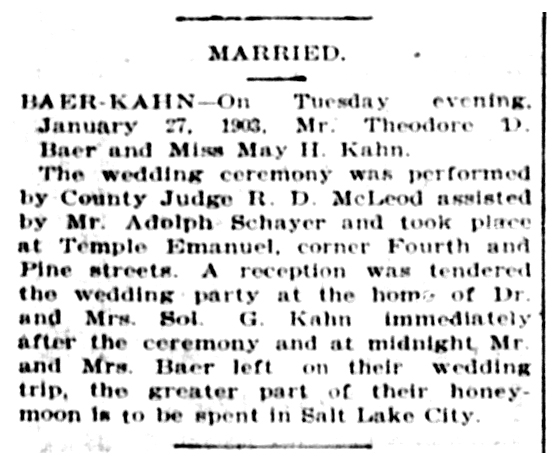
Notice announcing that Theodore Baer and May Kahn were married on January 27, 1903. This article erroneously identifies Temple Israel as “Temple Emmanuel”, which was the Reform synagogue located in Denver. [580]
Married. (Leadville, Colorado: The Herald Democrat). January 28, 1903. Page 3.
In addition to his importance within the Baer brothers enterprises, Theo also served as a part-time cantor for the Temple Israel congregation. [581] The young couple made their new home at 214 W. 7th Street. [582] May and Theo’s marriage lasted only until 1910 when, shortly after the couple relocated to Salt Lake City [583] in April, Theo suffered a fatal heart attack on September 22. [584] By 1916 May was reported residing in Southern California. [585]
Edwin Kahn worked for Marx from 1894 [586] to 1906. [587] He started out as a clerk but achieved manager status in 1903. [588] Ralph became a member of The Educational League, an academic group located in Denver. [589] On May 22, 1903, Lillie’s father, Samuel Rose, died in the Denver home of her sister, Irma Rose Barnett. Samuel’s health had been declining for several weeks, and both daughters were at his bedside when he passed. [590] Samuel Rose, who had become a successful Denver real estate broker, was rather wealthy, and upon his death left his two daughters Lillie Kahn and Irma Barnett significant holdings that included $5,000 in quarter-annual payments for the duration of their lives. Dr. Sol Kahn, and Irma’s husband, Marcus, were named co-executors of Mr. Rose’s estate. [591] A notice appeared in The Herald Democrat explaining that Mr. Rose conveyed half of the deed for two Leadville city lots to Lillie and her sister Irma for the consideration of one dollar, but it is unclear what date this transaction took place. [592] On June 15, 1903, Edwin represented the officers of the high school alumni association at their dance held at the New Armory Hall. [593]
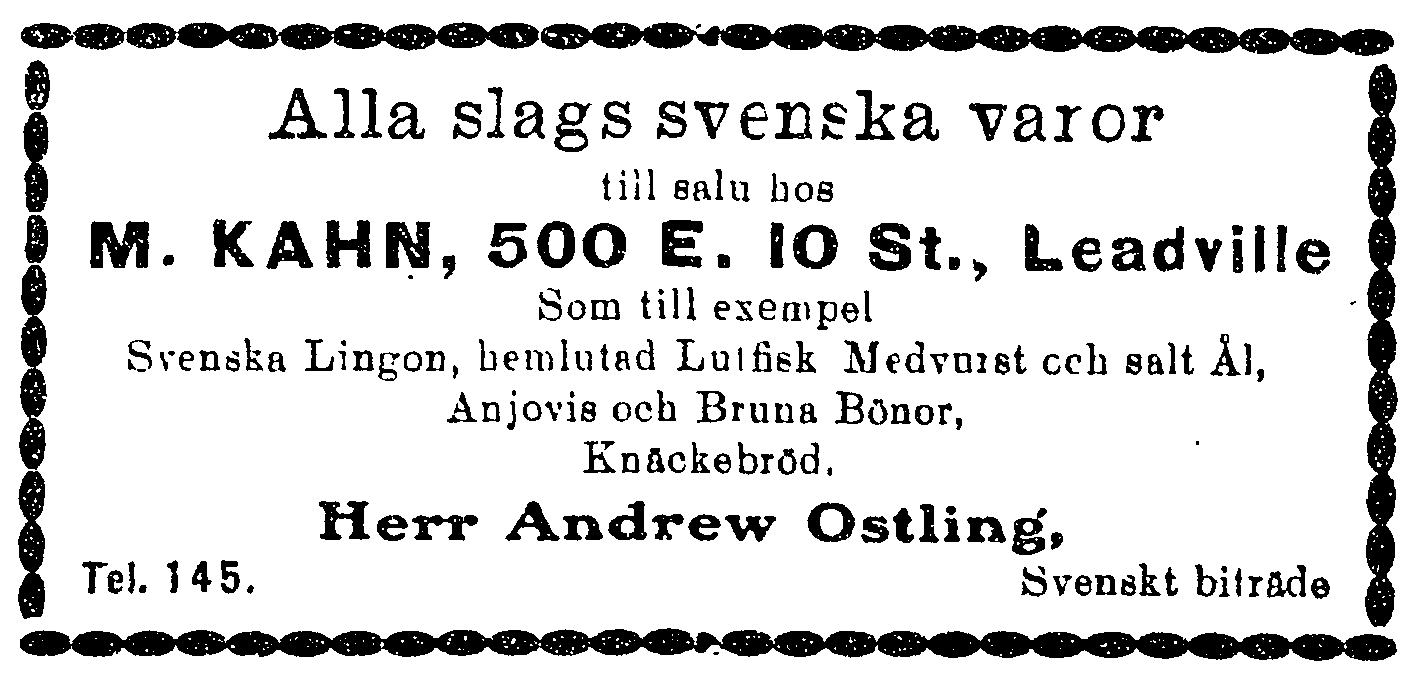
This advertisement appeared in the Svensk=Amerikanska Western, a Swedish language newspaper published in Denver. The advert shows:
Alla slags svenska varor
till salu hos
M. Kahn, 500 E. 10 St., Leadville
Som till exempel
Svenska Lingon, bemlutad Lutfisk Medvurst och salt Ål,
Anjovis och Bruna Bönor,
Knäckebröd.
Herr Andrew Ostling,
Tel. 145. Svenskt biträde
A line by line translation is:
All kinds of Swedish goods
for sale at
M. Kahn, 500 E. 10th St., Leadville
For example
Swedish lingonberries, pickled lutfisk [stockfish] with Medvurst [smoked pork sausage] and salted eel,
anchovies and brown beans [baked brown beans],
crispbread [rye crackers].
Mr. Andrew Ostling,
Tel. 145. Swedish assistance.
Alla slags svenska varor. (Denver, Colorado: Svensk-Amerikanska Western). January 1, 1903. Page 5.
In March of 1904, Jake signed as a surety on the $500 fireman’s bond for John Rice. [594] In January of 1904, Leadville was in the midst of a public health crisis attributed to bacteria in the city’s water supply. Dr. Sol Kahn noted that Leadville’s overall sanitation was a serious contributor to the issue and ordered that scavenging license requirements were suspended and that, “Every man who has a team or a horse and wagon is wanted to go to work in the effort to clean the city.” [595]
The following appeared in the March 6, 1904 edition of The Herald Democrat newspaper:
THOROUGHLY LIMED Yesterday marked the finish of the official lime wagon. The work of disinfecting the city of Leadville which was undertaken more than a month ago by the local health department and which has been carried out under the direction of Special Health Officer Kahn, was completed yesterday and the highways and byways of the city were last night declared officially disinfected and free from contagion. Although one occasionally hears an inquiry about the health of the city, it is generally conceded that all danger from the fever which threatened the health of Leadville in January and the early part of February is past. There have been no new causes of the fever for three weeks and no deaths during that period from that cause. The patients who were afflicted are reportedly nearly well and the outlook is that Leadville will enjoy its normal good health during the balance of the year. [596]
On April 5, the city council voted to uphold another of Dr. Sol’s public health orders that prohibited teamsters from washing their horses on the streets of Leadville. This, the doctor warned, was one of several orders that enabled the city to control “polluting the ditches” in town. [597] At the annual state medical assembly during October, Dr. Sol was appointed as the Colorado delegate to the American Medical Association convention held in June at Atlantic City, New Jersey. Dr. Sol was also selected as the state delegate for the Tuberculosis Congress of the World held at Washington, D.C. during April of 1904. [598]
On March 27, 1904, Dr. Sol was called before the City Council to discuss a public health issue after finding George Morrow, a former saloonkeeper, deathly ill and living in a squalid, abandoned cabin at the back of 110 Second Street. The council recognized that this dire situation was not limited to Morrow, and that others who had fallen on hard times were living under similar conditions. Citing the incident as a public health issue, Dr. Sol was then charged with locating these cabins and removing their inhabitants in an effort to ameliorate what authorities viewed as a burgeoning quandary. [599]
At the Excelsior Lodge of the United Workmen, Dr. Sol gave a lecture on “Germ Theory of Disease” on April 3, 1904. “The doctor held the close attention and interest of the members throughout his lecture, avoiding as much as possible the technical terms and phrases incident to a lecture of that character.” [600] At the group’s meeting the following week, Dr. Sol won first prize in a High Five card party April 9. [601]
Edwin served as an usher for the funeral of The Herald Democrat owner and editor Jacob Heimberger [602] at Temple Israel on June 1, 1904. [603] On July 3, Dr. Sol retired from his position as Master Workman for the Excelsior Lodge No. 5 of the Ancient Order of United Workmen. The lodge presented him with a gold “Past Master” badge as appreciation for his service. [604] Jake was a committee member for the Colorado Arkansas Valley Racing Association and served as a judge for the three-day “Leadville Day” horse races that began on August 11. [605]
On August 27, 1904, the following article appeared in the Twin Lakes Miner newspaper:
Death of Mrs. Noble a Sad Tragedy Caused by Hysteria and Despondency
Last Saturday night at Holt’s hotel [Twin Lakes, CO], Mrs. Bertha A. Noble, during an attack of hysteria and despondency, shot herself in the abdomen, the bullet penetrating the stomach and intestines.
Dr. Sol Kahn was sent for immediately and on his arrival dressed the wound temporarily. Early next morning, the patient was taken to St. Vincent hospital in Leadville and, at noon, an operation was performed as to ascertain the extent of her injuries. These were found to be of a very dangerous nature. After alternating periods of revival and collapse, Mrs. Noble finally came to her end at 4 o’clock last Wednesday morning.
Various sensational rumors, in circulating during the week, were found to be erroneous and with better understanding of the facts in the case much of the mystery has been cleared up.
Mrs. Noble made a statement that she shot herself and that her husband was entirely blameless for the deed.
In an interview the husband stated that his wife had more than her share of troubles in family matters. She had a son by a former husband and was separated from him for a number of years which was the great sorrow of her life. There had been a discussion Saturday evening about the selling of a table. It was of no serious nature, but the deceased had been worrying about a certain matter concerning herself alone which brought on a fit of despondency followed by the sad ending.
The defunct was 32 years old, she has several brothers who were notified of her death and are expected to arrive before the funeral.
Wm. P. Noble married his wife five years ago in Kokomo [a former satellite village of Leadville located near the retention ponds of today’s Climax mine atop Freemont Pass], they had been living the last two years in Twin Lakes and were highly respected. Mrs. Noble was a woman of unblemished character and great refinement who had made many friends and who at present are in mourning for her unfortunate demise.
After years of struggle, the recent sale of the Ruby mine had put the Noble family on the road to affluence. In our community they own the property now occupied by Willard’s grocery store, Hoover’s sample room and the Post office. [606]
On October 25, 1904 the following appeared in The Herald Democrat newspaper:
JUST A CHARCOAL HEATER- An alarm of fire was caused about 6 o’clock last evening by the sight of smoke issuing from the residence being erected by Dr. Sol Kahn on West Eighth street. The house is nearing completion and a charcoal heater was being used to dry the plaster in the building. The smoke from the charcoal burner filled the house and was pouring from the doors and windows. When the department arrived it was found that no damage was being done by the flames. [607]
Apparently the smoke damage was not extensive, because Dr. Sol Kahn and his family made this address at 120 W. 8th Street their new home by 1905. [608]
Tillie led the first Women’s Club meeting of the 1904-05 season on September 12, 1904; the discussion was on the biography of William Shakespeare and his childhood. [609]
The following appeared in the January 1, 1905 edition of The Herald Democrat newspaper:
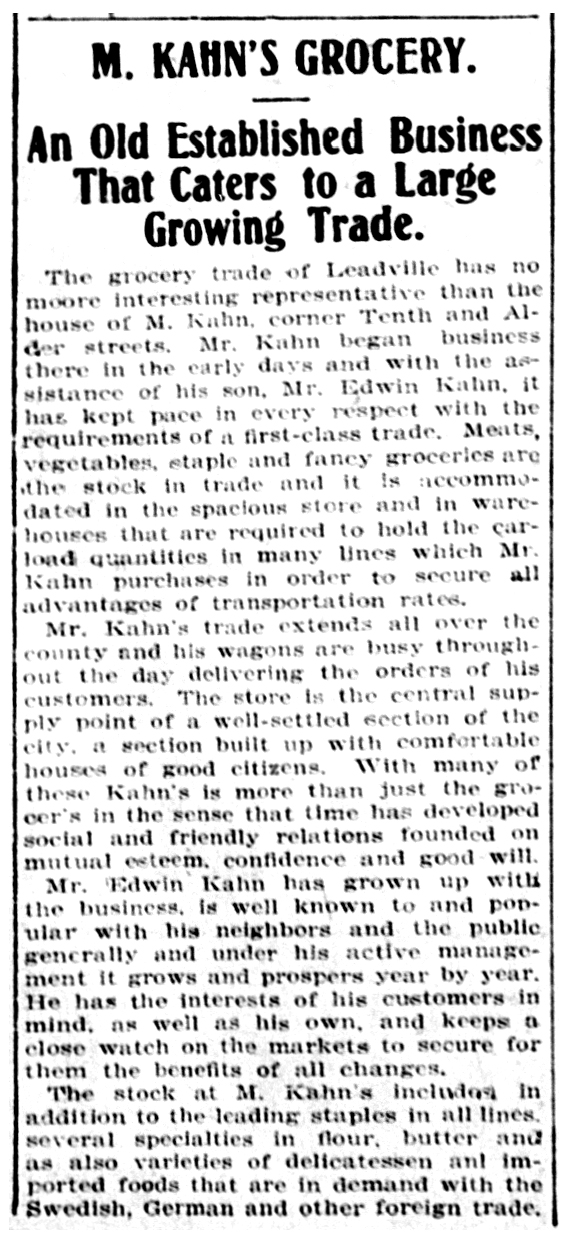
Extensive article in The Herald Democrat describing the grocery store owned by M. Kahn. Extensive descriptions of local businesses were common in Leadville’s New Year’s Day editions newspapers. [610]
M. Kahn’s Grocery. (Leadville, Colorado: The Herald Democrat). January 1, 1905. Page 6.
On January 3, 1905, Jake left Leadville to run the Salt Lake City branch of the Baer [611] Mercantile Company. [612] Jake was the first of the Marx Kahn children to relocate to Salt Lake City, in 1905, and although he moved there to manage affairs for The Baer Mercantile Co., he periodically visited Leadville as an executive of the Baer firm. He is listed in the 1908 city directory as “Vice President. Baer Mercantile Co.” with no local residence. [613] Later that month, at the wedding of Joseph Oliner and Louise Dorn of New York City, Marx “…performed the rites of the Hebrew church and offered the newly made Mr. and Mrs. Oliner, the glass of wine, according to custom, and placed the ring on the bride’s finger…” [614]
May Kahn Baer hosted a dinner party for the Baer and Kahn families at her home on November 12, 1905. [615]
Ralph and his cousin, Evelyn Mayer, [616] attended a skating party hosted by Florence Parks on February 4. [617] On April 22, Ralph attended a party given by Mrs. Dickerman at her home. [618] On May 31, Dr. Sol was elected Grand Physician for all Colorado lodges of the American Order of United Workmen. [619] Dr. Sol also served on the arrangement committee for Leadville’s 1905 Independence Day festivities. [620] On October 25, Dr. Sol performed sleight of hand magic tricks at the Woodmen’s smoker at the Oddfellows hall. [621]
A general article regarding the Jewish community in Leadville appeared in the November 24, 1905, edition of The Jewish Outlook newspaper in Denver and confirms much of what we know about the Marx Kahn family:
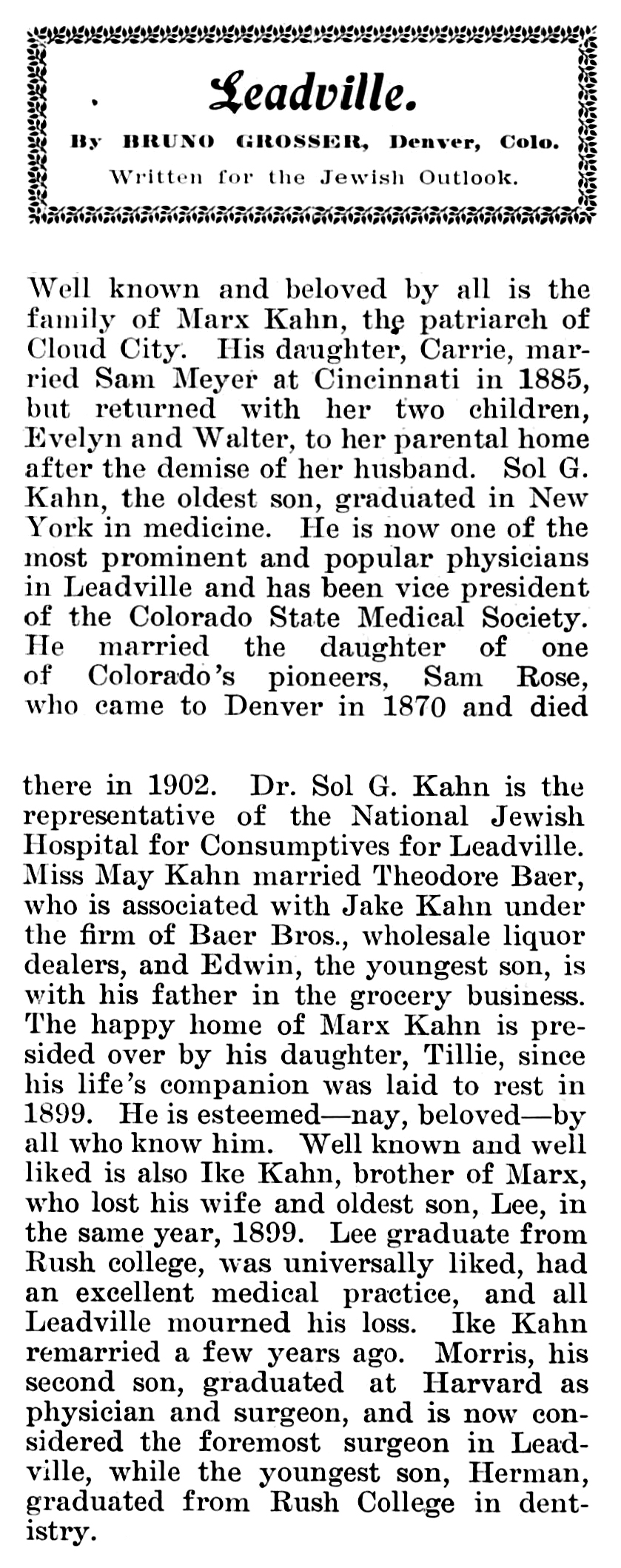
The Jewish Outlook, a weekly journal “devoted to the Jewish Communities of the Rocky Mountain region”, showed a large section dedicated to Leadville Jews that included a warm description of the Kahn family, among many other Leadville Jews mentioned. [622]
Leadville. Bruno Grosser. (Leadville. Denver, Colorado: The Jewish Outlook). November 24, 1905. Pages 45-46.
On January 1, 1906, Tillie contributed the following editorial to the New Year’s Day edition of The Herald Democrat newspaper:
BENEFIT OF WOMEN’S CLUBS TO
THE COMMUNITY
An education is not only a household benefit to the possessor of that education but to all he comes in contact. So is it also true of clubs. Not only are the members benefited, but the community in which that club exists is benefited.
The Woman’s club of Leadville, with the object “to bring the women of this city together for intellectual and moral advancement, and mutual benefit, in social and business relations”-must naturally reflect some good upon the community. Because “in union there is strength” is the great incentive to organization. The contact of the minds of more or less intelligence, with the desire to learn, naturally evolves ideas quite impossible to one alone. Out of the small town clubs has grown the State Federation, and out of the State Federation has grown the General Federation of Women’s Clubs: whose aims are lofty, [wholesome] and inspiring. To better understand the wide field of labor covered by this worthy institution, a partial list of the subjects discussed at the biennial meeting held in St. Louis in May, 1904, will be helpful.
The subject of child-labor was given special attention. Resolutions were adopted and through appeals sent to the state legislators, asking for the enforcement of child labor laws, many states have taken action upon them. This must be recognized as a great step toward advancement in preserving the strength and faculties of our young [men] and [womenhood].
Civil service reform, which has the ring of a political subject, is dealt with in its broadest sense. The Woman’s club is not a political club, but works for the uplifting of its country and institutions.
Extracts from the report of this work by the chairman will best explain: The fact that the work of civil services reform has been undertaken by committees having varied interests, shows the broadness of its scope and must sooner or later convince every one that it is the foundation of our public life and institutions. The work as carried on by committees has been and must largely be the work of education. With the end in view thousands of pamphlets have been distributed for use as collateral reading with history and civil government, in normal, high and grammar schools, and prizes have been offered to pupils for the best essays upon this subject. Too much cannot be said in favor of this feature of education, or the hope of the nation lies in its youth.
The establishment of traveling libraries is another of the very commendable works of the club.
The State Federation and clubs own and control 1,016 of these libraries, which contain 46,206 books. These are sent for a limited time, mostly to the country and mining camp districts, where libraries are scarce and reading matter hard to obtain.
Each state controls its own, through efficient committees. The club women in Colorado alone have contributed $5,000 towards its traveling libraries, and have given these over to the state, under whose control the work now progresses.
Forestry works, including tree planting for decorative purposes and forest preservation is another subject which is receiving much attention at the hands of the committees and results are evident.
For the benefit of those who feel that women’s clubs alienate women from the home, a little inquiry into the domestic science department may be interesting. The committee appealed to each club asking that efforts be made to introduce the teaching of domestic science into every school and higher institution of learning in the land, where girls are pupils. Encouraging reports have since been received from a number of states in which clubs have either given large sums to provide [equipment] for teaching domestic science or have aroused interest through lectures. With the opening of these new departments another problem arose, and one which was giving anxious thought to school boards-the lack of qualified teachers. An investigation was instituted to learn where schools were located w--- [illegible] gave normal courses in this science. It was found that some states are entirely void of this training. We are proud to note that Colorado has two institutions which teach this science, the State Agricultural College, Fort Collins [now Colorado State University]; the state Normal school, Greely [now University of Northern Colorado].
The work suggested and planned by the General Federation is accomplished through State Federations; but it would be impossible to go over the entire work done by the Colorado State Federation. One of their great philanthropic enterprises is the establishment of the scholarship fund. This is a loan fund to enable girls to get a college or university education. The money is loaned without interest, payable when convenient: thirty-two girls have thus far been enabled to graduate. Some requiring help for only a few months. All have paid back the amount loaned to them. Twenty-one have been helped during the past year. At the meeting of the State Federation in Denver in October $800 was subscribed to carry on this work this year.
The following important resolutions were adopted.
“Resolved. That the C.F.W.C. [Colorado Federation of Women’s Clubs] demands the enforcement of the law preventing the desecration of the American flag and its use for commercial purposes.
“That the C.F.W.C. favors legislation for the preservation of the cliff dwellings and also urges that some measures be taken to prevent the effacement of Colorado scenery.
“That the C.F.W.C. heartily approves of the juvenile court and of those institutions that are doing much good for unfortunate and dependent children and trusts that the clubs will carry the knowledge of their merits and methods throughout the state.
“That the C.F.W.C. asks club women to interest themselves to remove the copyright in America on our works of art, also to have duty removed on importations of photographs, paintings and statuary.”
These are the large questions which are treated by the federation of clubs. The individual clubs all lend assistance in their accomplishment and perfection. But there is also another side of club life. The study meetings which are weekly and occurrences, for the development [of] the mind and interchange of thought, act as the stimulus in greater things.
It has been truly said that the Woman’s club is a national university for women, giving education in special forms to women, who possibly could not attend the regular course of instruction. Let the good work go on.
MATHILDE KAHN [623]
On January 6, 1906, Dr. Sol Kahn gave the following address to the United Workmen:
UNITED WORKMEN
GROWING ORDER
___
Retiring and Incoming Master
Workmen Make Happy
Addresses to Members
___
Wednesday night last at the [annual] installation of officers, Excelsior lodge No. 5 A.O.U.W., Dr. Sol Kahn delivered the following address:
“It has been customary for the installing officer to make a few remarks, and as your committee has requested me not to overlook the custom. I have selected an article, I saw in a fraternal paper not long since and have changed it, to comply with this occasion, as it appeared to me to be rather appropriate.
“We are all starting on the new year with our recently installed officers in their respective stations. I commend these new officers in the fraternal consideration of the membership. They have been elected to serve their order and you. Their task is not an easy one. On them devolves the responsibility of the growth and advancement of their lodge during their term. They have no motives other than to help, to please and to assist in making the most progressive one in the jurisdiction. They pay in services for the honor they receive and it is not improbable that they may sometime err in judgment and when they do, rather than upbraid them, let members bear with them, and no one will notice the indulgence quicker than the erring officer.
“To the Master Workman I desire to say this; He is the pilot in command of the craft. To him has been assigned the responsibility of steering the ship into safe waters for the next six months. He must be impartial. He must see that inactive members are given an opportunity equal to the most favored ones. He must exercise rare tact, because he is setting an example. He must see to it that fraternity prevails, that no partiality is shown from his station. He must study the particularities of his members and find out their qualifications, so that when he appoints a committee. He can select members who are eminently fitted for the particular work required. He must handle with the greatest skill the individual in his lodge is known by the descriptive and suggestive name of “kicker.” He is found in all lodges, and too often the mistake is made of ignoring him. He is seldom without brains, usually has a good voice, and a catchy way of attracting to him a dissatisfied element of the lodge. My suggestion is to make him useful by [never] attempting to discredit him. Appoint him on working committee, ask his judgment and advice. Making him feel that he is of some consequence, and you create in him a desire to build up rather than tear down, and you have converted to a disagreeable, ugly, dissatisfied obstructionist into a sweet tempered, faithful, loyal and active member.
“The Master workman should be very careful never to lose his temper. He is arbitrator of all difficulties. Other members may lose their temper, but the Master Workman never; While flush of victory stimulates and encourages the prevailing side and the crush of defeat prompts the losing side to renew the battle at the very first possible moment thereafter, yet they are interesting only to the few participants and average members, the rank and file, the ones upon whom we depend for succor and stability, not participating therein, are annoyed because of the evident ill-feeling engendered by the squabbles, and if they are continued you will find that the membership dwindles to a mere handful.
“[Too] few people appreciate the real ob-member leaves home which is comfortable, member leaves, which is comfortable, cozy and adorned by his loved ones, to pay his weekly visit to his fraternal society. If the meeting is dull, uninteresting, no applications, no initiates, no entertaining features, he contrasts that with his home, and his next meeting night he waivers about going to lodge, thinks of the last meeting, and resolves the doubt in favor of his comfortable fireside. But if on the other hand he finds a goodly attendance, enthusiasm bubbling over, fraternity fairly teeming, a large class of candidates, well instructed officers, a rousing speech or two, and then some work assigned him which is to his liking, the member will come again, and he will bring other brothers with him. If he does not know any other brothers he will bring some of his friends to make members of them.
“I wish at the first meeting of your lodge the officers would see if they cannot devise some plan whereby you may have a larger attendance more attractive meetings, and receive more applications for membership. [624]
On January 14, 1906, word that Jake had found his bride in Salt Lake City reached the Leadville public:
Cards have been received from Salt Lake City announcing the engagement of Mr. Jacob A. Kahn to Miss Juliet A. Marks of that city. The groom is the son of Mr. M. Kahn of this city and formerly resided here, but is now in business in Salt Lake. [625]
Rabbi Alfred T. Goldshaw and Dr. Sol Kahn addressed the Temple Israel Congregation on January 28, 1906, on the subject of joining American Hebrew Congregations in developing a Jewish union. The congregation voted unanimously to join the effort. [626]
The following appeared in the April 7, 1906 edition of The Herald Democrat Newspaper:
Miss Mathilda Kahn leaves for Salt Lake City tonight where she expects to remain for some time. She will attend the wedding of her brother, Jake, before she returns to Leadville. [627]
Jake was married twice; first to Juliet Marks, whom he married at Salt Lake City on April 25, 1906. [628] The following appeared in the April 15 edition of the Herald Democrat newspaper:
Announcements have been received in the city of the marriage of Miss Juliette A. Marks to Mr. Jacob Kahn. The ceremony will take place Wednesday April 25, at Temple B’nai Israel, at Salt Lake. Immediately after the ceremony dinner will be served at the Emery-Holmes. The bride will be remembered as a recent guest of Mr. M. [Marx] Kahn [and] family. The groom is the son of Mr. M. Kahn of this city, and is well known here. The young couple have a host of friends in this city who wish them every happiness in their future. [629]
In July of 1906, Hannah, Julia, and Tillie Frankle visited Leadville from their home in Alliance, Nebraska and were the guests of Tillie. [630]
Edwin and Carrie made a trip to Cannon City, Colorado together on March 20, 1907. [631] In early May of 1907, Carrie would escort Edwin to Denver, where he underwent a successful appendectomy on May 2. [632] On July 2, Dr. Sol lost control of his team and as a result the runaway horses injured him “severely”. [633] He recovered faster than initial reports indicated because on July 30, 1907, Sol met R.W. Miller, who was on route from Sunset Mountain to Leadville seeking treatment for a severe hernia. Dr. Sol was able to alleviate Miller’s pain and escort him to St. Luke’s hospital where his ailments were more appropriately tended. [634] In an odd coincidence, Jake, visiting Leadville from Salt Lake, suffered minor injuries in another runaway incident a week later on July 9. [635]
On July 16, 1907, the following announcement appeared in The Herald Democrat newspaper signifying the finalé for the M. Kahn grocery store era in Leadville:
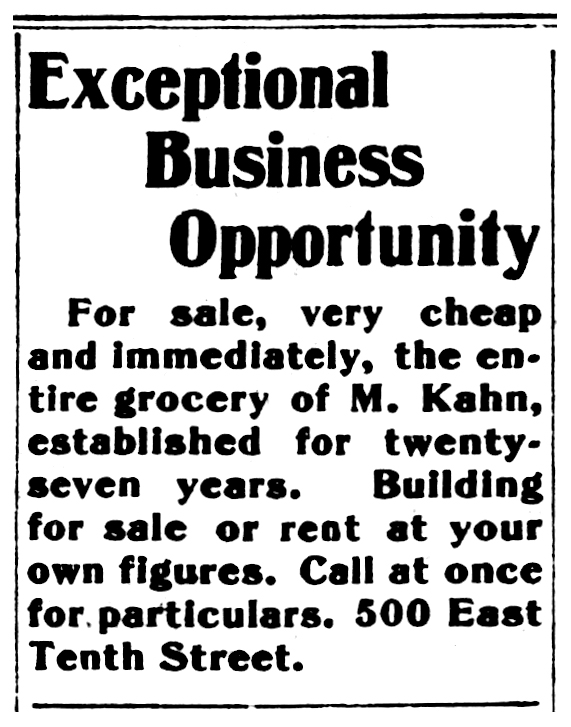
Advertisement by M. Kahn selling the entire existing grocery business at a low cost, as well as selling the building. [636]
Exceptional Business Opportunity. (Leadville, Colorado: The Herald Democrat). July 16, 1907. Page 8.
Marx Kahn continued to live in Leadville until 1908 and then moved to Salt Lake City to be with the majority of his children. [637] Ralph had the “time of his life” when he attended a sleigh ride hosted by Mrs. Robison on January 18, 1908. [638] Tillie was given a bon voyage celebration hosted by Carrie on February 15, [639] and Carrie also followed the family to Salt Lake City.
The following item appeared in the January 31, 1908, edition of the Jewish Outlook newspaper:
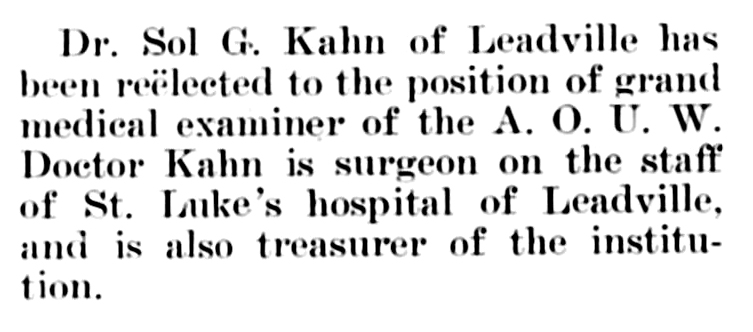
Snippet article stating that Dr. Sol G. Kahn was reelected to the position of grand medical examiner for the AOUW. The use of reëlected is an interesting alternate form of stating re-elected. [640]
Local Items. (Denver, Colorado: The Jewish Outlook. January 31, 1908). Page 7.
On February 17, 1908, Dr. Sol addressed members of the Leadville Woman’s Club on the subject of “The Child in the Home From a Physician’s Standpoint,” [641] at the Methodist church. [642] The following was submitted by Dr. Sol to The Herald Democrat newspaper and is likely the same messaging used in his lectures on rearing children:
Header for article titled Caring For Child by Dr. Sol G. Kahn, MD. [643]
Sol G. Kahn M.D. Caring For Child. (Leadville, Colorado: The Herald Democrat). January 1, 1909. Page 15.
In the physical development of the child, the moral training is a great factor and it should be recognized that the young must be looked after in every way in order to possess the sound mind in the sound body. The brain should not be developed too rapidly. Many a child has the brain developed at the expense of the body. The first care should be to build up a good, strong, healthy body. A healthy growing tree must have good roots; good digestion is as important to the active growing child or to the pupil in the public school as good roots are to the tree. True, [some] children who have slender bodies make fair progress in school work, but with a good body their record will be much better. We must also instill principles of honesty, sobriety and proper demeanor into our children. Parents often complain that children are deceptive, disrespectful, and falsify. Is this to be wondered at, when in some families, the first lessons given the children are in this direction? Parents often dispute and call each other harsh names in the presence of the child, soon the child thinks it can use the same language to the parents that they use to each other. If the parent can speak untruths (and deceive) the child, the child will practice the same on the parent. At times a promise is made, and then forgotten, or made without any intention of fulfillment, the child remembers, but the parent does not; this is altogether wrong, promises to children should not be made rashly and when once given they [should] be carried out to the letter, a child should know that the parent’s word can be depended upon, then we in turn can be depended upon, then we in turn can expect and demand the same of the child.
One of the most difficult problems is to teach a child obedience; subjection of a child to a parent, simply because the latter is physically stronger and can inflict punishment, does not constitute true discipline, it fosters [the] spirit of rebellion against all authority. The child ought to be trained to do certain other things, according to principles of right and wrong. There should be more confidence between parents and their children; the child’s training should be such that its first impulse when anything unusual occurs, be it pleasant or unpleasant, to its advantage or disadvantage, is to seek its parents and confide in them. The parents should meet the child with sympathy and understanding, if a wrong has been submitted the child should be made to comprehend wherein the wrong lay and not to be too harshly dealt with, so as to intimidate, and thereby discourage confession in the future. Many a wayward child has been driven from home by fear of the parental reprimand or punishment, when the leniency and wise guidance might have redeemed the child and saved the parents much sorrow. Parents should take an interest in the doings of their children, they should be more in sympathy with the pleasures and pastimes and be cognizant of their pursuits when absent from home; often unknown to the parents they are following pursuits which in themselves may be innocent, but which are apt to lend to more dangerous things, and ere long, they have drifted from the home and the home influence, and when temptation is placed in their way, are not morally strong enough to resist; even now the parents do not realize that they are at fault and not the child, and that it is lack of home training and influence which has brought this about. Good books and appropriate magazines should be provided instead of permitting indiscriminate reading, which usually consists of blood and thunder stories for the boys and cheap fiction for girls. Every child is entitled to recreation and this should be provided for; there should be some outdoor activity every day, there cannot be too much, many a little girl is a household drudge, every minute out of school is spent in the performance (of) some indoor task, such as carrying a heavy infant, a burden much too great, as the stooped shoulders, and misshapen figures frequently testify. We hear it said that gallantry and the respect toward elders is on the wane. Our children should be taught courtesy and consideration for others. Experience teaches that social customs, even trivial, are founded on good sense and sound ethics. For example the removal of the hat in bowing ought to be impressed on every boy, not as an arbitrary custom, or a servile observance, but as a tribute to womanhood, to old age, and to superior attainment.
Another point on which I wish to lay stress is the bad affect of associates and environment into which our boys are thrown in certain kinds of employment. That boys be educated in thrift, and that they be taught to earn their spending money, or in part their living money, may be well enough, but the kind of employment a child is allowed to accept should be selected by parents with care, and the expenditure be supervised. Boys in the messenger service, newsboys and those in similar employments have access to places like the brothel and wine room, which should be interdicted to the young, for they are brought into contact with much that is vicious and immoral. The temptations to gamble and smoke are special dangers. We cannot too strongly condemn the use of tobacco in any form by young boys and young men. We cannot be too forceful in our protest against it. The effect of its use is not alone injurious to the physical development of the one who is addicted to the habit, but it is also demoralizing. Boys who indulge in smoking always seek those who do likewise, and there is usually a leader who relates his own and the exploits of older persons, and influences these younger boys to perform acts and deeds of which they should be ashamed. The use of tobacco [also] has a peculiarly degrading effect on the moral nature of the young. In addition to making boys tired, stupid, and lazy it renders them irritable, perverse and careless of the rights and feelings of others, besides, in many instances, leading to lying and even stealing. The deleterious effect of tobacco on the muscular system, and in its effect in diminishing the powers of endurance is strongly emphasized by the fact that “Stop smoking” is one of the first injunctions given to an athlete on engaging in training for a race or a game of any kind requiring strength and fortitude. Parents should guard their boys against this pernicious habit which is more easily acquired than checked.
The average boy is wide awake, bright, of inquiring mind and credulous. The average girl remains in blissful ignorance of the sex problem unless she becomes intimate with low companions, who enlighten her regarding matters which have heretofore been a mystery, [for] it is the mystery that shrouds the subject which renders it attractive. It is the secrecy of its elders that piques the curiosity of the child. A reasonably full explanation that satisfies the young mind’s thirst for knowledge, will dissipate the fog of mystery and render the subject no longer alluring.
We must rely on the prophylactic value of very early education. If the anatomy of the sexual organs and their physiology were taught by every mother to her young children as soon as they are old enough to understand and the parent did not wait until adolescence forced to seek the knowledge elsewhere, correct and healthy thoughts on this important topic would take [the] place of the many of the present perverted ideas. When we are brought face to face with the consequence of wrong-doing, and when ignorance of this subject is the only defense, then we first realize how criminal has been the negligence, on the part of the parents.
The period which intervenes between childhood and adult age, should be marked by special care and watchfulness on the part of the parent or guardian. It is a time within which the most vital changes take place in the physical development, particularly in girls. The effect of the mental and physical education and occupation on the health should be carefully watched, and everything which results in increased strain on the body or mind should be avoided.
Exercise in the open air is particularly beneficial and should be encouraged. Employments and diversions which leave no irritation effects may be indulged in.
The excessive attention given to music in female education is directly hurtful by not leaving time for other and more serviceable employments for mind and body; by which the latter may be strengthened against the vicissitudes to which female life is doomed. The time which is usually devoted to this accomplishment can be better spent in healthful physical exercise, by which the material fabric may be fortified against the numerous causes of disease, continually assailing it.
Our children, the children we know personally, the children in the homes we visit, are the ones who will become the [leaders] and the representative citizens of the country. Therefore, let us combat the dangers that may threaten them. Let us continue to spend our time and efforts on their behalf.
[643]
He would give the same lecture a week later to an assembly of United Workmen. [644]
In July of 1908, both Dr. Sol and Lillie traveled to Chicago to retrieve Tillie, who was said to have been “…suffering severely with eye trouble…” [645] On July 9, Dr. Sol was appointed Chief Medical Officer at the 1908 Democratic National Convention in Denver and oversaw the construction of a perfunctory 50-bed field hospital at the event at Denver’s newly built Auditorium Arena. [646] On November 19, Dr. Sol and several of his contemporaries released health department guidance regarding the importance of good dental hygiene in regard to the prevention of many bacteria-related health concerns, noting that “few mouths are in a healthy condition, but in those apparently so, varieties of bacteria (germs) varying from fifty to one hundred fifty can be demonstrated…” [647] Dr. Sol was party to incorporating a new mining company as its secretary and treasurer in December of 1908. The company was formed to rescue the troubled Half Moon claim in the Robinson mining district. [648] Dr. Sol remained a member of the Good Roads Association, a lobbyist group behind the Lincoln Highway project dedicated to building and maintaining an automobile touring road that provided access to key points throughout the American West including Leadville. [649]
On February 9, 1909, Dr. Sol testified on the permanent disability of Mrs. James Bilton, who sued the city for damages after falling on a sidewalk near her home. [650]
The Leadville medical community gave a fond farewell to Dr. Sol Kahn with a grand banquet on June 19, 1909. [651] Shortly thereafter, Dr. Sol, Lillie and Ralph would leave for new adventures in Utah, although evidence suggests that Jake, Edwin and Dr. Sol would frequent Leadville for the next few years. [652] The 1910 United States Census shows Sol, Lille, Ralph and Marx residing together in Salt Lake City. [653]
LEADVILLE MEDICOS SPEAK
WARM WORDS OF FAREWELL
Departure of Dr. Sol Kahn for Salt Lake Occasion
Of Banquet Tendered Him by Fellow Practitioners—
Heartfelt Regret and Cordial
God Speed to Popular Physician.
TOASTS TO HEALTH AND PROSPERITY
Wit, humor and oratory flowed freely last night at the farewell banquet tendered Dr. Sol G. Kahn by his brother physicians of the Lake County Medical society at Odd Fellows hall on the eve of his departure for Rochester, Minn., where he will spend a few weeks prior to his locating permanently in Salt Lake City.
Commingled with the tempting terms of the elaborate menu that demanded the attention of the assembled doctors throughout a greater part of the evening and the brief but brilliant flashes of oratory contained in the toasts responded to by those gathered around the festal board were expressions of friendship and good fellowship for the guest of honor regret because of God speed and success in his new field of endeavor…
…The program of intellectual offerings was peculiarly benefitting the occasion and was by no means the least important feature of the evening.
Dr. E.T. Boyd, who presided, was the first speaker and sounded the keynote to the toast, “love Feast” as follows:
“Notwithstanding that the climate, people and the possibilities in a mining way, of Leadville are unexcelled, yet because of the broader field and greater opportunities afforded by a residence in a city, I dare say that there is not a man present but feels envious of Dr. Sol. Kahn, who, as we know, is about to leave our midst and cast his lot with the profession of Salt Lake.
“Though this little entertainment largely partakes of the nature of a love feast, we are none the less cognizant that often in times past, other feelings than envy and no more Christlike have been engendered between us as a result of misrepresentations, misunderstandings, shortcomings upon the part of some one, etc., but belonging to the noble profession of medicine, whose principal tenet is charity toward all mankind, we have this night invoked the use of the mantle, which is little if at all work, and through its beneficent influence with the knowledge that he, Dr. Sol. Kahn, will no longer be a part in the fight for the pursuit and possession of the elusive dollar, we are enabled to forget the faults common to humanity and inscribe his virtues upon the tablets of memory.
“Some years ago, upon the occasion of the death of a colleague, Dr. Reed, Dr. Lee Kahn called together the members of the profession that fitting action might be taken; at this meeting it was decided to attempt to resuscitate the then hibernating Lake County Medical association. Our efforts were preeminently successful, but there have been premonitory symptoms of relapse from time to time on several occasions. The process would have continued fatal termination had it not been for the strong arm of Dr. Sol. Kahn and his willingness to assist in performing artificial respiration.
“So long as the title ‘The Lake County Medical Association’ exists, its founders, Dr. Law, D’avignon, Hawkins, Carrington and associates, will be remembered, and by the same token those from whom the association has delivered its subsequent sustenance will not be forgotten, and not the least of these is Dr. Sol. Kahn.
“Coupled with our envy is heartfelt sympathy because of the grave responsibilities he is about to assume by moving to a state where one death may make a dozen windows; but let us hope that his medical skill may serve to prevent so dire a calamity and that his mortality may occur principally among the female sex.
“To those of us who are to remain upon the mountain top, recognizing that ‘to err is human,’ and that it is second nature for a doctor to talk about his fellow practitioners, I would say remember and ponder well the following:
“‘That there is so much that is had in the best of us, and so much that is good in the worst of us, that is does not behoove us to say anything about the rest of us.’
“Which is equivalent to saying in the language of Elbert Hubbard, ‘any man who thinks he is very much better than others, isn’t.”
“United We Stand, Divided We Fall” was responded to by Dr H.A. Calkins in the following language:
“United we stand, divided we fall.” This with several other maxims, such as: “In union there is strength.” “We must hang together or we’ll hang separately,” are expressions which all have been familiarly with since the beginning of our great republic.
“The medical profession, as a whole, was, until recent years, rather slow to grasp the need of more united efforts and the advantage of organization.
“But since this has been accomplished, the results are apparent in many ways; as in the raising of the standard of the medical colleges and increasing the required years of study, and in closing those institutions that do not come up to the specified requirements, the improved methods of sanitation, the study and elimination of disease, together with the appointing of a commission for the investigation and reporting of the newer pharmaceutical preparations, so that the physician may not be at the mercy of manufacturers of inferior and worthless preparations; also in their attempts at legislation to protect the public from the wiles of the charlatan or imposter.
“One other thing should be mentioned, which could not have been accomplished only for the united condition of the profession, and that is the post graduate work that has been so extensively carried on throughout the country and in which our own country society spent so many pleasant and profitable afternoons this past winter.
“All of these things, and many others, could not have been accomplished but for the united and systematic efforts of the whole-souled men that are to be found in our profession.
“And now it is my wish that Dr. Kahn may very soon be as strongly united and stand as highly with the profession in his new location as he has done in the past with the physicians of Leadville.”
Dr. E.T. Whitmore had been assigned the subject, “Behold How Good and How Pleasant It is for Brothers to Dwell Together in Unity.” He said:
“Behold, how good and how pleasant it is for brethren to dwell together in unity.”
“This beautiful and peaceful thought may be found in the Good Book, while another passage tells us that the lion and the lamb shall lie down together. It does not, however, go on to state that under these circumstances the lamb is usually to be found inside the lion, which results in an ideal unifying process very satisfactory, no doubt, to the lion, but disastrous to the lamb. So it often is with our individual selfishness of mankind, most of us prefer to occupy the position of the lion rather than that of the lamb. Hence many of our unfortunate differences. On one common ground, however, the medical profession at large is a unit, vis., that of combating disease and battering the physical condition of man. Of that gallant band composed of Reed, Lazear, Carroll, and Agramonte, who investigated and determined the mode of transmission of yellow fever as a result of which it is in our power today to banish this disease from the world. Of this band of heroes, I say, but one remains to tell the tale. But this is a mere incident in the history of medicine.
“From the days of Hippocrates to the present time many a hero in our ranks has given up his life for suffering humanity and I can say nothing more flattering to the gentleman in whose honor we meet tonight than that I believe him to have been a consistent member of our honored profession.
“And now, Dr. Kahn, in wishing you every success in your new field of labor let me say, ‘Be, not as the roaring lion, seeking whom it may devour; nor shouldst thou assume the attitude of the simple mind, but as a man and a physician maintain the honor and dignity of the profession, be kind and helpful especially in the younger members thereof, and in general so conduct thyself that the inhabitants of the Great Salt Lake valley may see and know what good things come from the clouds, and seeing and knowing rejoice therein and be exceeding glad. Demisus Voblacum.
Dr. George H. Curfman of Salida, who has been connected with the Mayo hospital at Rochester, Minn., discussed the methods in vogue there in a manner that held the close attention of his fellow physicians.
One of the humorous speeches of the evening was that by Dr. J.A. Jeanotte, who discussed “Gout or Rheumatism- Which?” The doctor talked about the ethics of the subject and inserted information from his personal experience.
A brief review of the history of the medical fraternity in Lake County was contained in the following remarks of Dr. A. J. McDonald:
“What I Would Give if I Were Leaving Leadville:
“It is in no easy matter for me to reply to this toast especially in the affirmative. The truth is when it comes to looking at the matter seriously, I am filled with conflicting emotions. It is easy to say, I would enjoy doing certain things, but when it comes to performance and the result is likely to be quite different from that which it was at first anticipated.
“It is now close to nineteen years since I arrived in Leadville, and although I cannot look upon myself as a pioneer. I can at least lay claim to being the oldest practitioner in Leadville today, for of the thirty and more physicians who were in active practice at that time, it is a little sad to think that not even one of them is left.
“They are all gone, a few of them to more congenial fields, but the greater majority to ‘that bourne from whence no traveler returns.’”
“We hear very little any more of even the most famous among them. When I came here Drs. D’Avignon and Bosanko were in the heyday of their success and glory. I remember the awe and admiration in which they were held by the younger members in the medical profession-how we used to look up to them and how, for some unknown reason, we held them in such holy fear. A few short years and the grim reaper claimed them for his own. So it too it was many others.
“Stately Dr. Meiere. Kindly, unselfish Dr. Lee Kahn, both warm friends of mine, to whom time will not permit more than a passing reference.
“Dr. Law is still living and we only wish he could be with us here tonight. He was one of [illegible] on the last occasion of this kind, but he was compelled to leave Leadville some years ago because of ill-health. He still has a warm spot in his heart for the scenes amid which he spent so many happy and prosperous years, and I know he would enjoy being with us on this occasion, but the condition of his health is such that he is required to stay away, much to his as well as our regret.
“Most of us remember Dr. Galloway, and it is a cause of sincere sorrow to all of us to know that the declining years of this genial and kindly man are clouded by ill-health and bereavement. He has our heartfelt sympathy, but alas, nothing we can do can fill the aching void or bring back the loved ones who are gone.
“Then there is Dr. MacLean, one of the old timers, who was the first to greet me on my arrival here-only the other day he left us for California, where he has gone in pursuit of a fortune. May is most sanguine hopes be realized, for he, too deserves, and has, our most cordial wishes for his success.
“Many others have come and gone in the nineteen years I have spent in Leadville. They had their vogue and their little day, and then passed from the scene.
“Those of them who were successful here still continue to be successful in their chosen fields, those of them who were not successful here are not successful where they are at present, and never will be, for wherever they go they carry along with them the habits and defects of character which are bound to end in dismal failure no matter how favorable the environment.
“There are certain principles recognized by the medical profession which if adhered to contribute in no small measure to the kind of success all honorable men aspire to. We medical men are a peculiar class of beings. We all desire to be successful in preventing and combating disease, even in the face of opposition and ridicule from the majority of our fellow citizens. Not only is this a fact, but there are very few physicians worthy of the name who would not rather restore his patient to health by one visit or one prescription than by many. We are wholly unselfish in this respect, but as age and responsibility commence to intrude their unwelcome visits upon us when in fact they have crossed the threshold and are already dwellers in our midst, we should not be censured if we commence to think a little of the financial side of success.
“I have had my ups and downs in Leadville-I cannot say that I have been unsuccessful in any sense of the word, for I have made money, but it has been said that physicians are the poorest financiers in the world, and I guess this is true, for not much of the filthy lucre has adhered to my fingers thus far.
“I expect to continue having my share of practice if I stay in Leadville, for I hope to continue to deserve it as in the past.
“Nor have I any fear for the future of Leadville.
“If I should ever leave Leadville or have any desire to do so, it would not be because of any unkindly treatment I have received at the hands of her citizens.
“Rather would it be because of a desire which possesses all residents of Leadville, more or less, to get in a larger city, and to give my family the advantages which exist in larger cities.
“A few weeks ago I learned the sad news that my friend and intimate associate in whose honor we are assembled around this festive board, was about to take his departure from our midst. I cannot conclude my remarks without paying my tribute of respect and esteem to this gentleman, who is our distinguished and honored guest tonight. I have known him for eighteen years and for the last five years I have been intimately associated with him in a business and professional manner.
“I have always found him steadfast, reliable and true. He is about to take up his abode among new surroundings and I not only wish but predict for him the largest measure of success.
“He has been deservedly successful here, and I feel certain that it is only a question of a little time when even greater success will crown his efforts in the new and larger field which he has chosen for his future home.
“He leaves here with the hearty goodwill and best wishes of his professional brethren, and I only hope his reception where he is going will be as whole-souled and generous in the Godspeed which accompanies him from here.
“So here’s to the man on whom one can rely.
“And here’s to his lasting success: May his species continue to multiply and his shadow never grow legs.”
A reply to the foregoing was brought forth from Dr. R.J. McDonald, who talked on “If I had Money I Would Not Go.”
“Why I prefer an Auto to a Horse” was the topic undertaken for explanation by Dr. E.F. Griffith, who gave numerous reasons, all of which he declared were good and sufficient.
Dr. Maurice Kahn brought the program of speech making to a close by his remarks on “Why I Don’t Want to Become a Mormon.” This was in response to the toast, “Why I Want to Become a Mormon,” assigned to Dr. Sol. Kahn. The latter, however, preferred to express himself in a few words which were full of expressions of gratitude for and appreciation of the honor bestowed upon him and a cordially spoken wish that continual success might crown the efforts of those members of the profession remaining in Leadville and that the friendship that existed between them in the past might be preserved during the years to come.
A pleasing feature of the banquet was a poem written by Mr. Frank E. Vaughn and read by Dr. Boyd as follows:
THE DOCTOR’S FAREWELL
___
There are dregs in the cup of sadness
There’s a void in the happiest heart.
Revelry feeds upon sadness.
And we sooner or later must part.
Life’s friendships are made but to sever.
Life’s pleasures are preludes for pain-
Our best wishes be with you forever-
Here’s hoping we’ll all meet again.
Doctor Boyd was the first with the “Love Feast,”
With a welcome and blessing for all.
While Calkins chose as his effusion
“United we stand. Divided we fall.”
(Why they had this down second we wonder.
It would have been more appropriate at last.)
Dr. Whitmore came out strong on “Unity.”
And showed that he wasn’t outclassed (period here)
Dr. Curtman who is not quite a stranger,
“Surgery at Rochester” declaimed
While Jeanotte had “Gout or Rheumatism”-
Told how to be jolly though maimed.
Dr. A.J. McDonald, was mourning
His misfortune in having to stay.
While R.J. stood up for Old Leadville,
And regretted Sol’s passing away.
Dr. Griffith with fellowship beaming
Made a careful and scholarly spiel.
He told how, through pity, he deserted
His horse for an automobile.
Then Sol Kahn, the king of the evening,
While the rims of his glasses were dim
Told his troubles, and how circumstances
We’re making a Mormon of him.
Then Maurice came in for the wind up,
Benediction and blessing combined-
He told of polygamous evils,
And their weakening effects on mankind-
Warned the wanderer to shun bad companions-
A safety valve keep on his joys-
To be regular and right in his habits
And never get out with the boys.
Then somebody started with singing,
But no one remembers a line.
‘Bout thirty years spent on a mountain
And memories of Auld Lang Syne.
Through the soul of it all there was ringing
A heartfelt and hearty farewell.
Friendly glances and handclasps bringing
A mélange the tongue could not tell.
‘Twas good luck, and God bless you old fellow!
May he save you from trouble and pain.
May your years and your memory be mellow.
Not good bye, but auf wiedersehen.
___
It seemed fitting, indeed, that the members of the medical profession should pay this tribute to Dr. Kahn. In analyzing his record it is easily seen that his has been a most active and useful career.
Dr. Kahn came to Leadville with his parents, Mr. and Mrs. M. Kahn, on March 11, 1879. He was born in Morrison, Whiteside county, Ill., and was of school age when he came here. He attended the schools of this city and after completing his education here went to New York where he at once took up the study of medicine and surgery. He entered the College of Physicians and Surgeons and studied there for two years. Then he entered the medical department of Columbia University, where he remained for two years. He next went to the University of the City of New York, remaining there a year and graduating high honors in 1890.
After leaving the university he secured and appointment as house physician and surgeon at St. Mark’s hospital in New York.
He served a year in that position with marked credit to himself and then came to Leadville to start active practice. That was April 1891. As an illustration of the fact that Dr. Kahn did not allow “the grass to grow under his feet” it need but be recalled that three days after arriving in town he had secured the appointment as city physician, which office he filled for two years.
Still yearning for more knowledge on the intricate subjects involving his calling he left Leadville in 1893 for Germany and Austria, in which countries he studied for a year. He visited all the leading hospitals there, taking instruction and gaining experience from the best surgeons in Europe.
Upon his return to Leadville in 1894 Dr, Kahn at once started on an extensive practice which he has maintained to the present time.
During his residence here Dr. Kahn has always been actively but quietly working for the advancement of Leadville. Much of his money has been spent in developing mining property here. He has invested in real estate and now owns a number of residence properties.
In April, 1906, he with Dr. A.J. McDonald and Dr. R.J. McDonald, purchased St. Luke’s hospital, which they refitted and remodeled, making it a first class and practical institution which has had a successful career almost from the time they took hold of it. This property has been taken over by the McDonalds and will be operated by them after Dr. Kahn’s departure.
At various times Dr. Kahn has held important positions that came in recognition of his valued professional services. Since 1906 he has been grand medical examiner for the A.O.U.W. He has also served as local and district examiner for many fraternal and the old line insurance companies.
In 1896 Governor [Charles S.] Thomas appointed him a member of the state board of medical examiners which place he held for six years, serving with the same satisfactory results that he gave to other matters in which he became interested.
He has also held office in the State Medical society and for a long time was president of the Lake County Medical society of which he was always one of the leading spirits.
Although he was never actively interested in politics, he was usually “mixed up” in all those things that pertained to the civic, social and moral advancement of the community. Two years ago he was chairman of the committee that had charge of the Fourth of July celebration given here and the success of that affair was largely due to his efforts.
For twelve and a half years he was the local physician and surgeon for the Colorado Midland railroad and attended to cases within a radius of a hundred miles of Leadville. He was also consulting surgeon for the Colorado and Southern railroad.
Dr. Kahn was married at Denver in 1897. His excellent wife and only son will accompany him to Salt Lake City when he takes up residence there.
Fraternally his Leadville life has also reflected the vigorous mentality that characterize him in every action. He is a prominent member of the A.O.U.W., Woodmen of the World. The Masons, the Elks and the Foresters. The members of all of these organizations express regret to lose so good a fellow and brother.
Dr. Kahn will leave Leadville this evening for Rochester, Minn., where he will enter Mayo’s hospital, one of the leading surgical hospitals in the country. He will study and practice there for two weeks after which he will return to Leadville to close up his affairs. He expects to get located at Salt Lake City in early July. [654]
On January 1, 1910, Dr. Sol briefly turned editorial correspondent when he contributed an article to Leadville’s The Herald Democrat that updated the lives of many former Leadvillians then residing in Salt Lake City:
“…It affords me great pleasure to comply with the request of the “Herald Democrat” to contribute my mite to the New Year Edition of 1910.
Since locating in Salt Lake, I have met a number of Leadvillites who are now residents of Zion City. Some of this city’s most prominent and enterprising citizens are old neighbors of ours. One and all seem pleased to stop and exchange a few pleasantries about the cloud city, and greet you with a hearty handshake, a word of good cheer and always inquire about those in whom they were most interested in the old days.
In nearly every line of business and industry you meet some former Leadvillite, and you find him among the leaders in his particular line.
It is noticeable the people of Leadville are progressive, and look ahead and those that have moved over here are not exceptions.
The Mining and Smelting industry has Mr. Samuel Newhouse or “Sammy” as he was called on Harrison Avenue in the early Eighties, for one of its leaders. He is also very heavily interested in Real Estate and the great advance made in building up the business section of Main Street, is credited to his business acumen and foresight.
Mr. Newhouse purchased nearly a square block opposite the post office, running two streets through his ground and erecting two modern eleven story office buildings, giving the Stock Exchange and Commercial Club sites valued at over $75,000 each, on condition that they would immediately erect suitable structures there on. His buildings were ready for occupancy June 1, 1909 and are both tenanted. The new Stock Exchange was opened Nov. 15th, 1909 and the Commercial Club will be ready Feb. 1st, 1910.
Mr. Newhouse is now erecting a million dollar hotel in close proximity to those other buildings. Through his efforts a large department store is to be erected adjacent to these buildings. This store it is said, will have a frontage of 250 feet, and will be ready next fall. He is also very active in other enterprises…
…The commission business is taken care of by Lee Kahn, son of Mr. and Mrs. Julius Kahn of 212 W. Seventh street…
One of the most successful firms is the Baer Bros.(delete comma) Merc. Co., whose native head is Mr. Adolf Baer, a Leadville pioneer with many holdings in the Cloud City today. Mr. Jacob A. Kahn is a member of this firm and still calls Leadville home, although he has been a resident of Salt Lake for five years. A popular of the firm is J.A. Summer.
Henry Simon is well remembered as a teacher of dancing, still circles, but has changed his calling and now steps lively around a cash register, calling the orders in a busy restaurant which bears his name...
…Two prosperous men interested in the liquor business are Sig Simon and Jake Bergerman…
The Salt Lake Taxi-Cab & Automobile Co., is a new enterprise with Edwin C. Kahn as secretary and treasurer. The company has just purchased a four story building on one of the main streets and Edwin invites all his friends to come over and ride with him…
The article went on to name two more of Leadville’s pioneer Jews who had relocated to Salt Lake City and found prosperity; pawnbroker Nathan Cohn and confectioner Julius Leon. [655] Remaining dedicated to his roots, Dr. Sol would contribute again to The Herald Democrat during a visit to Leadville in October of the same year:
“…I cannot but help note the improvement in Leadville,” he said, “both in business and in mining. The conditions all point to prosperity, and it is certainly gratifying to old residents of Leadville, who never lose their faith or confidence in the old camp. Why, there is a Leadville colony in Salt Lake who take as much interest as any of the home people in all that concerns the city. In fact you will always hear them referring to Leadville as ‘home.’
“One of the most gratifying pieces of mining news that was discussed by all the Leadville people in Salt Lake was the recent discovery of carbonate of zinc. The Herald Democrat’s accounts of the great strikes were read with the most absorbing interest, and we congratulated the city on this splendid addition to its resources. You may be assured that our little colony out there in Utah is loyal to the old camp. Every man is a booster for Leadville and any of them still hold interests here, which they are certain will materialize with the improved conditions that are so noticeable on every hand.”
[656]
May and Theo Baer remained in Leadville until 1910, and Theo’s last recorded service at Temple Israel was the funeral for senior Cantor Adolph Schayer on November 17, 1909. [657] The Baer brothers moved their headquarters to Salt Lake City in the spring of 1910, [658] and on April 16 of that year, May, Theo and their children Fredrick and Louise Baer, followed. [659] The move was short lived, for Theo tragically died from heart failure on September 22, 1910. [660] By January of 1911, May moved her family to Denver where she maintained a residence at 29th Street and Platte River Drive. [661] The widow, May Kahn Baer, is listed in the 1940 United States Census, living alone in Salt Lake City as the dean of a girl’s school, with more than five years of college education. [662] She died in Salt Lake City of unknown causes on August 27, 1970. [663]
Sol became the Vice President of the American Medical Association in 1913. [664] Dr. Sol’s impression on Leadville was indelible and had a continuous impact after his departure. In 1915, Henry Post, formerly one of Dr. Sol’s patients, after suffering an ailment that defied treatment in Leadville, Glenwood Springs, Pueblo and Los Angeles, made the journey to Salt Lake City where he underwent two weeks of treatment from Dr. Sol before meeting his demise as a result of his condition. [665]
The first notice of Marx Kahn’s passing in Salt Lake City on October 12, 1916, was received in Leadville by Louis Janowitz and shared with The Herald Democrat newspaper in their October 14 edition:
MARX KAHN
___
Louis Janowitz of the Janowitz Mercantile company received a message yesterday announcing the death of Marx Kahn, a “79er” of Leadville who for years managed a prosperous grocery business in [on] East Tenth street.
Mr. Kahn, who was nearly 87 years old, dropped to sleep Thursday and quietly passed away without awakening. He would have been 87 years old on December 16.
The pioneer came to Leadville in the spring of 1879 from Morrison, Ill. He opened the grocery on East Tenth street and at times engaged in mining with varying success. In the grocery business he attained a patronage thru honest dealings which [brought] him a prosperous fortune.
Mr. Kahn and his family left Leadville for Salt Lake seven or eight years ago and had since resided in that city.
Isaac Kahn, his brother, who died in Chicago at an advanced age, was buried here last year.
Children surviving are Mrs. Carrie Meyers, who visited here last summer at the home of the Janowitzs’. Dr. Sol Kahn formerly a physician here. Miss Tilly Kahn, who is engaged in the insurance business at Twin Falls, Ida… Jacob and Edwin Kahn, and Mrs. Theodore Bear, widow of the late manager of the former Baer Brothers’ Mercantile company here who resides in Southern California. All of the children except Miss Tilly Kahn and Dr. Maurice Kahn of Los Angeles, formerly a surgeon here, is a nephew of the late pioneer.
Mr. Kahn underwent an operation last year for the removal of a cataract on his eyes when he was threatened with blindness. He came thru the surgery nicely and had retained all of his faculties and excellent health until his death.
He will be buried in Salt Lake. [666]
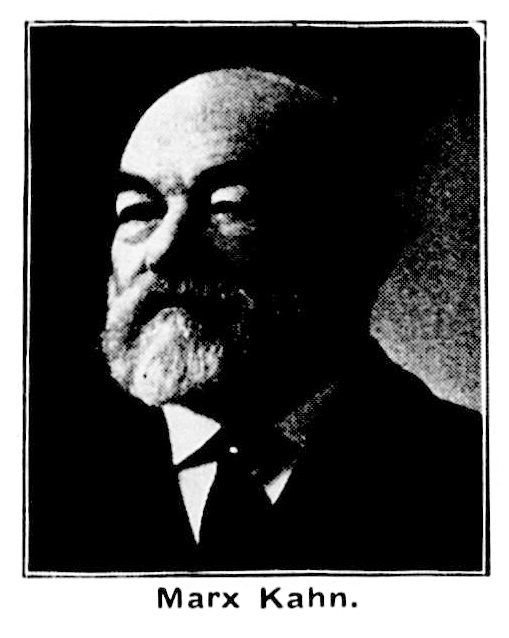
Portrait of Marx Kahn included with the previous article about Leadville Jews in The Jewish Outlook. [667]
Leadville. Bruno Grosser. (Leadville. Denver, Colorado: The Jewish Outlook). November 24, 1905. Page 45.
Carrie Kahn Mayer, an extremely active member of the Leadville community, served as Temple Israel’s Sunday School Superintendent from 1900 to 1908, as well as president for the Order of the Eastern Star, president of the Jewish Ladies’ Reading Club, and secretary for the Leadville Women’s Club. As the secretary for Leadville’s Public Library Association, Carrie was instrumental in securing a $5,000 matching grant from Andrew Carnegie to build Leadville’s first public library in 1904. The building still stands today at 9th Street and Harrison Avenue and is home to Leadville’s Heritage Museum. [668] Carrie appears to have remained near family after returning to Leadville following her husband’s death in 1894. She died in Salt Lake City only a few days after her sister-in-law, Lillie, on April 12, 1954. [669]
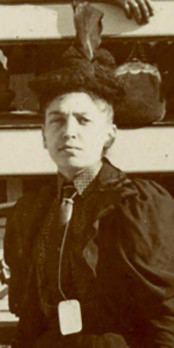
Detail photo of Carrie Kahn Mayer taken in 1895. [670]
Courtesy, Beck Archive of Rocky Mountain Jewish History, Special Collections, University of Denver Libraries
Thyria Wilson, National Council of Jewish Women, Denver Section, Kosher Picnic at Leadville, Colorado, 1895 July 28. University of Denver Libraries. 2021.
Lillie Rose Kahn passed away in Salt Lake City on April 9, 1954, from heart disease. Her death certificate notes that she had been a resident of the city for forty five years, [671] consistent with the 1909 relocation of the Marx Kahn family from Leadville.
Although Dr. Sol was present in Salt Lake at the time of Lille’s death, [672] he passed away in Los Angeles a few months later on June 21, 1954. Records indicate that he died in Ralph’s home. [673] In 1920 a request for a Tax Deed on the White Rabbit Lode was filed by the Lake County (Leadville) treasurer, a mining claim that Dr. Sol had abandoned years earlier. [674]
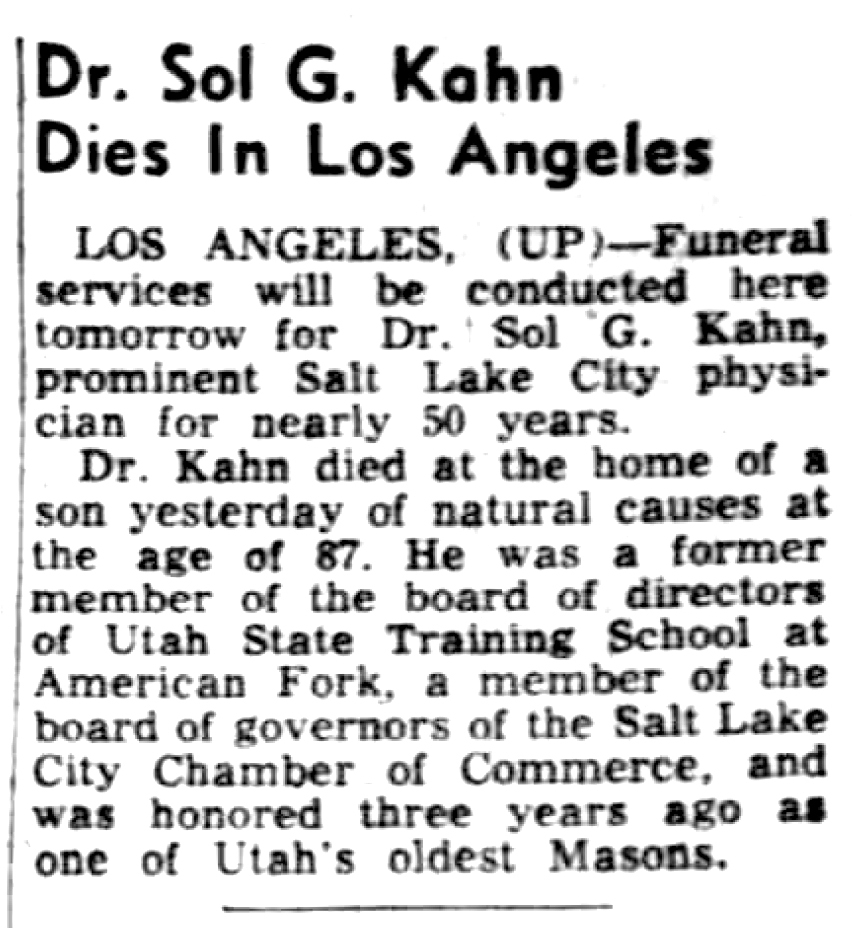
Notice in the Provo Daily Herald about the death of Dr. Sol G. Kahn. [675]
Dr. Sol Kahn Dies In Los Angeles. (Provo, Utah: Provo Daily Herald. J. Willard Marriot Library, University of Utah). June 22, 1954. Page 2.
Jacob A. Kahn began working for his father’s grocery store during 1890, where he remained for several years. From 1897 to 1898, Jacob worked as a bookkeeper at the Schayer Mercantile Store, another successful Jewish-owned business. In 1899, he began working at Baer Brothers Mercantile Co., where he rose to the rank of vice president in 1901. After 1905, Jacob relocated to Salt Lake City, where the Baer brothers established their new headquarters, but often frequented Leadville. On March 15, 1918, Jake, as president of the Baer Mercantile Company, and secretary Ezra Baer, signed a certificate of agreement in Leadville allowing the firm to delay. [676] The Baer enterprise was a highly diversified conglomerate of agricultural and mining companies by this time. The crown jewel was the Baer Land & Cattle Company, headquartered in Salt Lake City. The move was likely a consolidation action, as the Baer’s businesses would continue to operate with Ezra Baer at the helm. [677] While it’s unclear what facilitated the end of Jake and Julliet’s marriage, he married Harriet Simmonds of Chicago on November 20, 1917. [678] By 1940 Jake Kahn was a district manager for the General Electric Company. [679] He appears to have had no children with either wife and died of heart failure in Salt Lake City on November 18, 1961. He was 89-years old. [680]
In 1888, Tillie Kahn began working for Fred Butler at his Palace of Fashion department store, where she remained until 1892. During 1895, Tillie worked for the Beggs Dry Goods Company. She switched employers again in 1900, relocating to M. J. Frantz’s storefront where she worked as a clerk. Tillie last appeared in city directories in 1907. [681] In 1908, she was cited as living in Canon City, Colorado; other resources suggest she moved about the country [682] with some regularity. It is clear that she left Leadville with her sister, Carrie Kahn Mayer, to spend the winter in California and did not return. [683] By 1916, Tillie was “engaged in the insurance business in Twin Falls, Idaho.” [684] In 1921, she was in Salt Lake City with her brother, Dr. Sol. After an unspecified surgical procedure, Tillie was listed in “critical condition” [685] at Holy Cross Hospital in Salt Lake City. [686]
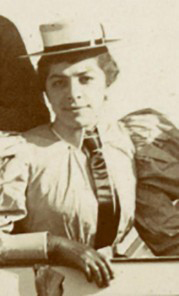
Detail photo of Tillie Kahn taken in 1895. [687]
Courtesy, Beck Archive of Rocky Mountain Jewish History, Special Collections, University of Denver Libraries
Thyria Wilson, National Council of Jewish Women, Denver Section, Kosher Picnic at Leadville, Colorado, 1895 July 28. University of Denver Libraries. 2021.
Tillie, who apparently never married, remained in Salt Lake City for a lengthy period and pursued a career as an artist. [688] She probably moved to the Los Angeles area in the mid-1940s [689] where she passed away at the age of 90 [690] on August 6, 1960. [691]
Although Edwin Kahn continued to visit Leadville, records indicate that he was living in Chicago in 1909. [692] Edwin likely split his time between Salt Lake and Chicago over the next decade. Records demonstrate he spent substantial periods in both cities. However, he was listed in Salt Lake City in 1910 as the secretary and treasurer for the Salt Lake Taxi-Cab & Automobile Co. [693] Edwin married later in life, at age 43, to Marion Leopold in Chicago on June 5, 1918. [694] The couple probably moved before the first of their two daughters, Marjorie (b. 1920) and Eleanor (b. 1922), were born in Salt Lake City in 1920. [695] The family remained there until at least 1940. [696] Edwin eventually wound up in the Los Angeles area, where he died of unknown causes on February 23, 1960. [697] Both he and Marion are interred side by side at Chicago’s Rosehill Cemetery and Mausoleum. [698]
Ralph Kahn, the son of Dr. Sol and Lillie Rose Kahn, married Adelaide F. Eichler in Buffalo, New York on November 2, 1925, [699] when he was recorded as a resident. [700] Ralph, who obtained a graduate degree, can be found in the 1940 United States Census managing the family grocery in Salt Lake City. By that time, he and Adelaide had two children: Ralph Jr. (b. 1930), and Arnold (b. 1939). The family probably moved to Southern California before 1950. [701] Ralph died of unknown causes in Los Angeles on January 30, 1995. [702]
354 Marx Kahn. Leadville, CO: Herald Democrat. October 14, 1916. P4.
355 Manly, Nancy, and Worford, Sherrill. Lake County, US Census Index For 1860, 1870 and 1880. Leadville, CO: Historical Research Cooperative. USA. 1985.
356 Mrs. Marx Kahn Dead and Many Mourn. Leadville, CO: Herald Democrat. October 14, 1889. P7.
357 Year: 1870; Census Place: Mount Pleasant, Whiteside, Illinois; Roll: M593_290; Page: 203A; Family History Library Film: 545789.
358 Ancestry.com. Utah, U.S., Death and Military Death Certificates, 1904-1961 [database on-line]. Provo, UT, USA: Ancestry.com Operations, Inc., 2014.
359 National Archives and Records Administration. Schedules of the Colorado State Census, 1885. Washington, D.C.: National Archives and Records Administration. M158, 8 rolls.
360 Marx Kahn. Herald Democrat. 1916. P4.
361 Manly and Worford. Lake County, US Census Index For 1860, 1870 and 1880. 1985.
362 Corbett, Hoye and Ballenger. Leadville, CO. 1880. P209.
363 Year: 1880; Census Place: Morrison, Whiteside, Illinois; Roll: 258; Page: 188C; Enumeration District: 206
364 Leadville Medicos Speak Warm Words Of Farewell. Leadville, CO: Herald Democrat. June 20, 1909. P1.
365 Hotel Arrivals. Leadville, CO: Leadville Daily Evening Chronicle. February 17, 1879. P3.
366 Corbett and Ballenger. Leadville, CO; USA. 1881. P174.
367 JH Ballenger and Richards. Ballenger & Richard’s Twenty-Ninth Annual City Directory: Containing a Complete List of the Inhabitants, Institutions, Incorporated Companies, Manufacturing Establishments, Business, Business Firms etc. in The City of Leadville for 1908. (Leadville, CO: Ballenger and Richards Publishers.1908). P#.
368 Marx Kahn’s Grocery. (Leadville, CO: Herald Democrat). January 1, 1902. P3.
369 Bold Burglars. Leadville, CO: Leadville Weekly Herald. March 26, 1881. P3.
370 Burglars’ Strategy. Leadville, CO: Leadville Democrat. April 1, 1881. P8.
371 White Loaf Flour. Leadville, CO: Herald Democrat. September 24, 1903. P5.
372 Y.M.C.A. Entertainment. Leadville, CO: Carbonate Chronicle. February 17, 1883. P1.
373 The Jewish New Year. Leadville, CO: Herald Democrat. October 5, 1883. P8.
374 Day Of Atonement. Leadville, CO: Carbonate Chronicle. October 4, 1884. P6.
375 Social Summary. Leadville, CO: Carbonate Chronicle. July 19, 1884. P8.
376 For more information on Theresa Sonnenberg and her family, please visit: http://jewishleadville.org/sonnenberg.html
377 Surprise Party. Leadville, CO: Leadville Daily Herald. April 14, 1885. P4.
378 A Confirmation. Leadville, CO: Carbonate Chronicle. August 1, 1885. P1.
379 Yisrael’s Yeomanry. Leadville, CO: Carbonate Chronicle. September 18, 1885. P7.
380 TB Corbett and JH Ballenger. Corbet, and Ballenger’s Seventh Annual City Directory: Containing a Complete List Of The Inhabitants, Institutions, Incorporated Companies, Manufacturing Establishments, Business, Business Firms etc. in The City Of Leadville For 1886. (Leadville, CO: Corbet and Ballenger Publishers). 1886. P155.
381 JH Ballenger and Richards. Ballenger & Richard’s Ninth Annual City Directory: Containing a Complete List of the Inhabitants, Institutions, Incorporated Companies, Manufacturing Establishments, Business, Business Firms etc. in The City of Leadville for 1888. (Leadville, CO: Ballenger and Richards Publishers.1888). P156.
382 JH Ballenger and Richards. Ballenger & Richard’s Tenth Annual City Directory: Containing a Complete List of the Inhabitants, Institutions, Incorporated Companies, Manufacturing Establishments, Business, Business Firms etc. in The City of Leadville for 1889. (Leadville, CO: Ballenger and Richards Publishers). 1889. P152.
383 Ancestry.com. U.S., School Catalogs, 1765-1935 [database on-line]. (New York, NY: New York University; Alumni of the Medical Schools. 1907). Provo, UT, USA: Ancestry.com Operations, Inc., 2012. P443.
384 A Pleasing Entertainment. Leadville, CO: The Leadville Daily Evening Chronicle. December 29, 1887. P4.
385 School Entertainment. Leadville, CO: Leadville Daily Evening Chronicle. February 9, 1888. P4.
386 The Schools Close. Leadville, CO: The Leadville Daily Evening Chronicle. April 28, 1888. P2
387 Chanuka Festival. Leadville, CO: The Leadville Daily Evening Chronicle. December 4, 1888. P2.
388 Miss Howe Entertains. Leadville, CO: Herald Democrat. July 28, 1889. P2.
389 Surprised By Friends. Leadville, CO: Herald Democrat. February 12, 1890. P5.
390 Intellectual Base Ball. Leadville, CO: Carbonate Chronicle. June 17, 1890. P1.
391 For more information on the Schayer family, please visit: http://jewishleadville.org/schayer.html
392 Pleasantly Surprised. Leadville, CO: Herald Democrat. August 28, 1890. P5
393 Thyria Wilson, National Council of Jewish Women, Denver Section, Kosher Picnic at Leadville, Colorado, 1895 July 28. University of Denver Libraries. 2021.
394 United States Deceased Physician File (AMA), 1864-1968. [database with images]. Joses, Maurice-Karmiohl, Louis (image 1775 of 3055); American Medical Association, Chicago, IL. 2019.
395 United States Deceased Physician File. Chicago, IL. 2019.
396 United States Passport Applications, 1795-1925. [database with images]. FamilySearch. (M1372) Washington, D.C.: National Archives and Records Administration. 2016.
397 Personal Mention. Leadville, CO: Carbonate Chronicle. June 17, 1889. P8.
398 A Deserved Promotion. Leadville, CO: Herald Democrat. March 14, 1890. P4.
399 JH Ballenger and Richards. Ballenger & Richard’s Twelfth Annual City Directory: Containing a Complete List of the Inhabitants, Institutions, Incorporated Companies, Manufacturing Establishments, Business, Business Firms etc. in The City of Leadville for 1891. (Leadville, CO: Ballenger and Richards Publishers. 1891). Pp 12 & 153.
400 How Doctors Are Made. Leadville, CO: Herald Democrat. July 4, 1891. P5.
401 To End Her Life. Leadville, CO: Leadville Daily Evening Chronicle. June 6, 1891. P4.
402 School Notes. Leadville, CO: Herald Democrat. March 14, 1891. P5.
403 Meletarian Melange. Leadville, CO: Herald Democrat. September 19, 1891. P4.
404 School Entertainment. Leadville, CO: Herald Democrat. April 16, 1891. P4.
405 Society’s Giddy Whirl. Leadville, CO: Leadville Daily Evening Chronicle. November 2, 1891. P1.
406 Social Nuggets. Leadville, CO: Leadville Daily Evening Chronicle. December 7, 1891. P1.
407 His Head Cut. Leadville, CO: Leadville Daily Evening Chronicle. November 13, 1891. P4.
408 He Received Awful Injuries. Leadville, CO: Leadville Daily Evening Chronicle. May 7, 1896. P4.
409 The Worse For Wear. Leadville, CO: Leadville Daily Evening Chronicle. June 9, 1891. P4.
410 Only Drank For Fun. Leadville, CO: Leadville Daily Evening Chronicle. August 17, 1892. P2.
411 Pitts Discharged. Leadville, CO: Herald Democrat. January 3, 1892. P1.
412 A Serious Affliction. Leadville, CO: Leadville Daily Evening Chronicle. January 29, 1892. P1.
413 A substance or medication that induces vomiting.
414 Her Third Attempt. Leadville, CO: Leadville Daily Evening Chronicle. February 22, 1892. P4.
415 State Street. Leadville, CO: Herald Democrat. November 21, 2018. P6.
416 She Took Morphine. Leadville, CO: Herald Democrat. December 29, 1892. P8.
417 Officers Elected. Leadville, CO: Herald Democrat. March 11, 1892. P4.
418 Visiting The Valley. Leadville, CO: Leadville Daily Evening Chronicle. April 8, 1892. P2.
419 Schools Of The City. Leadville, CO: Herald Democrat. May 17, 1892. P4.
420 Personal Mention. Leadville, CO: Herald Democrat. October 5, 1892. P5.
421 An Enjoyable Affair. Leadville, CO: Herald Democrat. May 12, 1892. P5.
422 Only Drank For Fun. Leadville, CO: Leadville Daily Evening Chronicle. August 17, 1892. P2.
423 On The Doorstep. Leadville, CO: Leadville Daily Evening Chronicle. May 20, 1892. P2.
424 At The Public Schools. Leadville, CO: Leadville Daily Evening Chronicle. September 19, 1892. P2.
425 At Home Party. Leadville, CO: Leadville Daily Evening Chronicle. December 19, 1892. P3.
426 Joint Installation. Leadville, CO: Leadville Daily Evening Chronicle. January 6, 1893. P4.
427 United States Passport Applications, 1795-1925. [database with images]. FamilySearch. (Washington, D.C.: National Archives and Records Administration, n.d.). 2016.
428 He Saw Snakes. Leadville, CO: Herald Democrat. April 9, 1893. P8.
429 Early Autumnal Days. Leadville, CO: Leadville Daily Evening Chronicle. September 4, 1893. P2.
430 Off For Europe. (Leadville, CO: Herald Democrat). September 15, 1893. P2.
431 Medical Society Meeting. (Leadville, CO: Herald Democrat). December 29, 1894. P6.
432 Lake’s Medical Society. (Leadville, CO: The Leadville Daily Evening Chronicle). October 9, 1894. P4.
433 A Horse Killed. (Leadville, CO: Herald Democrat). July 6, 1894. P1.
434 Ushered In The New Year. (Leadville, CO: Herald Democrat). January 6, 1895. P3.
435 Ballenger and Richards. Leadville, CO. 1894. P152.
436 Ballenger and Richards. Leadville, CO. 1898. P164.
437 Ballenger and Richards. Leadville, CO. 1899. P180.
438 For more information on the Baer Mercantile Company, please visit: http://jewishleadville.org/baer.html
439 Personal Mention. (Leadville, CO: Herald Democrat). September 23, 1900. P6.
440 Elocutionary Recital. (Leadville, CO: Herald Democrat). January 28, 1894. P5.
441 Sackcloth And Ashes. (Leadville, CO: Leadville Daily Evening Chronicle). March 5, 1894. P2.
442 For more information on Leah Rachofsky and her family, please visit: http://jewishleadville.org/rachofsky.html
443 For more information on Phillip Grossmayer and his family, please visit: http://jewishleadville.org/rachofsky.html
444 In Houses Of Worship. (Leadville, CO: Herald Democrat). June 12, 1894. P5.
445 For more information on Carrie Kahn Mayer’s life after her marriage to Ephraim “Sam” Mayer, please visit: http://jewishleadville.org/mayer.html
446 Marx Kahn’s obituary cites Carrie’s wedding to Ephraim “Sam” Mayer took place in 1885, but evidence strongly suggests that this is not accurate.
447 Crystal Turpin, Jeffrey P. Grant & Trevor Mark. Mayer. Leadville, CO: Temple Israel Foundation. 2020.
448 An excess of blood in the vessels supplying an organ or other part of the body.
449 A condition in which a muscle has lost its strength.
450 A Medical Point Of View. (Leadville, CO: Leadville Daily Evening Chronicle). January 29, 1895. P3.
451 Death From Blood Poisoning. (Leadville, CO: Herald Democrat). March 2, 1895. P2.
452 Personal Mention. (Leadville, CO: Herald Democrat). March 19, 1895. P5
453 Carrie Koch and her family lived in Leadville from 1879 to 1889. For more information on Carrie Koch and her family, please visit: http://jewishleadville.org/koch.html . Jeffrey Grant. Koch. Leadville, CO: Temple Israel Foundation. 2018.
454 The Hebrew Ladies Dance. (Leadville, CO: Herald Democrat). June 27, 1895. P6.
455 A Woman’s Notable Ideals. (Leadville, CO: Herald Democrat). July 28, 1895. P3.
456 For more information on Amelia Friedlander Cohn and her family, please visit: http://jewishleadville.org/friedlander.html
457 For more about Alfred Hoffman and his family, please visit: http://jewishleadville.org/hoffman.html
458 For more Information on Reinhold Rosendorf, please visit: http://jewishleadville.org/rosendorf.html
459 For more information on Sadie Herman Sands and her family, please visit: http://jewishleadville.org/sands-sandelowsky.html
460 For more information on Sol Garrett and his family, please visit: http://jewishleadville.org/garrett.html
461 For more information on Martha Kaliski and her family, please visit: http://jewishleadville.org/kaliski.html
462 For more Information on Mathilda Baer and her family, please visit: http://jewishleadville.org/baer.html
463 For more information on Jewish-American activist Sadie American, please visit: https://jwa.org/encyclopedia/article/american-sadie
464 For more information on Carrie Kahn Mayer after her marriage to Efraim Mayer, please visit: http://jewishleadville.org/mayer.html
465 Thyria Wilson, National Council of Jewish Women, Denver Section, Kosher Picnic at Leadville, Colorado, 1895 July 28. University of Denver Libraries. 2021.
466 For more information about Bruno Grosser and his family, please visit: http://jewishleadville.org/grosser.html
467 He Fell To An Awful Death. (Leadville, CO: Herald Democrat). August 16, 1895. P8.
468 Janice Fox. Grosser. (Leadville, CO: Temple Israel Foundation). 2019.
469 Dr. D’Avignon’s Funeral. (Leadville, CO: Herald Democrat). November 12, 1895. P4.
470 Our City Public Schools. Leadville, CO: Herald Democrat. November 4, 1895. P1.
471 Rounder’s Walks And Talks. Leadville, CO: Leadville Daily Evening Chronicle. October 19, 1905. P3.
472 Dave and Kathy Alexander. Ice Palace, Leadville, Colorado by William Henry Jackson, 1896. Warsaw, MO: Legends of America. 2021. https://www.legendsofamerica.com/co-icepalace/
473 Dardanelles, formerly Hellespont, Turkish Çanakkale Boğazı, narrow strait in northwestern Turkey, 38 miles (61 km) long and 0.75 to 4 miles (1.2 to 6.5 km) wide, linking the Aegean Sea with the Sea of Marmara. Adam Zeidan. Dardanelles. (London, England, United Kingdom: Encyclopedia Britannica). October 24, 2019.
474 The D. D. D’S. All On Deck. (Leadville, CO: Herald Democrat). February 20, 1896. P8.
475 Ice Rink in the Leadville Ice Palace Special Collections. [Image File: ZZR710000261]. (Denver, CO: Denver Public Library Special Collections). 2021.
476 Alumni Banquet. Leadville, CO: Leadville Daily Evening Chronicle. June 10, 1896. P4.
477 For more information on Solomon A. Guthman and his family, please visit: http://jewishleadville.org/guthman.html
478 Local Society Gossip. (Leadville, CO: Herald Democrat). October 5, 1896. P4.
479 New Mining Companies. (Leadville, Co: Herald Democrat). January 10, 1896. P4.
480 The High School Contest. (Leadville, CO: Herald Democrat). January 11, 1897. P3.
481 Notes From The Public Schools. (Leadville, CO: Leadville Daily Evening Chronicle). January 18, 1897. P4.
482 The World Of Society. (Leadville, CO: Herald Democrat). January 24, 1897. P6.
483 Ancestry.com. Colorado, County Marriage Records and State Index, 1862-2006 [database on-line]. Lehi, UT, USA: Ancestry.com Operations, Inc., 2016.
484 He Picked a Denver Rose. (Leadville, CO: Herald Democrat). February 8, 1897. P1.
485 Records indicate that “Mr. Rose”, is Samuel Rose who was a real estate broker who worked in the Denver financial district at 1640 Curtis Street. JH Ballenger and Richards.. Ballenger & Richard’s Twenty-fourth Annual City Directory: Containing a Complete List of the Inhabitants, Institutions, Incorporated Companies, Manufacturing Establishments, Business, Business Firms etc. in The City Of Denver for 1894. (Denver, CO: Ballenger Publishers. 1894). P903.
486 For more information on David May and his family, please visit: http://jewishleadville.org/may.html
487 For more information on Lee Wolf, please visit: http://jewishleadville.org/wolf.html
488 For more information on Adolph Schayer and his family, please visit: http://jewishleadville.org/schayer.html
489 For more information on Emmanuel Katz and his family, please visit: http://jewishleadville.org/katz.html
490 For more information on Adolph Baer and his family, please visit: http://jewishleadville.org/baer.html
491 For more information on Jacob Heimberger and his family, please visit: http://jewishleadville.org/hoffman.html
492 For more information on Al Hoffman and his family, please visit: http://jewishleadville.org/hoffman.html
493 For more information on Alfred Freedheim and his family, please visit: http://jewishleadville.org/freedheim.html
494 He Picked A Denver Rose. (Leadville, CO: Leadville Daily Evening Chronicle). February 8, 1897. P1.
495 Personal Mention. (Leadville,CO: Herald Democrat). February 15, 1897. P3.
496 Death Of S. Rose. (Leadville, CO: Herald Democrat). May 23, 1903. P6.
497 Nancy Manly, & Sherrill Worford. Lake County, US Census Index For 1860, 1870 and 1880. Leadville, CO: Historical Research Cooperative. USA. 1985.
498 TB Corbett and JH Ballenger. Corbet, and Ballenger’s Eighth Annual City Directory: Containing a Complete List of the Inhabitants, Institutions, Incorporated Companies, Manufacturing Establishments, Business, Business Firms etc. in The City Of Denver for 1880. (Denver, CO: Corbet and Ballenger Publishers.1880). P312.
499 Society. (Leadville, CO: Herald Democrat. March 6, 1898). P6.
500 Mrs. Tillie Meyers. (Cincinnati, OH: American Israelite). April 11, 1901. P3.
501 Personal Mention. (Cincinnati, OH: American Israelite). October 25, 1900. P2.
502 Met Death In The Busk Tunnel. (Leadville, CO: Herald Democrat). June 27, 1897. P3.
503 Harry H. Buckwalter. Colorado Midland R.R. [Image ID: 90.156.404]. Denver, CO: History Colorado Online Collection; Hart Research Center. 1997.
504 Carbolic acid was first discovered in the 1830s, is most commonly derived from coal oil and became a commonly used antiseptic by the late 1860s. In modernity it is generally used in the production of plastics and is more commonly known as Phenol. Hudson acquired his from a local drug store. For more information please see: P. P. Giri, R. Sinha, S. Sikka &, S. Meur. Acute carbolic acid poisoning: A report of four cases. (Indian Journal of Critical Care Medicine: Indian Society of Critical Care Medicine). 2016. Pp668–670.
505 He Took A Large Dose Of Poison. (Leadville, CO: Leadville Daily Evening Chronicle). May 4, 1897. P4.
506 Weston Opera House. (Leadville, CO: Herald Democrat). June 11, 1897. P7.
507 Willie Pitts Injured. (Leadville, CO: Herald Democrat). September 21, 1897. P6.
508 Jas. G. Ryder Bound Over. (Leadville, CO: Herald Democrat). May 19, 1888. P6.
509 Ryder Will Take His Medicine. (Leadville, CO: Herald Democrat). August 4, 1898. P7.
510 Society. (Leadville, CO: Herald Democrat). July 12, 1898. P7.
511 Shot In The Hand. (Leadville, CO: Herald Democrat). August 2, 1898. P8.
512 Basilio Augustin y Dávila. Basilio Augustin y Dávila - The World of 1898: The Spanish-American War (Washington, D.C.: The United States Library of Congress). April 11, 2013.
513 Another Volley From The Firing Line. (Leadville, CO: Herald Democrat). September 27, 1898. Pp 1, 6.
514 The World Of Society. (Leadville, CO: Herald Democrat). October 2, 1898. P6.
515 Nancy Manly, and Sherrill Worford. Lake County, US Census Index For 1900. Leadville, CO: Historical Research Cooperative. USA. 1985. P320.
516 A New Doctor Arrives. (Leadville, CO: Herald Democrat). December 24, 1898. P8.
517 For Rent. (Leadville, CO: Herald Democrat). December 20, 1898. P8.
518 Ballenger and Richards. Leadville, CO; USA. 1899.
519 A Painful Wound. (Leadville, CO: Herald Democrat). February 9, 1899. P8.
520 The World Of Society. (Leadville, CO: Herald Democrat). February 11, 1899. P7.
521 Elected Their Officers. (Leadville, CO: Herald Democrat). September 4, 1899. P6.
522 For more information on Hattie Cohn Garrett, please visit: http://jewishleadville.org/garrett.html , for more information on Hattie Cohn before her marriage to Solomon Garrett in 1904, please visit: http://jewishleadville.org/cohn.html
523 Hit With A Rock A Stringtown Episode. (Leadville, CO: Herald Democrat). September 18, 1899. P6.
524 Will Lie in State. (Leadville, CO: Herald Democrat). October 15, 1899. P6.
525 Mrs. Marx Kahn Dead and Many Mourn. (Leadville, CO: Herald Democrat). October 14, 1889. P7.
526 The World Of Society. (Leadville, CO: Herald Democrat). October 15, 1899. P8.
527 The World Of Society. (Leadville, CO: Herald Democrat). October 22, 1899. P8.
528 Wreck Near Beldon. (Leadville, CO: Herald Democrat). December 23, 1899. P1.
529 Ballenger and Richards. Leadville, CO. 1901. P150.
530 Personal Mention. (Leadville, CO: Herald Democrat). March 1, 1900. P7.
531 A Swell Turnout. (Leadville, CO: Herald Democrat). March 15, 1900. P8.
532 Filed For Record. (Leadville, CO: Carbonate Chronicle). May 14, 1900. P5.
533 United States Census, 1900. [database with images]. FamilySearch. (Washington, D.C.: National Archives and Records Administration, n.d.).
534 For more information on the Michael Goldsmith family please visit: http://jewishleadville.org/goldsmith.html
535 For more information on the Pelta family and their time in Leadville, please visit: http://jewishleadville.org/pelta.html
536 For more information on Celia Block and her family, please visit: http://jewishleadville.org/block.html
537 Society. (Leadville, CO: Herald Democrat). July 22, 1900. P12.
538 Among The Lodges. (Leadville, CO: Herald Democrat). January 14, 1901. P7.
539 At the time of this publication there are no details on what exactly the “Violet Circle” was. It was listed in general newspaper lodge reporting. The organization does not appear in city directories, as lodges often did. This was likely a social organization that can be likened to the International Order of Oddfellows, the Masonic Temple or the Benevolent and Protective Order Of Elks.
540 Personal Mention. (Leadville, CO: Herald Democrat). March 8, 1901. P7.
541 The Appointment… (Leadville, CO: Herald Democrat). April 16, 1901. P2.
542 Order Of Buffaloes. (Leadville, CO: Carbonate Chronicle). March 18, 1901. P6.
543 Personal Mention. (Leadville, CO: Herald Democrat). March 9, 1901. P7.
544 To Stamp Out The Disease. (Leadville, CO: Herald Democrat). April 19, 1901. P7.
545 His First Race. (Leadville, CO: Herald Democrat). July 8, 1901. P2.
546 Personal Mention. (Leadville, CO: Carbonate Chronicle). April 22, 1901. P8.
547 Personal Mention. (Leadville, CO: Herald Democrat). October 20, 1901. P12.
548 For more information on Charles Sands and his family, please visit: http://jewishleadville.org/sands-sandelowsky.html
549 Society. (Leadville, CO: Herald Democrat). December 1, 1901. P12.
550 For more information on Adolph Schayer and his family please visit: http://jewishleadville.org/schayer.html
551 William Korn, Robert George DeStoffle, Janice Fox, Jeffrey Grant, & Trevor Mark. Frontier Jewish Leadville. (Leadville, CO: Temple Israel Foundation). 2020. P9.
552 She Died So Young. (Leadville, CO: Herald Democrat). May 11, 1901. P8.
553 Frontier Jewish Leadville. Temple Israel Foundation. 2020. P9.
554 At Banquet Board. (Leadville, CO: Herald Democrat). June 12, 1901. P6.
555 Will Liberate Homers. (Leadville, CO: Herald Democrat). June 18, 1901. P9.
556 Bilton and Walker. (Leadville, CO: Herald Democrat). June 30, 1901. P2.
557 Little Checker’s Long Journey. (Leadville, CO: Herald Democrat). June 20, 1901. P7.
558 Personal Mention. (Leadville, CO: Herald Democrat). June 23, 1901. P9.
559 Personal Mention. (Leadville, CO: Carbonate Chronicle). July 1, 1901. P8.
560 Society. (Leadville, CO: Herald Democrat). August 11, 1901. P6.
561 Congregation Israel. (Leadville, CO: Herald Democrat). September 2, 1901. P7.
562 Marx Kahn’s Grocery. (Leadville CO: Herald Democrat. January 1, 1902). P6.
563 Policeman Stumbled. (Leadville, CO: Herald Democrat). December 12, 1901. P8.
564 Filed For Record. (Leadville, CO: Herald Democrat). December 27, 1901. P6.
565 Personal Mention. (Leadville, CO: Herald Democrat). January 7, 1902. P5.
566 Personal Mention. (Leadville, CO: Herald Democrat). April 1, 1902. P3.
567 Josef Maurer and Encyclopedia Staff. John Evans. Colorado Encyclopedia, last modified March 29, 2021.
568 Encyclopedia Staff. Denver Tramway Company. Colorado Encyclopedia, last modified July 09, 2020.
569 JH Ballenger and Richards. Ballenger & Richard’s Twenty-Second Annual City Directory: Containing a Complete List of the Inhabitants, Institutions, Incorporated Companies, Manufacturing Establishments, Business, Business Firms etc. in The City of Leadville for 1901. (Leadville, CO: Ballenger and Richards Publishers.1901). P144.
570 Society. (Leadville, CO: Herald Democrat). April 13, 1902. P11.
571 Personal Mention. (Leadville, CO: Herald Democrat). June 29, 1902. P11.
572 Society. (Leadville, CO: Herald Democrat). September 14, 1902. P11.
573 Congregation Israel. (Leadville, CO: Herald Democrat). September 29, 1902. P8.
574 William N. Beggs M.D. and W. Cameron Johnson M.D. The Colorado Medical Journal and Western Medical and Surgical Gazette, Vol II. (Denver, CO: The Colorado Medical Journal). 1896. P442.
575 Grand Army of the Republic.
576 This number is not accurate and the actual federal land grant was for 131 acres: 1931 Tales of Evergreen Cemetery. (Leadville, CO: Herald Democrat. October 18, 2018).
577 The Ladies Relief Hospital does appear in the 1880 Leadville city directory, along with St. Vincent’s Hospital, as one of two hospitals officially operating in Leadville. The Ladies Relief Hospital was located at 309 E. 8th Street and its matron was listed as a Mrs. Rosetta S. Smith. (Corbett, Hoye and Ballenger. Leadville, CO. 1880. P35.). The hospital’s construction was still not complete as patients were being admitted in March of 1880 (At The Relief Hospital. Leadville, CO: Leadville Weekly Democrat. March 3, 1880. P8.). A brick addition was scheduled to be added in the spring of 1880, as soon as weather would permit (Preparing for Spring. Leadville, CO: Leadville Weekly Democrat. March 3, 1880. P4.). The hospital had ceased operations by mid-December of 1880 (City And Vicinity. Leadville, CO: Leadville Daily Herald. December 15, 1880. P4.).
578 Dr. Sol. Kahn, M.D. The History of the Pioneers in Medicine in Lake County. (Denver, CO: The Colorado Medical Journal And the Western Medical and Surgical Gazette . A Scientific Medical Journal. The Colorado Medical Journal Company). 1902. P15-17.
579 For more information on May and Theo Baer, and their family, please visit: http://jewishleadville.org/baer.html
580 Married. (Leadville, CO: Herald Democrat). January 28, 1903. P3.
581 Grant. Baer. 2019.
582 JH Ballenger and Richards. Ballenger & Richard’s Twenty-Fourth Annual City Directory: Containing a Complete List of the Inhabitants, Institutions, Incorporated Companies, Manufacturing Establishments, Business, Business Firms etc. in The City of Leadville for 1903. (Leadville, CO: Ballenger and Richards Publishers.1903). P70.
583 Society. (Leadville, CO: Herald Democrat). February 27, 1910. P6.
584 Death Of Theo. Baer. (Leadville, CO: Herald Democrat). September 23, 1910. P5.
585 Marx Kahn. Leadville, CO: Herald Democrat, October 14, 1916.
586 Ballenger and Richards. Leadville, CO. 1894. P152.
587 JH Ballenger and Richards. Ballenger & Richard’s Twenty-Seventh Annual City Directory: Containing a Complete List of the Inhabitants, Institutions, Incorporated Companies, Manufacturing Establishments, Business, Business Firms etc. in The City of Leadville for 1906. (Leadville, CO: Ballenger and Richards Publishers. 1906). P188.
588 Ballenger and Richards. Leadville, CO. 1903. P184.
589 Subscribers to the Educational League. Denver, CO: The Jewish Outlook. July 6, 1906. P10.
590 Death Of S. Rose. Leadville, CO: Herald Democrat. May 23, 1903. P6.
591 Colorado, Wills and Probate Records, 1875-1974 [database on-line]. Provo, UT, USA: Ancestry.com Operations, Inc., 2015. Original data: Colorado County, District and Probate Courts. Pp342-346.
592 Filed For Record. (Leadville, CO: Herald Democrat). May 24, 1903. P6.
593 The Alumni Dance. (Leadville, CO: Herald Democrat). June 16, 1903. P3.
594 Coffee Hit Her. Leadville, CO: Herald Democrat. March 9, 1904. P2.
595 Gathering Data On Epidemic. Leadville, CO: Herald Democrat. January 24, 1904. P2.
596 Thoroughly Limed. (Leadville, CO: Herald Democrat). March 6, 1904. P6.
597 From County Jail There Came A Wail. (Leadville, CO: Herald Democrat). April 6, 1904. P2.
598 Society. (Leadville, CO: Herald Democrat). October 11, 1903. P8.
599 Leaning Out The Disease Holes. (Leadville, CO: Herald Democrat). March 23, 1904. P2.
600 Excelsior Lodge No. 6. I. A. O.U.W. (Leadville, CO: Herald Democrat). April 3, 1904. P6.
601 Excelsior Lodge No. 6. I. A. O.U.W. (Leadville, CO: Herald Democrat). April 10, 1904. P6.
602 For more information on Jacob Oppenheimer Heimberger and his family, please visit: http://jewishleadville.org/heimberger.html
603 Was A City Of Sorrow For An Honored Citizen. (Leadville, CO: Herald Democrat). June 4, 1904. P1.
604 Lodge News. (Leadville, CO: Herald Democrat). July 4, 1904. P4.
605 Race Meet Tomorrow. (Leadville, CO: Leadville Daily Evening Chronicle). August 10, 1904. P5.
606 Death of Mrs. Noble. (Twin Lakes, CO: Twin Lakes Miner). August 27, 1904. P1.
607 Just A Charcoal Heater. (Leadville, CO: Herald Democrat). October 25, 1904. P6.
608 JH Ballenger and Richards. Ballenger & Richard’s Twenty-Sixth Annual City Directory: Containing a Complete List of the Inhabitants, Institutions, Incorporated Companies, Manufacturing Establishments, Business, Business Firms etc. in The City of Leadville for 1905. (Leadville, CO: Ballenger and Richards Publishers.1905). P180.
609 Leadville Woman’s Club Opening Of The Season. Leadville, CO: Herald Democrat. September 19, 1904. P8.
610 M. Kahn’s Grocery. (Leadville, CO: Herald Democrat). January 1, 1905. P6.
611 For more information on the Baer Mercantile company, Hattie and May Kahn’s lives after marrying into the Baer family, please visit: http://jewishleadville.org/baer.html
612 Personal Mention. (Leadville, CO: Herald Democrat). January 3, 1905. P6.
613 Ballenger and Richards. Leadville, CO. 1908. P167.
614 Pretty Wedding Ceremony Took Place Yesterday. (Leadville, CO: Herald Democrat). January 16, 1905. P3.
615 Society. (Leadville, CO: Herald Democrat). November 13, 1904. P7.
616 Evelynn Mayer is the daughter of Carrie Kahn Mayer. For more information on the Mayer family, please visit: http://jewishleadville.org/mayer.html
617 Society. (Leadville, CO: Herald Democrat). February 5, 1905. P10.
618 Society. (Leadville, CO: Herald Democrat). April 30, 1905. P10.
619 Felicitations From The Lodge. (Leadville, CO: Herald Democrat). June 1, 1905. P8.
620 Committees Hard At Work On Big Celebration. (Leadville, CO: Herald Democrat). June 16, 1905. P2.
621 Lodge Has Smoker. (Leadville, CO: Herald Democrat). October 26, 1905. P4.
622 Bruno Grosser. (Leadville. Denver, CO: The Jewish Outlook). November 24, 1905. P45.
623 Mathilda Kahn. Benefit Of Woman’s Clubs To The Community. (Leadville, CO: Herald Democrat). January 1, 1906. P17.
624 United Workmen Growing Order. (Leadville, CO: Herald Democrat). January 8, 1906. P2.
625 Society. (Leadville, CO: Herald Democrat). January 14, 1906. P10.
626 Jewish Union Movement, Dr. Goldshaw’s Address. (Leadville, CO: Herald Democrat). January 29, 1908. P6.
627 Personal Mention. (Leadville, CO: Herald Democrat). April 7, 1906. P2.
628 Ancestry.com. Utah, U.S., Select Marriage Index, 1887-1985 [database on-line]. (Provo, UT, USA: Ancestry.com Operations, Inc). 2015.
629 Society. (Leadville, CO: Herald Democrat). April 15, 1906. P10.
630 Personal Mention. (Leadville, CO: Herald Democrat). July 29, 1906. P9.
631 Personal Mention. (Leadville, CO: Herald Democrat). March 21, 1907. P6.
632 Local Items. (Denver, CO: Jewish Outlook). May 3, 1907. P8.
633 Colorado News Items. (Twin Lakes, CO: Twin Lakes Miner). July 13, 1907. P3.
634 Local Mention. (Twin Lakes, CO: Twin Lakes Miner). August 3, 1907. P4.
635 Runaway Incident. (Leadville, CO: Herald Democrat). July 10, 1907. P5.
636 Exceptional Business Opportunity. (Leadville, CO: Herald Democrat). July 16, 1907. P8.
637 Marx Kahn. (Leadville, CO: Herald Democrat). October 14, 1916. P4.
638 Society. (Leadville, CO: Herald Democrat). January 19, 1908. P6.
639 Society. (Leadville, CO: Herald Democrat). February 16, 1908. P6.
640 Local Items. (Denver, CO: Jewish Outlook. January 31, 1908). P7.
641 Woman’s Club Lecture. (Leadville, CO: Herald Democrat). February 18, 1908. P5.
642 Women’s Club Lecture Course. (Leadville, CO: Herald Democrat). February 19, 1908. P7.
643 Sol G. Kahn M.D. Caring For Child. (Leadville, CO: Herald Democrat). January 1, 1909. P15.
644 A.O.U.M. Lecture Course. (Leadville, CO: Herald Democrat). Febraury 26, 1908. P5.
645 Will Return From Chicago. (Leadville, CO: Herald Democrat). July 24, 1908. P5.
646 Tammany Is Tame Tiger. (Leadville, CO: Herald Democrat). July 9, 1908. P1.
647 Prevention Of Germ Infection. (Leadville, CO: Herald Democrat). November 19, 1908. P2.
648 New Company To Work Half Moon. (Leadville, CO: Herald Democrat). December 31, 1908. P3.
649 Enthusiasm Widespread. (Leadville, CO: Herald Democrat). May 16, 1912. P5.
650 Six Saloons Go Out Of Business. (Leadville, CO: Herald Democrat). February 10, 1908. P4.
651 Leadville Medicos Speak Warm Words OF Farewell. (Leadville, CO: Herald Democrat). June 20, 1909. P1.
652 Personal Mention. (Leadville, CO: Herald Democrat). December 19, 1909. P8.
653 Year: 1910; Census Place: Salt Lake City Ward 5, Salt Lake, Utah; Roll: T624_1607; Page: 7A; Enumeration District: 0141; FHL microfilm: 1375620
654 Leadville Medicos Speak Warm Words Of Farewell. (Leadville, CO: Herald Democrat). June 20, 1909. P1.
655 Sol. G. Kahn. Former Leadvilleites Now Residents Of Salt Lake City, Utah. (Leadville, CO: Herald Democrat). January 1, 1910. P13.
656 All Loyal to Leadville. (Leadville, CO: Herald Democrat). October 16, 1910. P5.
657 Remains Of Adolph Schayer Laid To Rest Yesterday. (Leadville, CO: Herald Democrat). November 18, 1909. P8
658 Personal Mention. (Leadville, CO: Herald Democrat). April 17, 1910. P8.
659 Here From Salt Lake City. (Leadville, CO: Carbonate Chronicle). February 21, 1910. P2.
660 Death Of Theo. Baer. (Leadville, CO: Herald Democrat). September 23, 1910. P5.
661 TB Corbett and JH Ballenger. Corbet, and Ballenger’s Thirty-ninth Annual City Directory: Containing a Complete List of the Inhabitants, Institutions, Incorporated Companies, Manufacturing Establishments, Business, Business Firms etc. in The City Of Denver for 1911. (Denver, CO: Ballenger Publishers. 1911). P148.
662 Year: 1940; Census Place: Salt Lake, Salt Lake, Utah; Roll: m-t0627-04227; Page: 5B; Enumeration District: 30-137
663 Ancestry.com. California, U.S., Death Index, 1940-1997 [database on-line]. (Provo, UT, USA: Ancestry.com Operations Inc). 2000.
664 United States Deceased Physician File (AMA), 1864-1968. [database with images]. Family Search. American Medical Association, Chicago. 2019.
665 Henry M. Post Dies on Coast. (Leadville, CO: Carbonate Chronicle). April 19, 1915. P1.
666 Marx Kahn. (Leadville, CO: Herald Democrat). October 14, 1916. P4.
667 Grosser. Denver, CO. 1905. P45.
668 Crystal Turpin, Jeffrey P. Grant & Trevor Mark. Mayer. (Leadville, CO: Temple Israel Foundation). 2020. http://jewishleadville.org/mayer.html
669 Mayer. Leadville, CO: Temple Israel Foundation. 2020.
670 Thyria Wilson, National Council of Jewish Women, Denver Section, Kosher Picnic at Leadville, Colorado, 1895 July 28. University of Denver Libraries. 2021.
671 Lillian Kahn. Salt Lake City, UT: Deseret News and Salt Lake Telegram. April 10, 1954. P13.
672 Utah, U.S., Death and Military Death Certificates, 1904-1961 [database on-line]. (Provo, UT, USA: Ancestry.com Operations, Inc). 2014.
673 Ancestry.com. California, U.S., Death Index, 1940-1997 [database on-line]. Provo, UT, USA: Ancestry.com Operations Inc, 2000.
674 Treasurer’s Notice On Request For Tax Deed. (Leadville, CO: Herald Democrat). July 17, 1920. P3.
675 Dr. Sol Kahn Dies In Los Angeles. (Provo, UT: Provo Daily Herald. J. Willard Marriot Library, University of Utah). June 22, 1954. P2.
676 Filed For Record. (Leadville, CO: Herald Democrat). March 15, 1918. P3.
677 Jeffrey P. Grant. Baer. (Leadville, CO: Herald Democrat). March 15, 2020.
678 Illinois, Cook County Marriages, 1871–1920. Index. FamilySearch, Salt Lake City, Utah, 2010. Illinois Department of Public Health records. Marriage Records, 1871–present. Division of Vital Records, Springfield, Illinois.
679 Year: 1940; Census Place: Salt Lake, Salt Lake, Utah; Roll: m-t0627-04226; Page: 4B; Enumeration District: 30-133
680 Ancestry.com. Utah, U.S., Death and Military Death Certificates, 1904-1961 [database on-line]. Provo, UT, USA: Ancestry.com Operations, Inc., 2014.
681 JH Ballenger and Richards. Ballenger & Richard’s Twenty-Eighth Annual City Directory: Containing a Complete List of the Inhabitants, Institutions, Incorporated Companies, Manufacturing Establishments, Business, Business Firms etc. in The City of Leadville for 1907. (Leadville, CO: Ballenger and Richards Publishers.1907). P192.
682 Personal Mention. (Leadville, CO: Herald Democrat). April 5, 1908. P8.
683 Personal Mention. (Leadville, CO: Herald Democrat). October 18, 1908. P7.
684 Marx Kahn. Herald Democrat. October 14, 1916. P4.
685 Personal Mention. (Leadville, CO: Herald Democrat). March 21, 1921. P3.
686 Personal Mention. (Leadville, CO: Herald Democrat). March 20, 1921. P2.
687 Thyria Wilson, National Council of Jewish Women, Denver Section, Kosher Picnic at Leadville, Colorado, 1895 July 28. University of Denver Libraries. 2021.
688 Gale Research Company. Biography and Genealogy Master Index. (Detroit, MI, USA: Gale Research Company). 2008.
689 Ancestry.com. California, U.S., Voter Registrations, 1900-1968 [database on-line]. (Provo, UT, USA: Ancestry.com Operations Inc). 2017.
690 JewishGen, comp. JewishGen Online Worldwide Burial Registry (JOWBR) [database on-line]. Provo, UT, USA: Ancestry.com Operations Inc, 2008.
691 Ancestry.com. California, U.S., Death Index, 1940-1997 [database on-line]. (Provo, UT, USA: Ancestry.com Operations Inc). 2000.
692 Personal Mention. (Leadville, CO: Herald Democrat). April 25, 1909. P6.
693 Sol. G. Kahn. (Leadville, CO: Herald Democrat). January 1, 1910. P11.
694 Illinois, Cook County Marriages, 1871–1920. Index. FamilySearch, Salt Lake City, Utah, 2010. Illinois Department of Public Health records. Springfield, Illinois.
695 Year: 1940; Census Place: Salt Lake, Salt Lake, Utah; Roll: m-t0627-04226; Page: 63A; Enumeration District: 30-134A
696 Year: 1940; Census Place: Salt Lake, Salt Lake, Utah; Roll: m-t0627-04226; Page: 63A; Enumeration District: 30-134A
697 Ancestry.com. California, U.S., Death Index, 1940-1997 [database on-line]. Provo, UT, USA: Ancestry.com Operations Inc, 2000.
698 Ann Day. Memorial Page for Edwin G Kahn (1874–1960). Find a Grave. [database and images]. [Find a Grave Memorial no. 170807779]. Citing Rosehill Cemetery and Mausoleum. (Chicago, Cook County, Illinois, USA). 2021.
699 Doctor’s Wife Dies at 78. Salt Lake City, Utah: The Salt Lake Tribune. April 10, 1954. P27.
700 New York State Archives; Albany, New York; State Population Census Schedules, 1925. Election District: 01; Assembly District: 01; City: Buffalo Ward 25; County: Erie; Page: 25
701 Year: 1940; Census Place: Salt Lake, Salt Lake, Utah; Roll: m-t0627-04223; Page: 12B; Enumeration District: 30-16
702 Ancestry.com. California, U.S., Death Index, 1940-1997 [database on-line]. Provo, UT, USA: Ancestry.com Operations Inc, 2000.
Bibliography

To cite any of the information in this biography, please use the following reference.
AUTHORS: Matt Hulstine, Trevor Mark, Jeffrey P. Grant
CONTRIBUTORS: Janice Fox
EDITOR: William Korn and Andrea Jacobs
SOURCE: Jewish Surnames/Kahn
PUBLISHED BY: Temple Israel Foundation. Leadville, CO; USA. 2022.
STABLE URL: http://www.jewishledville.org/kahn.html