Leopold “Leo” Klein was an accomplished musician and composer. His songs were played the world over and performed by some of the biggest conductors of the era, most notably John Phillip Sousa who recorded Leo’s “Fidelity March” in the 1890s, and again by the United States’ Marine Corps Band under the direction of William Santelmann in the early 1900s. It is likely that Leo was a German immigrant as some of his compositions were adapted and recorded by German popular artists.
Leo likely arrived in Leadville in 1879. By 1887, he was teaching music, primarily piano, from his residence at 612 Harrison Avenue, and even when he moved residences several times during his time in Leadville, he continued to teach from his house. By 1891, Leo was fully invested in his music career, performing regularly at R.C. Cummings Saloon at 114 West 2nd Street while continuing to teach piano and organ from his residence. In 1892, his first sheet music composition, “Pretty May-Bells Schottlesche”, was published and sold locally at Kolch’s Drug Store.
By 1898, Leo had become quite popular as a musician and teacher that he finally opened a music store and rehearsal studios at 708 Harrison Avenue. He published his second major composition, “March of the Sand Eaters”, which was released on June 21, 1896. Reviews of the song in local newspapers described it as a “…weird Oriental march.” By 1899, Leo began to conduct orchestras for events around the city that included the Armory Dance on September 14 and the Conductor’s Masquerade Ball at Armory Hall on November 16. His highly successful music store diversified into home entertainment by selling the latest line of Gramophones, which he demonstrated with regular concerts featuring the newly developed flat-disk recording format like we are familiar with today. Earlier models used a hollow wax cylinder. Throughout the early 1900s, Leo continued to perform and conduct at a variety of musical events in the city while continuing to teach his students from his shop and studio. By 1907, Leo was the house pianist for the silent movie presentations at the Imperial Theater.
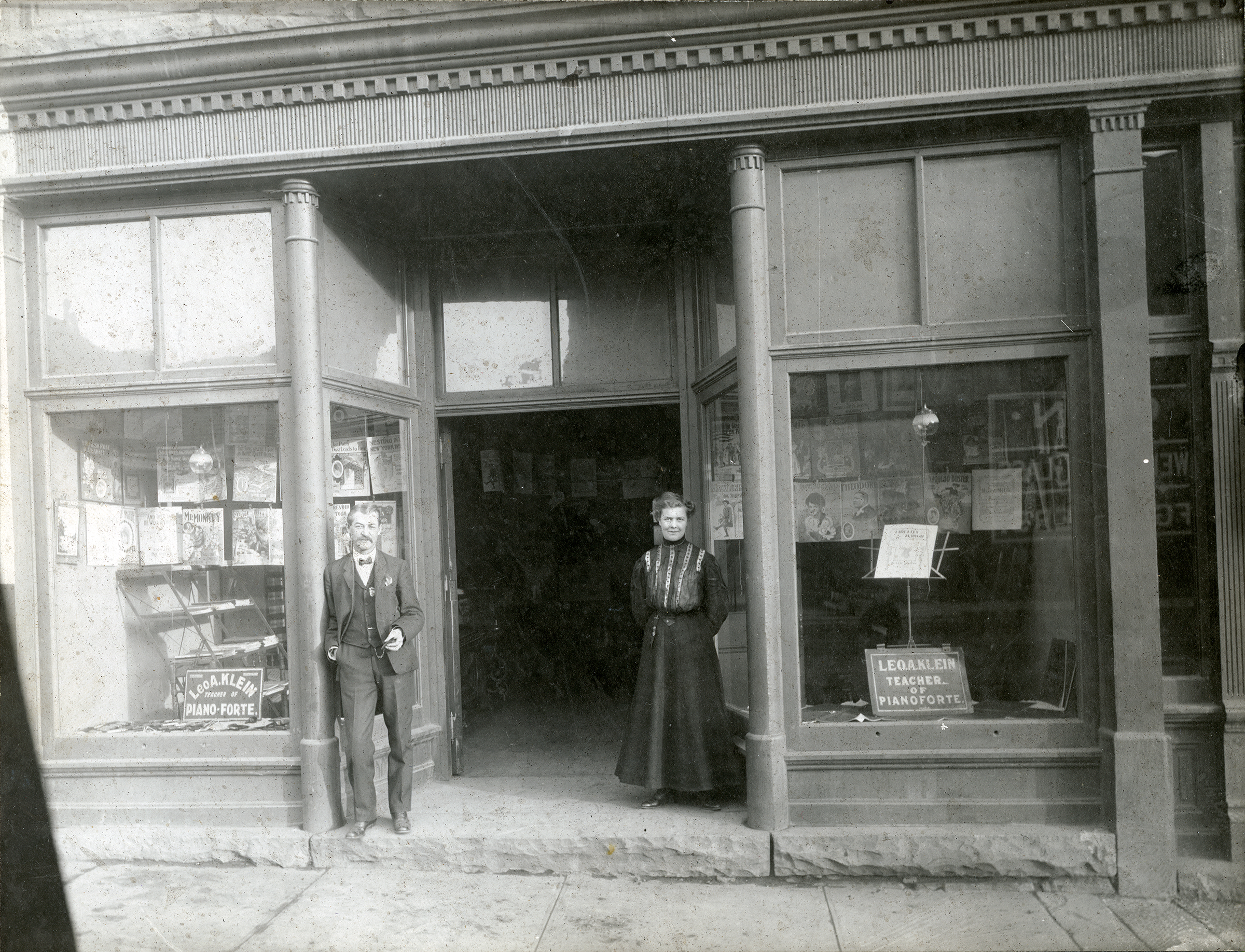
Cabinet photo of Leo Klein and presumably Mrs. Klein outside of the music store in Leadville possibly in March of 1907.
Temple Israel Museum collection.
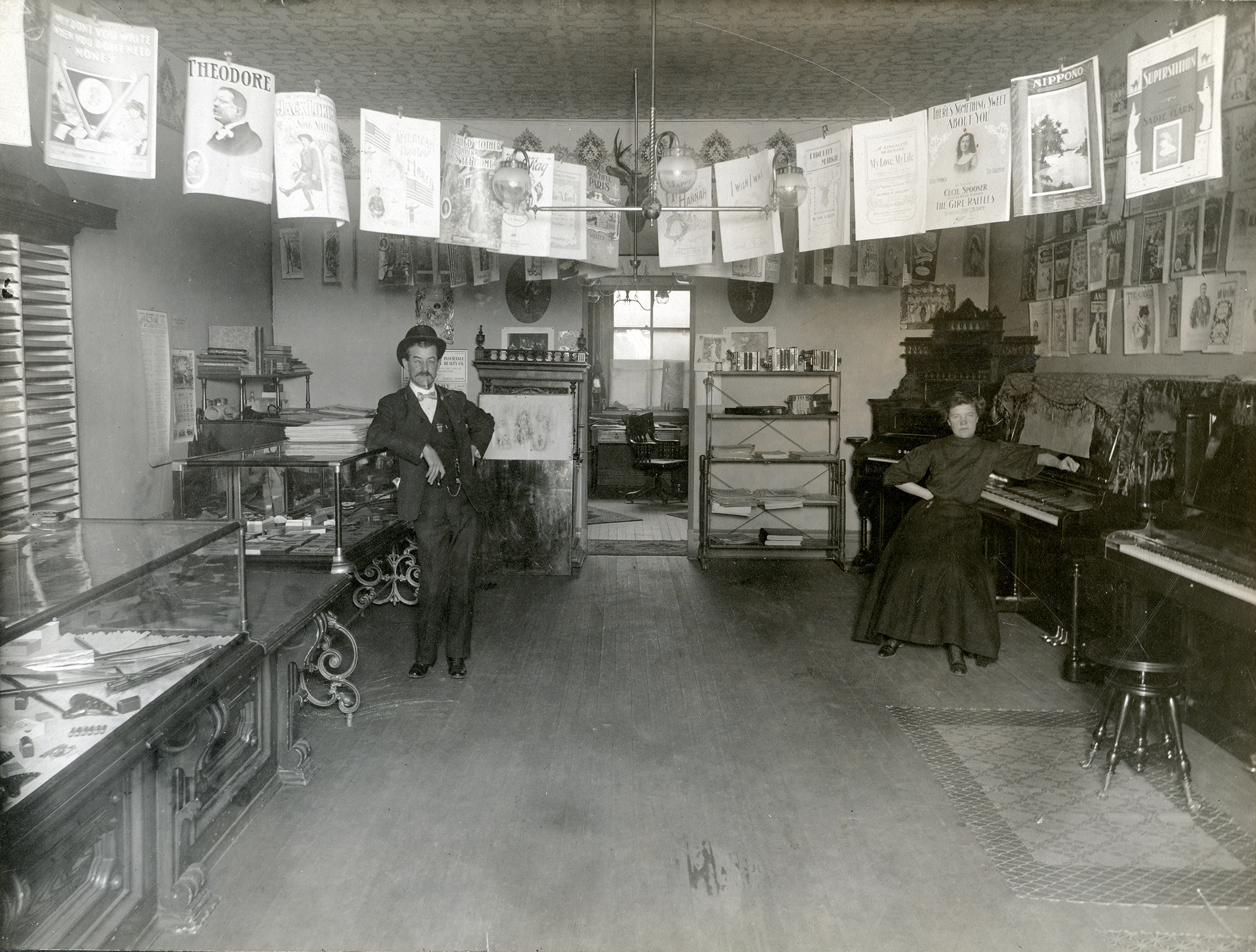
Cabinet photo of Leo Klein and presumably Mrs. Klein inside the music store in Leadville in March of 1907.
Temple Israel Museum collection.
The photos above show a large selection of sheet music shown within the windows, against the walls, and hanging on wires in the middle of the store. The Temple Israel Museum is happy to have two sheet music books in the collection along with the cabinet photos!